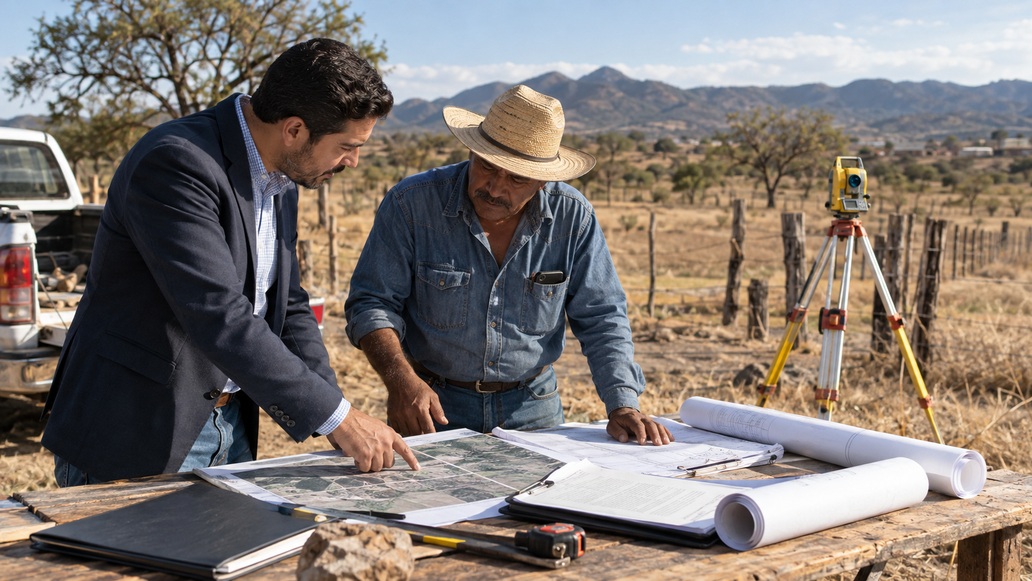
Buying Property in La Punta Zicatela: Documentation, Costs, and Things to Check

Buying property in La Punta Zicatela requires reviewing much more than the price, proximity to the beach, or vacation rental potential. In this area of Puerto Escondido, there are specific considerations related to land tenure, possession documentation, transfer costs, infrastructure, and urban development that should be carefully analyzed before paying a deposit.
La Punta has strong tourism demand thanks to its international atmosphere, surf culture, restaurants, cafés, coworking spaces, and walkable access to the beach. However, precisely because it is an area experiencing rapid growth, buyers should conduct a detailed legal and physical review of each property.
In practical terms, before buying, it is advisable to verify at least four key aspects:
-
Which document proves the rights over the property.
-
Who appears as the legal owner or recognized possessor.
-
How much it will actually cost to complete the transaction.
-
Which physical, urban, and infrastructure conditions may affect the property.
What should you know before buying property in La Punta Zicatela?
La Punta is located at the southern end of the Zicatela corridor, within the municipality of Santa María Colotepec.
Unlike other areas of Puerto Escondido where properties with public deeds under private ownership are more common, an important part of La Punta's real estate market is related to communal land and possession certificates.
This difference completely changes how a purchase should be evaluated.
A visually attractive house located just minutes from the ocean and offering strong rental potential may still involve significant risk if there is no clarity regarding:
-
the origin of possession rights;
-
the transfer history;
-
physical boundaries;
-
recognition by the community;
-
potential disputes;
-
building permits;
-
the legal status of existing structures.
For this reason, in La Punta, document review should take place before becoming emotionally committed to a property or negotiating based solely on price.
Possession certificate: one of the most important documents
For properties located under communal land arrangements, buyers may encounter a possession certificate instead of a traditional public deed.
The certificate documents possession rights recognized under the applicable land regime, but it does not function in exactly the same way as a deed registered as private property.
Before buying, it should be verified that:
-
the certificate is authentic;
-
it is properly registered;
-
it corresponds exactly to the property being offered;
-
the seller's name matches the recognized rights holder;
-
there are no disputes regarding possession;
-
the measurements match the physical reality of the property;
-
the transfer can be properly authorized.
Receiving a copy of the document from the seller is not enough.
Verification should be carried out directly with the appropriate authorities and organizations.
Possession certificate vs. public deed
This distinction is fundamental.
Public deed
A deeded property normally includes:
-
a deed executed before a Notary Public;
-
registration with the Public Registry of Property;
-
formal ownership;
-
registry history;
-
the ability to verify liens and encumbrances;
-
a legal structure that is more familiar for conventional real estate transactions.
Possession certificate
On communal land, the certificate documents possession rights recognized by the corresponding community.
Transfers usually require the involvement or approval of the relevant communal authority.
This means that buying through a possession certificate should not be analyzed as if it were exactly the same as buying a deeded property.
The process, risks, and required documentation may be different.
Verify the seller before paying any money
One of the first steps should be confirming that the person attempting to sell the property actually has the authority to transfer the corresponding rights.
The following should be reviewed:
-
seller identification;
-
possession certificate;
-
possession history;
-
previous transfers;
-
acquisition documentation;
-
potential heirs;
-
family disputes;
-
third-party claims.
It is also advisable to confirm that the name, surface area, and location described in the documents match the property being shown exactly.
A small discrepancy in square meters, boundaries, or location can later become a significant problem.
Request documentation confirming there is no litigation
As part of due diligence, it may be important to obtain documentation showing whether the property is involved in any legal dispute.
A certificate of no litigation may help identify conflicts related to possession rights.
This review becomes particularly important in areas where issues such as the following may historically have occurred:
-
duplicate documentation;
-
disputes between possessors;
-
boundary conflicts;
-
incomplete transfers;
-
family disputes;
-
community claims.
The absence of a visible conflict on the property does not necessarily mean that no legal dispute exists.
Confirm measurements, lot size, and boundaries
Do not assume that the advertised measurements automatically match the documents.
A lot advertised as 300 m² should physically contain approximately those 300 m², and the same information should match the documentation.
It is advisable to obtain a professional survey to verify:
-
surface area;
-
frontage;
-
depth;
-
boundaries;
-
location;
-
access points;
-
encroachments;
-
physical discrepancies.
This is especially important when buildings are close to property lines, old walls exist, or new developments are being built nearby.
Verify legal access to the property
The existence of a visible road does not necessarily mean that access is legally guaranteed.
It is advisable to review:
-
where the property's legal access is located;
-
whether a right of way exists;
-
whether the road crosses third-party land;
-
whether any informal agreement exists;
-
whether access is recognized in the documentation.
A property with a great ocean view but disputed access can create major problems for residential use, construction, rental operations, or eventual resale.
Review what can be built nearby
La Punta has experienced significant densification.
For this reason, buying a property solely because of its current ocean view can be risky if there is an empty lot directly in front of it or next door.
Before paying a premium for the view, it is advisable to investigate:
-
what may legally be built on neighboring lots;
-
permitted building height;
-
density;
-
applicable restrictions;
-
new developments nearby;
-
potential changes to access.
An open view today may not necessarily remain unchanged in the coming years.
How much does it cost to buy property in La Punta Zicatela?
The advertised price does not represent the total acquisition cost.
In addition to the property's value, expenses may include:
-
lawyers;
-
document review;
-
Notary Public fees;
-
taxes;
-
transfer of rights;
-
appraisal;
-
surveys;
-
physical inspection;
-
permits;
-
bank trust, when legally applicable;
-
registration;
-
bank transfers;
-
currency conversion.
The sources analyzed provide different cost ranges depending on the type of property and the legal structure of the transaction.
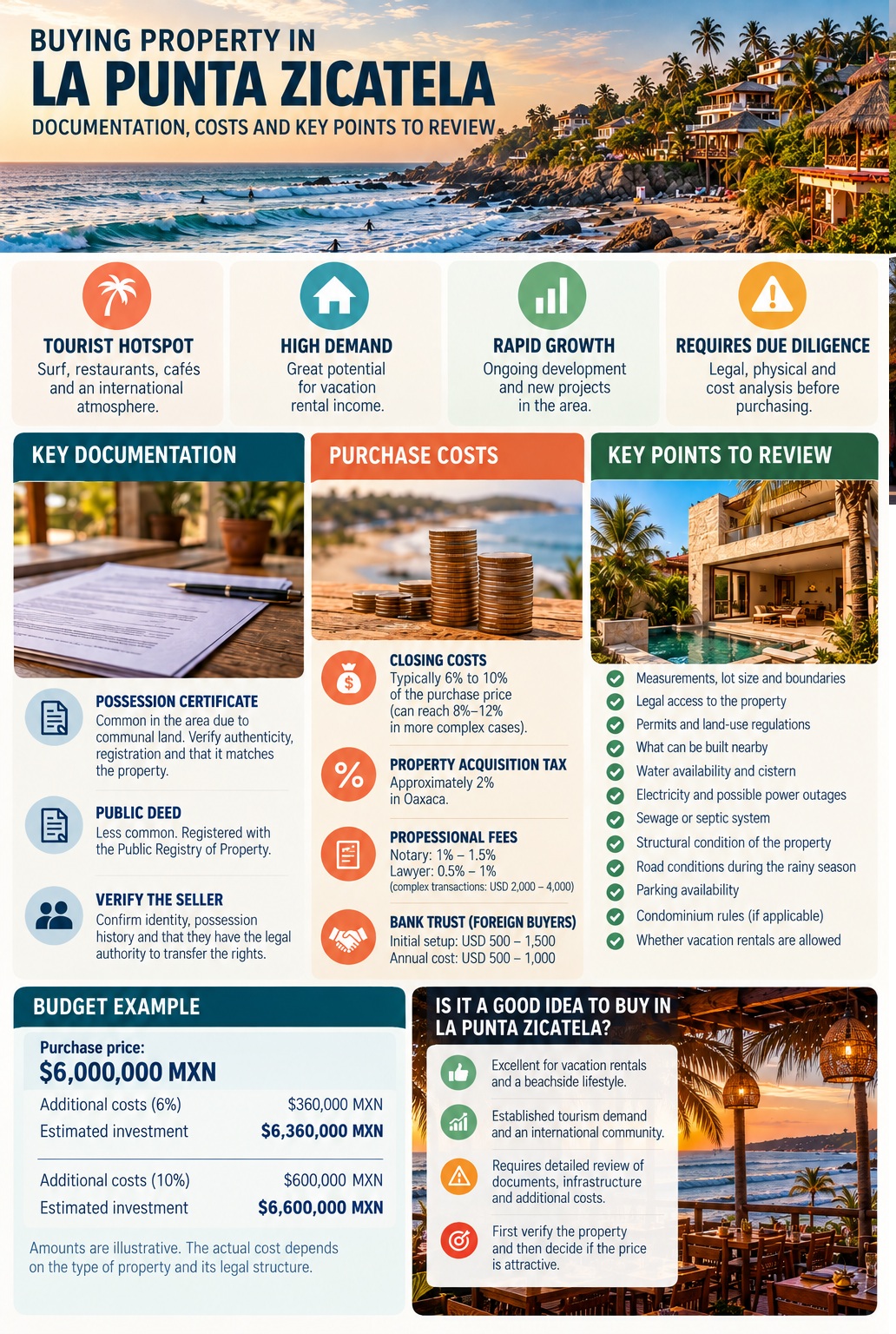
As a general reference for real estate transactions in Mexico, closing costs of approximately 4%–6% of the purchase price are commonly mentioned.
Other references specific to Puerto Escondido place additional costs at approximately 6% to 10%.
For more complex transactions involving communal land and specific structures for foreign buyers, total additional costs may reach approximately 8%–12% above the purchase price.
For this reason, it is not advisable to automatically apply a single percentage to every property in La Punta.
Budget example
Suppose a property costs:
$6,000,000 MXN
If the transaction involves approximately 6% in additional costs:
-
Price: $6,000,000
-
Estimated expenses: $360,000
-
Approximate total investment: $6,360,000
Under a 10% scenario:
-
Price: $6,000,000
-
Estimated expenses: $600,000
-
Approximate total investment: $6,600,000
These calculations are for illustrative purposes only.
The actual cost should be determined after confirming the exact legal regime of the property.
Do not confuse closing costs with the down payment
The down payment or initial deposit forms part of the purchase price.
Closing costs are additional.
For example, if a transaction includes:
-
purchase price;
-
initial deposit;
-
balance due at closing;
-
legal fees;
-
taxes;
-
transfer fees;
-
document review;
the deposit should not be added to the purchase price again as an additional expense, while fees and taxes do represent separate costs.
This distinction is important when calculating how much capital a buyer should have available.
How much can be requested as a deposit?
Some real estate transactions use initial deposits of approximately 10% to 20% of the purchase price, depending on the negotiated terms.
However, paying money before completing the legal review may increase the buyer's risk.
Before making the deposit, the following should be clearly established:
-
refund conditions;
-
the outcome of due diligence;
-
closing timeline;
-
documents the seller must provide;
-
consequences if legal problems are discovered;
-
each party's obligations.
The contract should define these conditions precisely.
Do you need a lawyer to buy in La Punta?
Because of the particular characteristics of the La Punta market, specialized legal advice can be especially important.
The lawyer should understand:
-
communal land;
-
transfers of possession rights;
-
the real estate regime in Santa María Colotepec;
-
real estate contracts;
-
transactions involving foreign buyers;
-
background review.
The lawyer's role should not be limited to reviewing the final contract.
Legal involvement can begin before the deposit is paid.
Among the matters a lawyer may review are:
-
document authenticity;
-
possession history;
-
existence of disputes;
-
seller authority;
-
contracts;
-
surface area;
-
applicable land regime;
-
purchase structure.
What is the role of the Notary Public?
The Notary Public plays a central role in real estate transactions formalized through a public deed.
Responsibilities may include:
-
verifying documentation;
-
calculating taxes;
-
formalizing legal acts;
-
preparing public instruments;
-
registering transactions when applicable.
However, the Notary Public does not necessarily replace an independent attorney representing the buyer.
The attorney represents the buyer's individual interests during the transaction review process.
Foreign buyers: the restricted zone
The Mexican Constitution establishes restrictions on direct ownership of real estate by foreigners within 50 kilometers of the coastline.
Puerto Escondido is located within this restricted zone.
For deeded private property, a common structure used by foreign buyers is a bank trust.
The bank formally holds the property in trust while the foreign buyer retains the right to:
-
use it;
-
rent it;
-
sell it;
-
inherit it;
-
designate beneficiaries.
However, when communal property is involved, the legal structure may be different.
For this reason, it should not automatically be assumed that any property in La Punta can be purchased simply by establishing a conventional bank trust.
Bank trust costs
For properties where using a bank trust is legally viable and required, the sources analyzed mention reference costs such as:
-
initial setup: approximately $500 to $1,500 USD;
-
corresponding permit: may involve additional costs;
-
annual administration: approximately $500 to $1,000 USD.
These amounts may vary depending on the bank, structure, and transaction.
The bank trust should be included in the budget both for its initial setup cost and ongoing annual maintenance.
Property acquisition tax
Among the common expenses in a private-property transaction is the real estate acquisition tax.
The sources analyzed use approximately 2% for Oaxaca as a reference, although the final calculation may depend on the legally recognized value used to determine the tax.
This expense is generally paid by the buyer.
Before closing, a detailed estimate should be requested showing exactly how the tax is calculated.
Notary and legal fees
Fees also depend on the type and complexity of the transaction.
As a general reference, some of the sources analyzed mention:
-
Notary Public: approximately 1%–1.5% in conventional real estate transactions;
-
independent attorney: approximately 0.5%–1%;
-
specialized legal transactions: legal fees of approximately $2,000 to $4,000 USD.
For transactions involving communal land, costs may vary considerably depending on the procedures required.
Physically inspect the property
Correct documentation does not guarantee that the structure itself is in good condition.
Proximity to the ocean creates specific environmental conditions:
-
humidity;
-
salinity;
-
corrosion;
-
intense sun exposure;
-
heavy rain.
An inspection may review:
-
structural condition;
-
foundation;
-
waterproofing;
-
electrical system;
-
plumbing;
-
drainage;
-
moisture;
-
corrosion;
-
termites;
-
roof.
The sources analyzed place some residential inspections at approximately $300 to $1,500 USD, depending on property size and level of specialization.
Check the water supply before buying
Water availability is a particularly important issue in La Punta.
A house can look spectacular during a thirty-minute showing, but everyday life changes completely if the property has supply problems.
It is advisable to ask:
-
does the property have a water connection?
-
how consistent is the supply?
-
does it have a cistern?
-
what is its capacity?
-
does it use a pump?
-
is water purchased by tanker truck?
-
what is the approximate consumption?
For a property intended for vacation rentals, an undersized cistern can quickly become an operational problem.
Electricity and power outages
Electrical infrastructure also deserves attention.
Service interruptions may occur during the rainy season.
If the property will be used for tourist accommodation, it may be useful to determine whether it has:
-
a backup generator;
-
a solar system;
-
batteries;
-
a voltage regulator;
-
protection against electrical fluctuations.
A property designed for rental use may require additional infrastructure to provide guests with a consistent experience.
Drainage and wastewater
It should not be assumed that all properties have the same sanitation infrastructure.
Before buying, it is advisable to identify:
-
drainage system;
-
septic system, if applicable;
-
system condition;
-
required maintenance;
-
capacity;
-
problems during the rainy season.
This type of infrastructure can represent a significant expense if rehabilitation is required.
Road conditions and accessibility during the rainy season
One characteristic of La Punta is that some streets remain unpaved.
During the rainy season, certain roads may experience:
-
mud;
-
standing water;
-
access difficulties;
-
erosion and wear;
-
problems for smaller vehicles.
A property located five minutes from the beach on foot may be excellent for tourism, but it is advisable to visit the area under different weather conditions before buying.
Is there enough parking?
Parking is another factor that can easily be overlooked.
Increasing construction density and tourism activity may make parking more difficult.
If the property does not have private parking, review:
-
street parking;
-
traffic flow;
-
accessibility;
-
number of nearby units;
-
new developments.
This factor can affect both the owner's experience and that of guests.
Buying for Airbnb in La Punta
La Punta stands out for its potential for short- and medium-term rentals.
The visitor profile includes:
-
surfers;
-
digital nomads;
-
international travelers;
-
couples;
-
guests staying several weeks;
-
tourists looking for a walkable area.
For this reason, attractive property types often include:
-
apartments;
-
studios;
-
houses with independent units;
-
small villas;
-
properties with rooftops;
-
accommodations with outdoor spaces.
However, owning property in La Punta does not automatically guarantee high profitability.
Check whether the condominium allows vacation rentals
When the property is part of a condominium or development, one of the most important documents is its rules and regulations.
It should be expressly confirmed whether it allows:
-
Airbnb;
-
short-term rentals;
-
guest access;
-
external property management;
-
nightly rentals.
The following should also be verified:
-
maintenance fee;
-
reserve fund;
-
restrictions;
-
use of common areas;
-
pet rules;
-
operating hours;
-
owner obligations.
Buying first and discovering later that the regulations restrict vacation rentals can completely change the financial viability of the investment.
Calculate the real costs of a vacation rental
Gross revenue should not be analyzed in isolation.
A tourism property may generate expenses related to:
-
management;
-
booking platforms;
-
cleaning;
-
electricity;
-
water;
-
internet;
-
maintenance;
-
repairs;
-
insurance;
-
furniture;
-
linen replacement;
-
taxes.
The sources analyzed indicate that operating costs may absorb approximately 35%–50% of gross revenue in certain vacation-rental scenarios.
For this reason, the important question is not how much a property can gross, but how much income remains after expenses.
Location within La Punta: a few streets can make a difference
Not all properties in La Punta perform in exactly the same way.
A property located within a five-minute walk of:
-
the beach;
-
restaurants;
-
cafés;
-
the commercial corridor;
may have a different rental profile from another property that requires a motorcycle or car.
Walkability is one of the area's main attractions.
However, being too close to restaurants, bars, or nightlife areas can also create noise.
Visit the property during the day and at night
A showing at eleven in the morning does not necessarily reveal what the area is like at night.
Before buying, it is advisable to visit:
-
early in the morning;
-
in the afternoon;
-
around sunset;
-
at night;
-
on a weekend.
This can help identify:
-
noise;
-
nearby bars;
-
pedestrian traffic;
-
lighting;
-
parking;
-
security;
-
traffic.
For permanent living, these details can be just as important as distance from the beach.
Buying to live vs. buying to invest
The criteria should change depending on the objective.
For living
The following may be more important:
-
quiet surroundings;
-
parking;
-
water supply;
-
accessibility;
-
privacy;
-
ventilation;
-
services;
-
day-to-day comfort.
For investment
The following may carry greater weight:
-
walkability;
-
proximity to the beach;
-
number of bedrooms;
-
independent units;
-
rooftop;
-
swimming pool;
-
design;
-
average nightly rate;
-
occupancy;
-
ease of management.
A property that is excellent for tourists will not necessarily be the best permanent residence.
Checklist before buying property in La Punta
Before signing or paying a deposit, it is advisable to verify:
-
Who is selling the property.
-
Which document proves their rights.
-
Authenticity of the possession certificate when applicable.
-
Transfer history.
-
Existence of litigation.
-
Measurements and boundaries.
-
Physical survey of the land.
-
Legal access.
-
Status of existing structures.
-
Permits.
-
Condominium rules.
-
Whether vacation rentals are permitted.
-
Water availability.
-
Cistern capacity.
-
Electrical system.
-
Drainage or septic system.
-
Structural condition.
-
Future construction on neighboring lots.
-
Closing costs.
-
Annual property ownership costs.
So, is buying property in La Punta Zicatela a good idea?
La Punta can be a very attractive area for buyers looking for property connected to tourism, vacation rentals, surfing, and a walkable lifestyle close to the beach.
The market already benefits from established tourism demand and a well-developed international community.
However, buying in this area requires a more detailed review than simply comparing square footage and prices.
Documentation, possession regime, infrastructure, additional costs, and increasing development density should all form part of the analysis from the beginning.
The most important rule is simple: verify the property first, then decide whether the price is attractive.
A real estate opportunity stops being a good opportunity when the documentation, boundaries, or transaction cannot be properly verified.
Frequently Asked Questions
Can you buy property in La Punta with a possession certificate?
Some transactions in La Punta are documented through possession certificates because communal land arrangements exist in parts of the area. However, this should not be treated the same as deeded property. Authenticity, history, measurements, absence of disputes, and the ability to legally complete the transfer should all be verified.
How much should I budget in addition to the purchase price?
There is no single percentage that applies to every transaction. The references analyzed mention approximately 4%–6% for conventional real estate transactions, 6%–10% in certain Puerto Escondido scenarios, and as much as 8%–12% in more complex transactions involving specialized legal structures.
Can a foreigner buy property in La Punta Zicatela?
Foreigners face restrictions on direct ownership of real estate within 50 kilometers of the coast. For private property, a bank trust may generally be used. However, when communal land is involved, the structure must be analyzed specifically before assuming that a conventional bank trust is sufficient.
What should I review before paying a deposit?
Before paying any money, it is advisable to review the seller's documentation, authenticity of the possession certificate or deed, possession history, potential litigation, measurements, boundaries, and legal access. The contract should also establish what happens to the deposit if due diligence identifies a problem.
Is La Punta a good area for Airbnb?
La Punta has a strong vacation-rental profile because of its proximity to the beach, restaurants, surfing, walkability, and presence of international visitors. However, buyers should review property rules, competition, operating costs, seasonality, and net returns before evaluating the investment.
What infrastructure issues should I review in La Punta?
Key points include water availability and pressure, cistern capacity, electricity supply, drainage, rainy-season accessibility, parking, and internet service. These conditions can affect both permanent living and the operation of a property intended for vacation rentals.