
How much income tax do you pay to the SAT when selling a house?
If you want to know how much you pay the SAT when selling a house, the first thing you need to understand is that there is no fixed percentage that is automatically applied to the sale price.
In some cases, you may pay $0 in ISR if the property you are selling is your primary residence and you meet the requirements to qualify for the exemption. When the transaction is taxable, Income Tax (ISR) is calculated primarily on the profit obtained from the sale, taking into account the updated acquisition cost, certain investments, expenses, and allowable deductions.
That is why two people who sell homes for exactly the same price may end up paying completely different amounts to the SAT.
What tax does a person pay when selling a house?
The main federal tax that an individual must consider when selling real estate in Mexico is Income Tax (ISR) on the sale of assets.
This tax is intended to tax the profit obtained from the sale of the property.
In simplified terms, the calculation follows a logic like this:
Sale price
minus updated acquisition cost
minus allowable deductions
= taxable gain
However, the actual tax calculation is more extensive.
When the transaction is formalized through a public deed, the notary will normally determine the provisional ISR payment, apply the corresponding deductions, verify whether an exemption applies, and remit the tax.
So, how much do you pay the SAT when selling a house?
The answer can range from $0 to a considerable amount, depending on the characteristics of each transaction.
There are three main scenarios:
- The sale is fully exempt from ISR.
- Part of the transaction is exempt and another part is taxable.
- The sale is taxable and ISR must be calculated on the corresponding gain.
This means that simply saying that "you pay 20%, 30%, or 35% when selling a house" can be misleading.
ISR is not determined by directly applying that percentage to the total value of the house.
When can I sell my house without paying ISR?
The Income Tax Law establishes an exemption for the sale of the taxpayer's primary residence, provided that certain requirements are met.
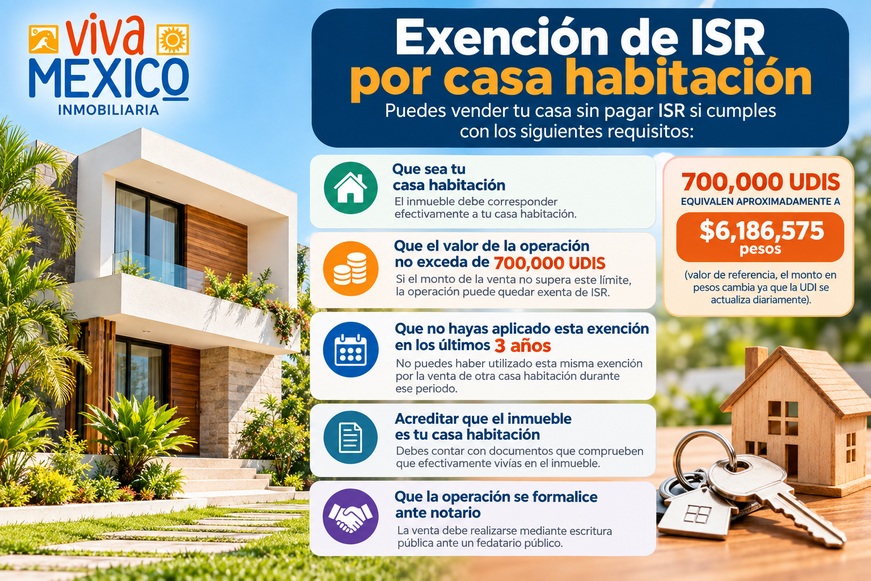
One of the main requirements is that the amount received from the sale does not exceed 700,000 UDIS.
UDIS, or Investment Units, change in value over time.
As of October 2, 2026, one UDI has an approximate value of $8.837965 pesos, meaning that 700,000 UDIS represent approximately: $6,186,575.50 pesos
This amount should not be considered a permanent fixed figure, since the value of the UDI changes daily.
Requirements to avoid paying ISR when selling your house
In order to apply the primary residence exemption, the corresponding tax requirements must be met.
Among the most important are:
- The property must actually be your primary residence.
- The transaction must be formalized before a public notary or other authorized public official.
- The corresponding value must not exceed the 700,000 UDIS limit for the full exemption.
- You must not have applied this same exemption to the sale of another primary residence during the immediately preceding three years.
- You must be able to prove before the notary that the property was actually your primary residence.
Meeting only the maximum value requirement is not enough.
The property must meet the tax definition of a primary residence, and this situation must be properly documented during the transaction.
How do I prove that it is really my primary residence?
To apply the exemption, the taxpayer must prove before the public official that the property corresponds to their primary residence.
Documents that may be used include:
- Voter identification card.
- Tax receipts for electricity service.
- Landline telephone service receipts.
- Account statements issued by financial institutions.
- Account statements from retail stores or non-bank credit cards.
The address shown on these documents must match the property being sold.
In certain cases, these documents may be in the name of the owner, their spouse, direct-line ascendants, or direct-line descendants, provided that the applicable provisions are met.
Example of a sale that could be exempt from ISR
Suppose a person sells their primary residence for:
$5,000,000 pesos
Additionally:
- The property has actually been their primary residence.
- They can prove it with documentation.
- The transaction is completed before a notary.
- They have not used the primary residence sale exemption during the previous three years.
Since the price is below the equivalent of 700,000 UDIS, the transaction could be exempt from ISR on the sale, provided that all legal requirements are met.
In this scenario, the ISR on the sale could be:
$0 pesos
This does not mean that every house sold for less than that amount is automatically exempt.
The primary residence requirement is essential.
What happens if I sell my house for more than 700,000 UDIS?
Exceeding the 700,000 UDIS limit does not necessarily mean that the entire sale price loses the exemption.
When the consideration exceeds this limit, the law provides for the gain corresponding to the excess to be determined and for deductions to be considered proportionally.
In simple terms:
the exempt portion may be preserved, while ISR is determined on the taxable proportion of the excess, following the procedure established in the Income Tax Law.
The notary must perform the corresponding calculation.
Does the SAT charge up to 35% when selling a house?
The maximum ISR rate for individuals can reach 35%, but that does not mean the SAT automatically charges 35% of the sale price of a property.
For example, if a house is sold for $4,000,000 pesos, it does not mean that you must automatically pay $1,400,000 to the SAT.
To determine the tax, factors such as the following must be analyzed:
- Sale price.
- Original acquisition price.
- Cost adjustment.
- Acquisition date.
- Years elapsed between acquisition and sale.
- Construction and improvements made.
- Notarial expenses.
- Deductible taxes and fees.
- Real estate commissions.
- Applicable exemptions.
- Tax gain obtained.
That is why the result can vary significantly from one transaction to another.
How is ISR calculated when selling a house?
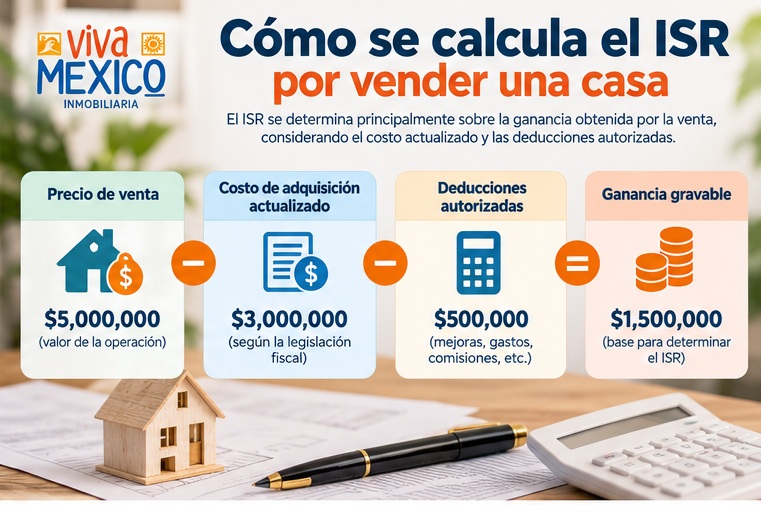
Although the complete tax procedure must be carried out in accordance with current legislation, a simple way to understand it is to begin by determining the gain.
For example:
Property sale price: $5,000,000
Minus updated acquisition cost: $3,000,000
Minus deductible improvements: $300,000
Minus allowable expenses and deductions: $200,000
The approximate taxable gain before performing the corresponding calculations would be: $1,500,000
ISR is not obtained simply by applying a fixed percentage to those $1,500,000. The Income Tax Law establishes a procedure that takes into account, among other factors, the years elapsed between the acquisition and sale of the property.
What expenses can I deduct when selling a house?
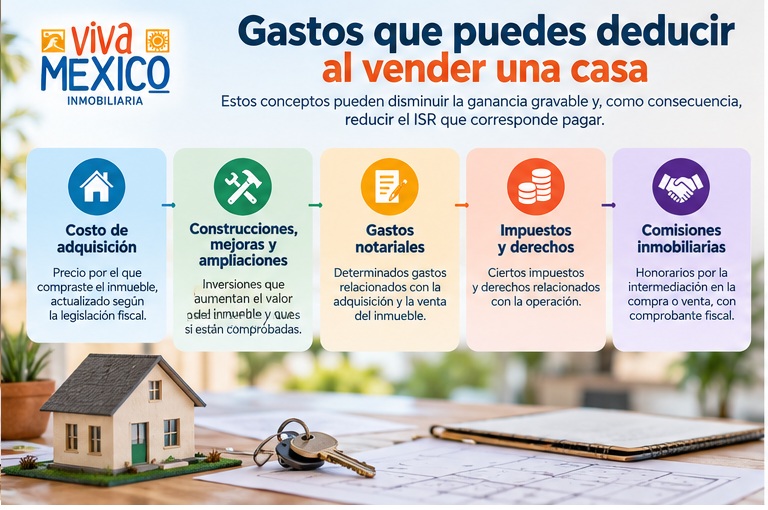
Deductions can reduce the taxable gain and, as a result, reduce the amount of ISR that must be paid.
The following are some of the items that may be considered.
Documented acquisition cost
The price you originally paid to acquire the property is one of the main elements used to determine the gain.
This cost is adjusted according to the procedure established by tax legislation.
Construction, improvements, and additions
Investments made to build, improve, or expand the property may be considered under certain circumstances.
It is important to distinguish between an actual improvement or addition and a simple maintenance expense.
For example, building an additional room may receive different treatment from simply repainting a wall.
It will also be essential to have documentation that proves these investments.
Notarial expenses
Certain notarial expenses related to the acquisition and subsequent sale of the property may be considered among the allowable deductions when they meet the corresponding requirements.
Taxes and fees
There may also be taxes and fees related to the acquisition or sale that can be considered within the tax procedure.
Real estate commissions
Commissions paid for brokerage services related to the purchase or sale of the property may be deductible when they meet the applicable tax requirements and are properly documented. For this reason, it is important to request the corresponding invoice for the real estate services contracted.
Why is it so important to keep invoices for improvements?
Imagine that you purchased a property several years ago and later invested a significant amount in:
- Building a swimming pool.
- Expanding bedrooms.
- Adding another floor.
- Completely remodeling certain areas.
- Making structural additions.
These investments may have significantly increased the tax basis of your property.
However, if you cannot properly prove those expenses, you may lose the opportunity to consider them when reducing the taxable gain.
That is why keeping invoices and documentation for improvements made to the property can have a direct impact on the ISR you ultimately pay when you sell.
Who calculates the tax when I sell my house?
In a purchase and sale transaction formalized through a public deed, the notary plays a fundamental role.
Among other responsibilities, the public official must determine the provisional ISR related to the transaction when applicable.
The calculation considers information such as:
- Sale price.
- Acquisition date.
- Historical cost.
- Updated cost.
- Allowable deductions.
- Exempt portion.
- Taxable portion.
- Gain obtained.
- ISR due and withheld.
The public official must also provide the taxpayer with information related to the tax determination.
Does the notary pay the ISR to the SAT for me?
In real estate transactions formalized through a public deed, the notary normally calculates, withholds, and remits the corresponding provisional payment in accordance with the Income Tax Law.
This means that, in practice, the seller does not simply receive the full sale price and then decide how much to pay.
The tax impact is part of the deed execution and closing process.
For this reason, before accepting an offer, it is advisable to know an estimate of the net amount you will receive after taxes, commissions, outstanding debts, and other expenses related to the sale.
Do I pay ISR on the sale price or on the profit?
This is one of the most important questions.
In general terms, ISR on the sale of a property is related to the taxable gain, not simply to receiving money from selling the property.
For example, it is not the same to:
Buy for $1,000,000 and sell for $5,000,000
as it is to:
Buy for $4,500,000 and sell for $5,000,000.
Although both properties are sold for exactly $5,000,000, the potential gain is completely different.
In addition, adjustments, deductions, years of ownership, and other tax rules must be considered.
What happens if I bought the house many years ago?
The amount of time that has passed since the acquisition is relevant to the calculation.
The law provides for the adjustment of the documented acquisition cost and a specific procedure for determining the provisional payment based on the years elapsed between the acquisition date and the sale, subject to the limit established by the law itself.
For this reason, knowing the following can be essential:
- Exact acquisition date.
- Original price.
- Value corresponding to the land.
- Value of the buildings.
- Improvements made.
These details can be fundamental.
What happens if I inherited the house?
An inherited property can also be sold, but correctly determining its tax basis requires reviewing how it was acquired and the corresponding documentation.
It should not be assumed that because the property was received at no cost, its tax basis is automatically zero.
Properties acquired through inheritance are subject to specific rules that must be analyzed before calculating the gain from a subsequent sale.
What happens if the property was received as a gift?
Gifts are also subject to specific rules.
The treatment may depend, among other factors, on who made the gift, the relationship between the parties, and the property's tax history.
Therefore, if you want to sell a property acquired through a gift, it is especially important to review its deed and tax history beforehand.
Can land qualify for the primary residence exemption?
Vacant land, by itself, should not be confused with a primary residence.
The exemption applies to the taxpayer's primary residence.
Tax regulations provide that a primary residence may also include the land on which it is built, but only within certain limits.
In general terms, it may include a land area that does not exceed three times the area covered by the buildings that make up the primary residence.
Therefore, selling only a parcel of land requires a different analysis.
Is VAT charged on the sale of a house?
The sale of buildings intended or used as a primary residence is exempt from VAT.
Land is also included among the exemption cases established by the VAT Law.
However, real estate transactions with different characteristics may require additional analysis.
For example, a property used for commercial purposes will not necessarily receive the same treatment as a primary residence.
ISR and acquisition tax are not the same
Another common mistake is confusing taxes that apply to the seller with those related to the buyer.
ISR on the sale of property is related to the person who sells the property and obtains the gain.
In contrast, local taxes related to acquisition or transfer of ownership are different concepts, and their treatment depends on the legislation of each state.
Therefore, when someone asks "how much tax do you pay when selling a house," it is first necessary to identify which tax and which part of the transaction is being analyzed.
Is there a 5% payment when selling real estate?
The Income Tax Law provides for a payment to the corresponding state equal to 5% of the gain obtained from the sale of land, buildings, or both.
However, this amount should not be added again as though it were an independent additional tax on top of ISR.
The payment made to the state can be credited against the provisional ISR payment corresponding to the same transaction.
In transactions formalized through a public deed, the public official performs the corresponding calculations.
Example: I sell a house for $4 million pesos, how much do I pay the SAT?
It cannot be determined solely by knowing the sale price.
To properly calculate ISR, it would be necessary to know at least:
- Whether it is actually your primary residence.
- Whether you can prove that you lived there.
- Whether you have used the exemption during the previous three years.
- When you acquired the property.
- How much you originally paid.
- How much of the value corresponds to land and construction.
- What documented improvements you made.
- What deductible expenses exist.
- What commissions you paid.
- Whether there are any special tax circumstances.
If the property meets the requirements for the primary residence exemption, the ISR could be $0.
If it does not, the taxable gain must be calculated.
Example: I sell my house for $8 million pesos, do I lose the entire exemption?
Not necessarily.
If the property is actually your primary residence and you meet the other requirements, exceeding the 700,000 UDIS limit does not mean that the entire $8 million automatically becomes subject to ISR.
The law establishes a mechanism for calculating the gain corresponding to the excess and applying deductions proportionally.
Therefore, the calculation must be performed specifically for that transaction.
What should I review before selling to know how much I will pay?
Before committing to a sale price, it is advisable to gather at least:
- Acquisition deed.
- Date you purchased the property.
- Acquisition price.
- Invoices for construction and improvements.
- Receipts for notarial expenses.
- Invoices for real estate commissions.
- Documentation proving that the property is your primary residence.
- Information about primary residence sales made in previous years.
- Estimated sale price.
With this information, it will be much easier to estimate the tax impact before closing the transaction.
Do not calculate your profit simply by subtracting what you paid
From a financial perspective, it may seem logical to make this calculation:
Sale price - purchase price = profit
But for tax purposes, there are additional factors.
The acquisition cost may be adjusted, and certain investments and expenses may reduce the taxable gain.
For this reason, making an overly simple estimate may cause you to calculate a tax amount that is very different from what actually applies.
Can I know how much money I will have left before selling?
Yes.
In fact, this analysis should be performed before defining the minimum price you are willing to accept.
An estimate of the transaction outcome may consider:
Sale price
minus outstanding mortgage balance
minus estimated ISR
minus real estate commission
minus expenses related to the transaction
minus other outstanding debts
= estimated net amount for the owner
This number may be much more important to the seller than the property's advertised price.
Common mistakes when calculating the tax on the sale of a house
Thinking that you always pay 35%
The maximum ISR rate does not mean that you automatically have to pay 35% of the total property price.
Believing that all houses are exempt
The exemption requires meeting specific conditions and proving that the property is your primary residence.
Not keeping invoices
Not having documentation for improvements, expenses, or commissions may affect the deductions that could reduce the taxable gain.
Confusing the sale price with the gain
Receiving $5 million pesos for a property does not mean that you obtained a taxable gain of $5 million pesos.
Waiting until signing to find out the tax
Knowing the possible ISR before negotiating allows you to determine how much you actually need to receive from the sale.
So, how much do you pay the SAT when selling a house?
The most accurate answer is:
You may pay as little as $0 in ISR if the sale of your primary residence meets the exemption requirements. If the transaction is taxable, the tax is calculated on the taxable gain according to the procedure established in the Income Tax Law, rather than as a fixed percentage applied directly to the total sale price.
Therefore, to know how much you will actually pay, you need to know the sale price, acquisition cost and date, available deductions, improvements made, years of ownership, and whether you qualify for the primary residence exemption.

Are you thinking about selling your house, land, or property?
Knowing how much you might pay in taxes is only one part of the sales process. It is also important to correctly determine the property's value, prepare the documentation, establish a competitive price, find qualified buyers, and coordinate the negotiation through closing.
At Viva México Inmobiliaria, we can help you market your house, land, or property, guiding you throughout the sales process and helping you properly present the property to potential buyers.
If you are considering selling and would like to learn how we can assist you, visit our property sales service with Viva México Inmobiliaria.
Frequently asked questions about ISR when selling a house
How much does the SAT charge for selling a $3 million peso house?
There is no automatic amount charged for selling a house for $3 million pesos. If the property is your primary residence and you meet all the exemption requirements, the ISR could be $0. If you cannot apply the exemption, the taxable gain must be determined by considering the acquisition cost, deductions, and other applicable factors.
How much does the SAT charge for selling a $5 million peso house?
The price alone does not determine the tax. A primary residence sold for $5 million pesos could fall within the 700,000 UDIS limit and qualify for the exemption if the other requirements are met. If it is not a primary residence or does not meet the required conditions, the corresponding ISR must be calculated.
For how much can I sell a house without paying taxes?
The ISR exemption for a primary residence has a limit of 700,000 UDIS and requires additional conditions to be met. The equivalent amount in pesos changes because the UDI value is updated. As of October 2, 2026, 700,000 UDIS are equivalent to approximately $6.19 million pesos.
Who pays ISR when a house is sold?
The ISR resulting from the gain on the sale corresponds to the seller. When the transaction is formalized through a public deed, the public official calculates and remits the applicable provisional payment, in addition to providing the taxpayer with information regarding the tax determination.
Can I deduct the real estate agency commission?
Commissions and brokerage fees paid in connection with the acquisition or sale of the property may be included among the allowable deductions when they meet the corresponding tax requirements. It is important to have the tax invoice and documentation necessary to properly substantiate the expense.
How often can I sell a house without paying ISR?
The exemption for the sale of a primary residence cannot be used if the taxpayer has already applied the same exemption during the three years immediately preceding the date of the new sale. In addition, all other requirements established by law must once again be met.