Trust Costs in Mexico: Setup Fees, Annual Fees, and Closing Expenses
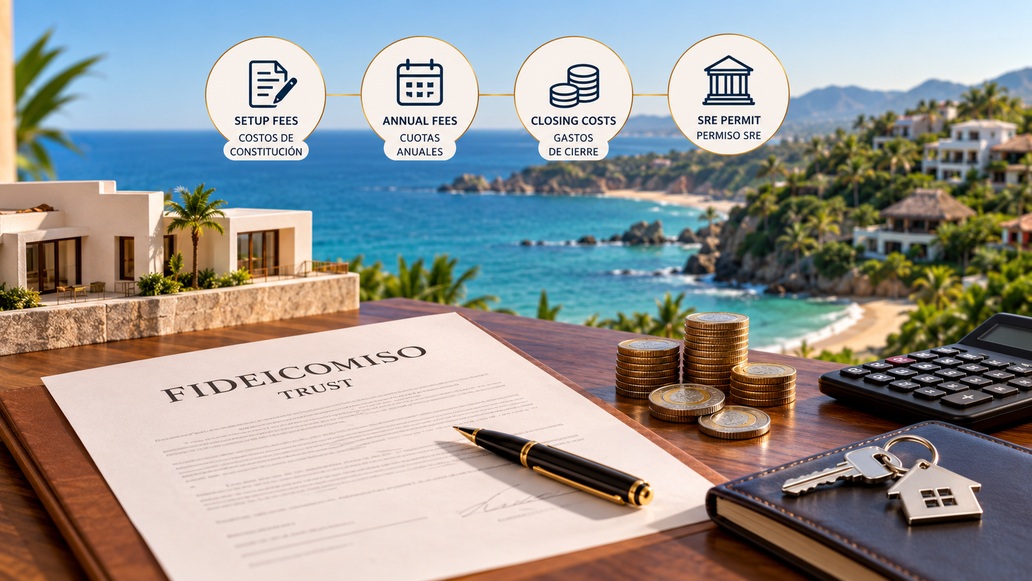
The cost of a real estate trust in Mexico, commonly known as a fideicomiso, includes the initial setup fee, annual administration fees charged by the trustee bank, and expenses associated with modifying, transferring, or terminating the trust.
In 2026, one of the most significant expenses for foreign property buyers is the permit issued by Mexico's Ministry of Foreign Affairs (SRE), which has an official fee of MXN $21,650.
Additional expenses include bank fees, notary fees, and, when applicable, registration fees with the Public Registry of Property.
Unlike other real estate acquisition expenses, a fideicomiso can represent an ongoing financial obligation throughout its duration.
How Much Does It Cost to Set Up a Trust in Mexico in 2026?
The cost of establishing a real estate trust depends on the bank selected, the property's location, the required procedures, and the terms of the trust agreement.
For a real estate trust used by foreigners purchasing residential property within Mexico's restricted zone, the main expenses include:
| Expense | Cost in 2026 |
|---|---|
| SRE permit | MXN $21,650 |
| Bank setup or acceptance fee | Varies by institution |
| Notary fees | Depend on the notary, transaction, and state |
| Public Registry fees | Depend on state regulations and fee schedules |
| Property appraisal, when applicable | Depends on the property and provider |
| First annual administration fee | Depends on the bank agreement |
The SRE permit has a federally established fee. Other expenses must be quoted individually because there is no universal bank or notary fee for real estate trusts throughout Mexico.
As a commercial reference, some real estate guides published in 2026 mention bank setup fees ranging from approximately USD $500 to $1,500. However, these figures are estimates rather than official quotations and may exclude the federal permit, notary fees, and additional expenses.
Therefore, buyers should request an itemized estimate and confirm exactly which services are included before beginning the process.
SRE Permit: Official Cost in 2026
Mexico's Ministry of Foreign Affairs (Secretaría de Relaciones Exteriores, or SRE) establishes the federal fees applicable to creating and modifying trusts within the restricted zone.
According to the official fee schedule effective January 1, 2026, the amounts are:
| SRE Procedure | Federal Fee |
|---|---|
| Issuance of a permit to establish a trust | MXN $21,650 |
| Permit modification to expand trust assets or change its purposes | MXN $595 for application review, plus MXN $9,740 for issuance |
| Extension of the trust's duration | MXN $595 for application review, plus MXN $9,740 |
| Late application for extension of duration | MXN $595 for application review, plus MXN $10,615 |
These fees apply to specific procedures handled by the federal government. They do not automatically include bank commissions, notary fees, or property registration expenses.
It is important to distinguish the government permit required to establish a fideicomiso from the fees charged by the trustee bank. These are separate expenses that may appear on the same real estate closing statement.
How Much Do Banks Charge Annually to Manage a Fideicomiso?
Trustee banks charge recurring fees to maintain and administer real estate trusts.
Commercial references from Mexico's 2026 real estate market indicate approximate annual fees of USD $500 to $700 for certain residential fideicomisos established for foreign buyers.
This range is not an official government rate and does not guarantee that every bank offers the same conditions.
Annual fees may vary depending on the bank, trust assets, contractual structure, included services, and fee adjustment provisions.
Before signing, buyers should verify whether the annual fee includes VAT, whether it is denominated in US dollars or Mexican pesos, and whether it increases periodically.
It is also important to confirm when the first annual fee becomes payable. Some arrangements require payment when the trust is established, while others may specify different terms.
How Much Does It Cost to Maintain a Trust for 10, 20, or 50 Years?
Accumulated administration fees can become a significant expense, even when the annual amount appears relatively modest.
For illustration, consider a fideicomiso with a fixed annual fee of USD $600.
| Duration | Total Administration Fees |
|---|---|
| 1 year | USD $600 |
| 5 years | USD $3,000 |
| 10 years | USD $6,000 |
| 20 years | USD $12,000 |
| 50 years | USD $30,000 |
This calculation is illustrative only. It does not include fee increases, taxes, contractual modifications, extraordinary expenses, or trust setup and termination costs.
Therefore, comparing banks based solely on their initial setup fees is insufficient. Annual administration fees and their adjustment conditions can have a greater financial impact over time.
Real Estate Trust Closing Costs in Mexico
Closing expenses can refer to two different stages: the initial completion of a property purchase through a fideicomiso or the termination of an existing trust.
This distinction is important because the applicable expenses and amounts are not necessarily the same.
Closing Costs When Purchasing Property
When a foreign buyer purchases real estate through a fideicomiso, transaction closing costs may include property acquisition tax, notary fees, registration fees, and trust establishment expenses.
The property acquisition tax and deed registration costs depend on the laws and fee schedules applicable in the state where the property is located.
Consequently, the cost of establishing a fideicomiso should not be confused with the total closing costs of buying property in Mexico.
For example, someone purchasing a condominium in Puerto Escondido, Oaxaca, must consider both the costs associated with the trustee bank and the taxes and registration expenses applicable to the real estate transaction.
How Much Does It Cost to Cancel or Terminate a Fideicomiso?
Terminating a real estate trust may generate additional expenses depending on the agreement's conditions and the transaction leading to its termination.
Potential costs include:
-
Bank fees for termination, cancellation, or transfer of beneficial rights, when applicable.
-
Notary fees for documents requiring formal execution.
-
Registration or cancellation expenses with the Public Registry of Property.
-
Outstanding administration fees and other contractual balances.
-
Taxes arising from the transfer of the property, when a taxable event occurs.
There is no single federal fee that determines the cost of terminating every real estate trust in Mexico.
Furthermore, terminating a fideicomiso is not necessarily the same as selling the property. Its termination may involve different legal procedures depending on what happens to the property and the beneficiary's legal status.
Before closing a trust, owners should request an account statement and a written estimate of applicable fees from the trustee bank.
What Happens to Fideicomiso Costs When the Property Is Sold?
When a property held in a fideicomiso is sold, several options may be available depending on the buyer's nationality and the legal structure of the transaction.
If the new buyer is also a foreign national and the property remains within Mexico's restricted zone, it may be possible to transfer the beneficial rights under the trust or establish a new trust arrangement, subject to applicable legal and banking requirements.
If the buyer is legally permitted to acquire direct ownership of the property, the transaction may require transferring the title and terminating the existing fideicomiso.
In either case, bank fees, notarial formalization, registration expenses, and potential tax consequences must be reviewed.
The allocation of these expenses between buyer and seller depends on applicable law, each party's tax obligations, and the terms negotiated in the purchase agreement.
Who Pays the Fideicomiso Fees in Mexico?
In a real estate purchase involving a fideicomiso, the foreign buyer generally pays the trust establishment costs and subsequent annual administration fees, unless the parties negotiate a different arrangement.
However, when an existing trust is transferred, the buyer and seller may agree on who will cover certain trustee fees and notary expenses, without changing the tax obligations legally assigned to either party.
These conditions should be clearly established in the purchase agreement, especially when there are outstanding annual fees or charges for transferring beneficial rights.
How to Compare Fideicomiso Fees Between Banks
When selecting a trustee bank, it is advisable to compare the complete cost of the service rather than focusing exclusively on the initial setup fee.
A bank's quotation should specify:
-
Initial setup or acceptance fee.
-
Annual administration fee and applicable taxes.
-
Currency in which fees are charged.
-
Conditions governing future fee adjustments.
-
Charges for amendments, beneficiary changes, or transfers of beneficial rights.
-
Termination and cancellation fees.
-
Procedures and costs for extending the trust's duration.
For example, a bank offering lower setup fees could ultimately be more expensive if its annual administration charges are higher.
Comparisons should be based on current quotations under equivalent conditions.
How Long Does a Real Estate Trust Last in Mexico?
Real estate trusts established under Mexico's foreign investment framework within the restricted zone may have a maximum duration of 50 years, with the possibility of applying for an extension under applicable law.
This does not mean that the annual bank administration fee automatically covers the cost of extending the trust.
In 2026, the SRE establishes specific federal fees for issuing permits to extend a fideicomiso's duration. Additional bank, notary, or registration fees may apply depending on the required procedure.
Therefore, buyers planning to retain a property over the long term should account for both recurring administration costs and potential expenses associated with extending the trust.
Are Real Estate Trusts Subject to Annual Taxes in Mexico?
The bank's annual administration fee does not replace the taxes and other obligations associated with owning real estate.
Property held through a fideicomiso may be subject to annual property tax (predial) and, depending on its use, additional tax obligations arising from rental income, commercial activities, or a future sale.
Establishing a trust also does not automatically eliminate taxes associated with purchasing or selling real estate.
For this reason, the annual ownership budget should distinguish between trustee fees, property taxes, and ordinary property maintenance expenses.