The Difference Between Possession, Assignment of Rights, and Private Property in Mexico

Before buying land or a house in Mexico, it is essential to understand the difference between possession, assignment of rights, and private property ownership. Although these terms are often used interchangeably in real estate listings, they represent different legal situations and do not offer buyers the same level of protection.
Possession means exercising control over a property without necessarily owning it. An assignment of rights involves transferring certain rights from one person to another, which does not always mean acquiring ownership. Private property ownership, on the other hand, gives the owner the legal right to use, enjoy, and dispose of the property, subject to limitations established by law.
Understanding these differences can help identify risks, verify documents, and avoid purchasing a property whose ownership cannot be legally established.
What Does It Mean to Have Possession of Land?
Possession refers to the actual control a person exercises over an asset. Under Article 790 of Mexico's Federal Civil Code, a possessor is someone who exercises such control over an asset, subject to the exceptions established by law.
For example, someone may live in a house, maintain a plot of land, fence it, or use it for years without having a property deed in their name.
However, having possession of land does not automatically mean owning it.
There are different types of possession:
-
Original possession: Exercised as if the possessor were the owner, although legal ownership must still be established.
-
Derivative possession: Occurs when someone uses a property with authorization or through rights granted by another person, such as a tenant.
-
Good-faith possession: Occurs when someone possesses property under a title that provides sufficient grounds for possession or is unaware of defects in that title.
-
Bad-faith possession: May occur when someone possesses property without a title or knows about defects that prevent them from possessing it lawfully.
These distinctions are important because not all forms of possession allow someone to subsequently seek legal recognition of ownership.
Can Possession Be Converted into Private Property Ownership?
In certain cases, yes. Mexican law recognizes acquisitive prescription, also known as adverse possession or usucapión, a legal mechanism through which someone may acquire ownership by meeting specific legal requirements.
Generally, factors such as possession as an owner, continuity, public possession, peaceful possession, the required time period, and other conditions established by applicable law must be examined.
However, occupying a property for many years does not automatically make someone its legal owner. It may be necessary to initiate judicial proceedings and obtain a ruling that can be registered with the appropriate property registry.
Likewise, paying property taxes, utility bills, or constructing buildings does not, by itself, establish ownership.
What Is an Assignment of Rights Over Land?
An assignment of rights is a legal transaction through which one person, known as the assignor, transfers specific rights to another person, known as the assignee.
In real estate transactions, an assignment may involve possessory rights, inheritance rights, contractual rights, agrarian rights, or other legally transferable rights.
For example, someone possessing land without a property deed may offer to transfer the rights they claim to hold over it. In this situation, the buyer must verify which rights actually exist and whether they can legally be transferred.
An assignment of rights is not necessarily equivalent to a private property deed. Its legal effects depend on the rights transferred, the assignor's legal authority, and the applicable legal formalities.
Is It Safe to Buy Land Through an Assignment of Rights?
It depends on the property's legal status and the type of rights being transferred.
A properly executed assignment may be legally valid, but this does not mean it always provides the same protections as purchasing privately owned property with verified registration records.
The main risks include:
-
The person assigning the rights may lack the legal authority to transfer them.
-
Other owners, heirs, or individuals may have stronger legal claims.
-
The land may be involved in judicial or agrarian disputes.
-
Obtaining a private property deed may not be legally possible.
-
The advertised land area may differ from the information contained in the available documents.
For this reason, before making a deposit, it is advisable to have a notary public or real estate attorney review the property's legal history and determine exactly what is being acquired.
What Is Private Property Ownership in Mexico?
Private property ownership is the legal right that allows a person to use, enjoy, and dispose of an asset within the limits established by law.
Article 830 of Mexico's Federal Civil Code recognizes these rights of property owners.
In real estate transactions, ownership may be transferred through a sale, donation, inheritance, or other legally permitted transactions.
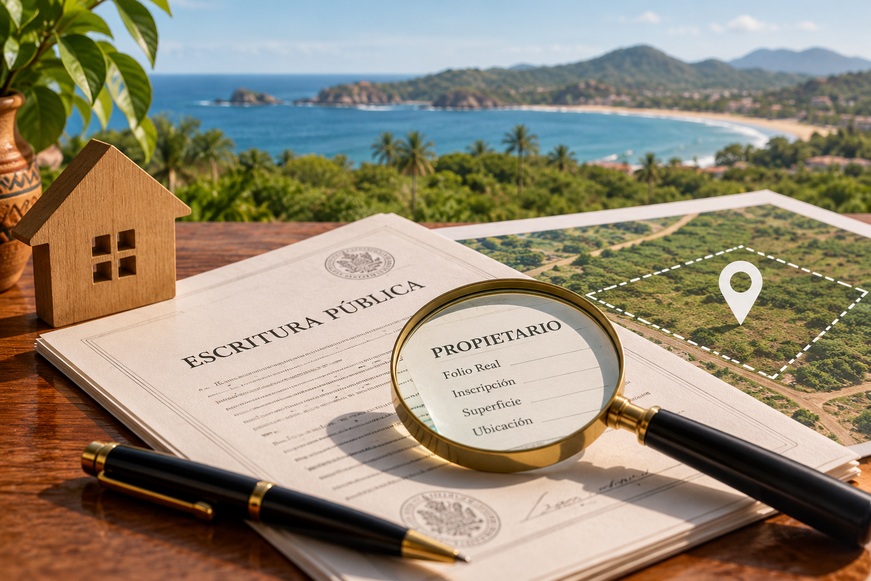
To verify the legal status of a house or plot of land, buyers should generally review the relevant property deed or title, ownership history, and information recorded with the Public Registry of Property (Registro Público de la Propiedad).
It is also important to verify that there are no mortgages, liens, lawsuits, ownership restrictions, or other circumstances that could affect the transaction.
Having a property deed does not eliminate the need to investigate the property's registration history.
Comparison: Possession vs. Assignment of Rights vs. Private Property Ownership
| Feature | Possession | Assignment of Rights | Private Property Ownership |
|---|---|---|---|
| What does it represent? | Actual control over a property | Transfer of specific rights | Legal ownership of the property |
| Does it establish ownership? | Not necessarily | Depends on the rights assigned | Yes, through a valid legal title |
| Can the holder sell as the owner? | Not based on possession alone | Only if they lawfully hold and transfer ownership rights | Generally, yes |
| Is a deed required? | Not always | Depends on the rights and transaction | Real estate transfers must comply with applicable legal formalities |
| Can the property be mortgaged? | Not through possession alone | Depends on the rights and legally available guarantees | Generally, yes, subject to requirements |
| Main risk | Inability to prove ownership | Acquiring rights different from those expected | Liens, legal disputes, or title defects |
The most important distinction is that possession describes a person's relationship with a property, an assignment transfers specific rights, and private property ownership represents the legal right of ownership.
Be Careful with Ejido Land and Assignments of Rights
In Mexico, some land offered through assignments of rights involves ejido parcels or properties governed by agrarian law.
These properties require special attention because ejido parcel rights should not be confused with private property ownership.
Mexico's Agrarian Law establishes specific procedures for transferring ejido parcel rights and, under certain circumstances, obtaining full ownership rights (dominio pleno).
Therefore, an assignment of ejido rights should not automatically be interpreted as a private property deed.
Before purchasing, it is necessary to verify the land's legal classification, its status with the National Agrarian Registry (Registro Agrario Nacional), and whether the legal requirements for the proposed transaction can be met.
This is particularly important when land is advertised with promises that it can be formally titled in the future. The possibility of obtaining legal title should be verified before purchasing, rather than accepted as a guarantee from the seller.
What Documents Should You Review Before Buying Land?
Whether a property is advertised as privately owned, possessed, or offered through an assignment of rights, conducting a document review before committing money is essential.
The main items to review include:
-
Title or original legal document: Property deed, contract, assignment agreement, court ruling, or agrarian documentation, as applicable.
-
Registration history: Identification of the registered owner and review of the property's record with the Public Registry of Property or the relevant authority.
-
Legal status: Potential liens, lawsuits, restrictions, co-owners, or third-party rights.
-
Cadastral information: Property area, location, measurements, and boundaries, compared against the actual physical conditions.
-
Seller's identity and legal authority: Verification that the seller has the legal capacity and authority to transfer the rights being offered.
-
Feasibility of obtaining a deed: Confirmation of which procedures are required, whether they are legally possible, and who will be responsible for their costs.
Property tax payments and utility bills may provide useful information, but they do not replace legal due diligence or independently prove that the seller owns the property.
Which Is Better: Possession, Assignment of Rights, or Private Property Ownership?
If your goal is to purchase land to build, live on, finance, or eventually resell, acquiring privately owned property with verified legal documentation and registration history is generally the preferable option.
This provides a clearer legal foundation for establishing ownership and carrying out future transactions, although the property's specific circumstances must always be reviewed.
Transactions involving assignments of rights or properties held in possession are not necessarily illegal. However, they require more careful investigation because buyers may acquire limited rights, face legal regularization procedures, or encounter obstacles when attempting to obtain a property deed.
The decision should not be based solely on the land's price.
Before buying, the most important step is to determine who legally owns the property, what rights they can lawfully transfer, and what documentation the buyer will receive. A prior legal and notarial review can help prevent financial losses and future disputes.