What to Look for in a Deed Before Buying Property in Mexico

Before buying a house, apartment, or plot of land in Mexico, it is essential to verify that the deed is authentic, that the seller has the legal right to sell the property, that the property details are accurate, and that there are no mortgages, liens, or other legal restrictions.
The public deed is one of the most important documents in a real estate transaction, but having a copy alone does not guarantee that the property can be sold without complications.
To protect your investment, verify the information with the Public Registry of Property, review supporting documents, and resolve any irregularities before making substantial payments or signing the purchase agreement.
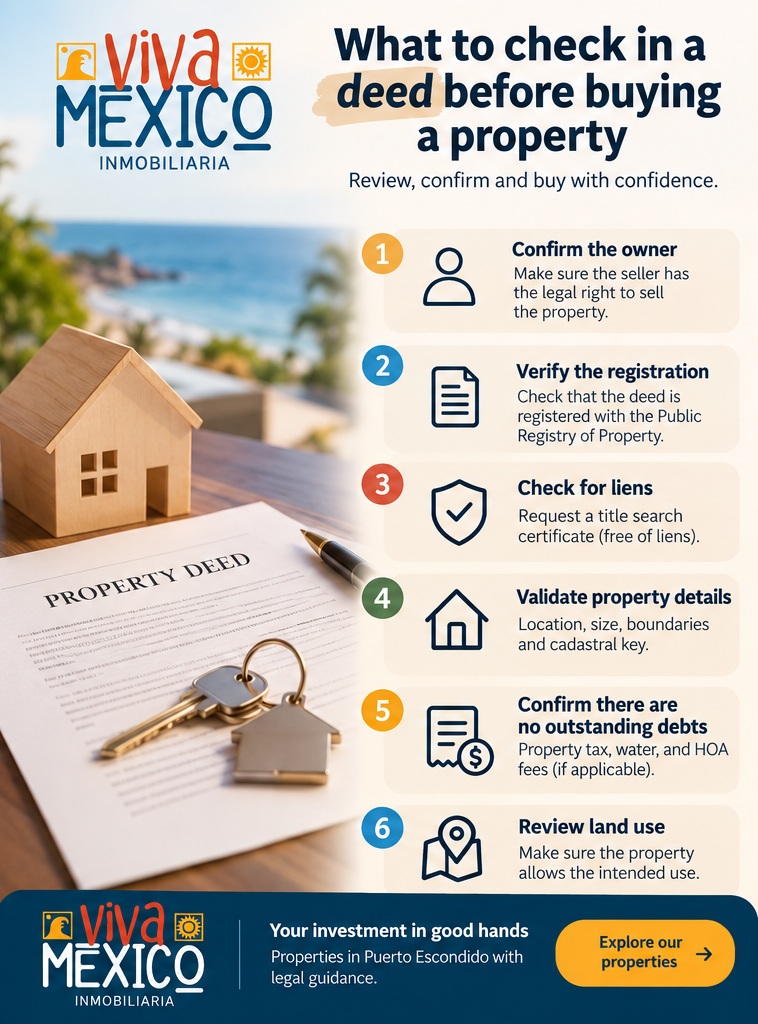
1. Verify that the seller is the legal owner
The first step is to confirm that the person offering the property has the legal authority to sell it.
The deed must identify the owner, including their full name and details of how they acquired the property.
Before proceeding with the transaction, check the following:
-
The owner's name matches their official identification.
-
The property is registered in their name with the Public Registry of Property.
-
There are no other co-owners whose authorization is required.
-
Where applicable, the spouse has given the consent required under the marital property regime.
-
If a representative is involved, they hold a valid notarized power of attorney sufficient to complete the sale.
What if the seller is not named on the deed?
This does not necessarily indicate fraud, but it does require clarification.
It may involve an inheritance, legal representation, or a transfer of ownership that has not yet been formalized. In any of these cases, the seller must provide documentary proof of their right to carry out the transaction.
Do not make a down payment until this situation has been resolved.
2. Confirm that the deed is recorded with the Public Registry of Property
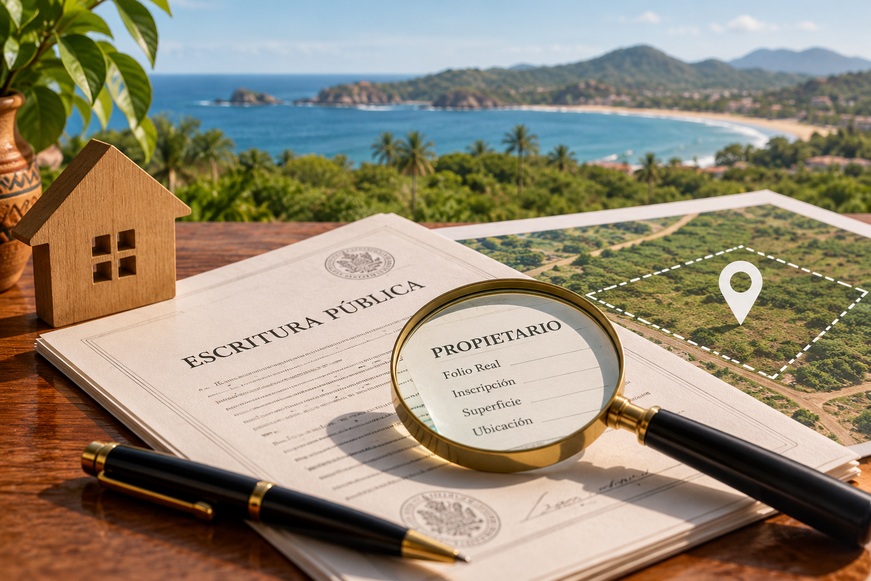
A deed provided by the seller should be checked against the property's registry records.
The Public Registry of Property shows who is listed as the owner and which legal acts have been recorded against the property.
Pay particular attention to:
-
Deed number.
-
Date of execution.
-
Name and number of the notary public involved.
-
Registration details or property folio number.
-
Registered ownership.
-
Previous records of property acquisition.
It is important to distinguish between a notarized deed and its registration. A notary's involvement does not replace the need to verify the property's current legal status.
If the deed and registry records do not match, request clarification before proceeding.
3. Check that the property is free of liens and encumbrances
One of the most important documents when buying real estate is the certificate of freedom from liens, also called a certificate of no encumbrances in some Mexican states.
This document helps identify registered claims or encumbrances that may affect the property.
These may include:
-
Outstanding mortgages.
-
Court-ordered attachments or seizures.
-
Certain ownership restrictions or limitations.
-
Other registered encumbrances that could affect the sale.
A mortgaged property is not necessarily prohibited from being sold. However, the transaction must include a secure procedure to pay off the debt and discharge the mortgage.
For example, if the seller still owes money on a mortgage, the notary may coordinate repayment and the necessary steps to release the lien.
The priority is to ensure the buyer does not acquire a property with unknown or unresolved encumbrances.
Request a current certificate and ask the notary to confirm its validity and scope before signing.
4. Confirm that the dimensions, area, and location are accurate
The property's physical details should match the deed and cadastral records.
This is especially important when buying land, rural property, or real estate intended for construction.
Check the following:
|
Item |
What to verify |
|---|---|
|
Location |
The address and location match the property you visited. |
|
Area |
The land and building areas in square meters are accurate. |
|
Measurements and boundaries |
The described boundaries correspond to the property. |
|
Cadastral identification number |
It identifies the parcel involved in the transaction. |
|
Buildings and improvements |
Any additions or construction work have the required documentation. |
If the actual measurements differ from those in the deed, a land survey, correction, or regularization procedure may be necessary.
These discrepancies can affect the price, notarial procedures, building plans, and a future resale.
5. Check for outstanding property tax, water, or maintenance fees
A property may have proper ownership documentation and still have unpaid obligations.
Before buying, request updated receipts or certificates covering:
-
Property tax.
-
Water service, where applicable.
-
Maintenance and administration fees, if the property is in a condominium.
-
Special assessments approved by the condominium administration.
-
Other debts associated with the property.
Not all of these debts appear on a certificate of freedom from liens.
That is why registry verification must be supplemented by tax and administrative checks.
The agreement should also specify who is responsible for settling any outstanding amounts before handover.
6. Review the ownership regime: private, condominium, or ejido land
Not all properties in Mexico have the same legal ownership regime.
This distinction is especially important when buying land in expanding urban areas, tourist destinations, or rural communities.
Private property
Verify that a valid title exists, that the documents match the property, and that its registry status permits the sale.
Condominium property
In addition to the individual deed, review the condominium regime, ownership shares, internal regulations, and common areas.
For apartments and residential developments, also verify which parking spaces, storage units, or exclusive-use areas are included in the purchase.
Ejido land
Ejido land must not automatically be treated as private property.
If the seller claims the land has been regularized, request documents proving its legal status, including, where applicable, the adoption of full private ownership (dominio pleno), the corresponding title, and its registration.
An ejido parcel certificate is not, by itself, equivalent to a private property deed.
If the land remains under the ejido regime, its transfer is subject to special rules and cannot be assumed to qualify for an ordinary real estate sale.
7. Verify land use and permits before buying
A deed provides legal information about a property, but it does not guarantee that you can develop any project on it.
If you plan to build a house, apartment building, commercial premises, or tourism development, confirm that the land-use designation allows the intended activity.
Review:
-
Permitted land use.
-
Building restrictions.
-
Permitted density and height.
-
Easements or access restrictions.
-
Applicable permits and licenses.
-
Environmental status, where relevant.
For example, a plot of land may be privately owned and properly registered but still be subject to urban planning or environmental restrictions that prevent your intended project.
This review is particularly important in destinations such as Puerto Escondido, Oaxaca, where location, land characteristics, and applicable regulations can directly affect an investment's feasibility.
8. Check the deed for irregularities or alterations
Receiving photographs or a PDF of the deed is not enough.
Request a legible copy and, when necessary, a certified copy to compare the documents against notarial and registry records.
Watch for potential warning signs:
-
Inconsistent names or property areas.
-
Notarial details that cannot be verified.
-
Missing pages.
-
Discrepancies between documents provided by the seller.
-
Refusal to provide registry information.
-
Pressure to pay before allowing a legal review.
The deed's authenticity must be verified through the appropriate legal channels, not merely by its appearance.
If anything seems suspicious, seek specialized notarial or legal assistance.
9. Carefully read the new deed before signing
In addition to reviewing the seller's existing deed, it is essential to examine the draft of the new deed under which you will acquire the property.
Before the signing appointment, ask the notary for a copy to review.
Make sure it accurately includes:
-
Complete buyer and seller details.
-
Description and identification of the property.
-
Purchase price and payment method.
-
Statements regarding the property's legal status.
-
Agreed terms for delivery of possession.
-
Allocation of taxes, duties, and expenses.
-
Release of liens, where applicable.
Also verify that its terms reflect what was previously agreed in the purchase agreement.
Do not sign documents containing amounts different from those actually agreed upon or statements you do not understand.
Documents to request before buying a property
In addition to the deed, prepare a file that allows you to verify the property's legal, tax, and physical status.
Document checklist
Mark the documents you have reviewed
0 of 10 reviewed
ResetThe exact documentation may vary by state, ownership regime, and transaction characteristics.
Who should review the deeds before buying?
A notary public plays an essential role in formalizing the sale, conducting the applicable document checks, and registering the relevant legal acts.
However, when inheritances, ejido land, registry irregularities, area discrepancies, or investment projects are involved, it may also be advisable to obtain real estate legal advice before signing an agreement or paying a deposit.
As part of this process, Viva México Inmobiliaria provides support during property purchases and access to legal advice for prospective buyers.
If you are considering your options, you can browse its selection of houses, apartments, and land for sale and learn about its property purchase advisory services.
Reviewing documents early helps identify issues that could delay or jeopardize a real estate transaction.
What should you do if you find problems with the deed?
Finding inconsistencies does not necessarily mean you must reject the property. Some irregularities can be corrected through notarial, registry, cadastral, or court procedures.
The recommended approach is to identify the issue, determine the required procedure, and establish who will cover the costs and responsibilities of regularization.
Avoid signing or making substantial payments based solely on verbal promises that the documents will be corrected later.
Buying property safely means more than confirming that a deed exists; it means ensuring that the property, its owner, and the transaction terms are legally compatible with the sale.
A thorough document review before committing your money can help prevent legal disputes and unexpected expenses.