How to Find Out Who the Legal Owner of a Plot of Land in Oaxaca Is
To find out who legally owns a piece of land in Oaxaca, the most reliable method is to check its ownership history through the Public Registry of Property (Registro Público de la Propiedad), administered by the Oaxaca State Property Registration Institute (Instituto de la Función Registral del Estado de Oaxaca, or IFREO). This process allows you to identify the registered owner, review property records, and detect potential legal issues before purchasing.
However, not all land falls under the same ownership system. If the property is ejido or communal land, the investigation must be conducted through the National Agrarian Registry (Registro Agrario Nacional, or RAN).
Understanding this distinction is essential to avoid purchasing land from someone who does not have the legal authority to transfer ownership.
Where Can You Check Who Owns Land in Oaxaca?
The institution you need to contact depends on the property's legal ownership classification.
| Type of Land | Institution to Contact |
|---|---|
| Private property | Oaxaca State Property Registration Institute (IFREO) |
| Ejido land | National Agrarian Registry (RAN) |
| Communal land | National Agrarian Registry and the relevant community authorities |
| Land with unknown legal status | IFREO and, if there are indications of communal or ejido ownership, RAN |
IFREO has registry offices in different regions of Oaxaca, including Oaxaca de Juárez, Puerto Escondido, Huatulco, and Pochutla.
How to Investigate Land Ownership Step by Step
1. Request the Property Deed or Ownership Title
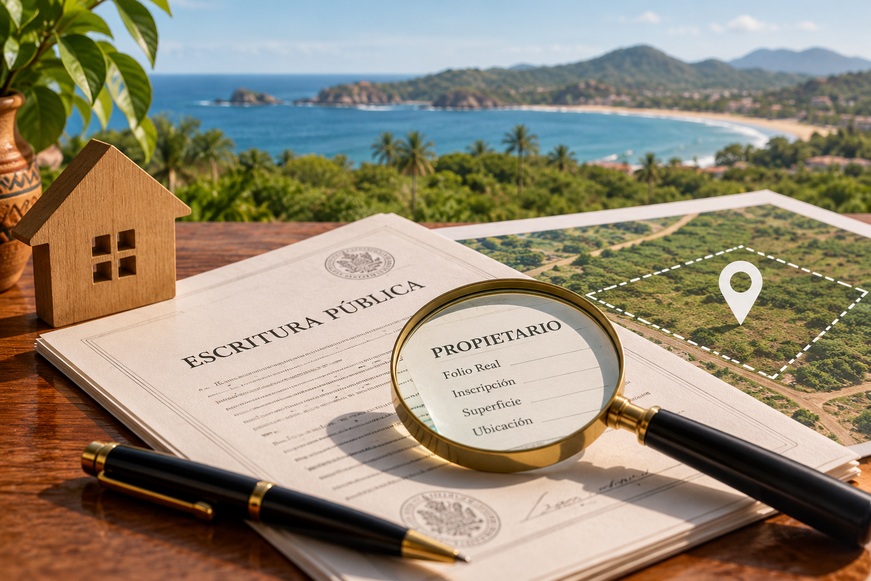
The first step is to ask the seller for a copy of the public deed (escritura pública) or another legal title supporting their ownership rights.
Pay particular attention to:
-
Full name of the registered owner.
-
Property location, total area, measurements, and boundaries.
-
Deed number and notary information, when applicable.
-
Registration details from the Public Registry of Property.
-
Previous ownership records explaining how the property was acquired.
The seller's name should match the registered owner's name, unless the seller is acting through legal representation or another legally justified arrangement.
Simply presenting a deed is not enough. You must also verify that the document corresponds to the actual property and that ownership has not subsequently been transferred.
2. Check the Property Records at the Public Registry
Using the property's information, visit the IFREO registry office responsible for the area where the land is located.
Request a property records search or information regarding its ownership history.
Details that may help locate the property include its real estate folio number (folio real), registration number, registry book or volume, owner's name, and property location.
IFREO provides services such as the Property Registration Data Certificate (constancia de datos registrales de propiedad), which certifies registered information about a property.
Other services provide information about the history of ownership transfers, which can help investigate previous transactions.
For more information, read our guide on what the Public Registry of Property is and how to check your property folio.
3. Request a Certificate of Liens or Encumbrances
Identifying the owner is not enough. You should also investigate whether the land is subject to registered legal restrictions or financial obligations.
IFREO issues certificates indicating the existence or absence of registered encumbrances (certificados de libertad o existencia de gravamen). These documents can help identify mortgages and other registered liens or obligations.
The standard procedure documented by the institute covers a five-year period. Depending on the circumstances, a more extensive historical review may be necessary.
It is important to understand that a certificate showing no registered liens does not replace ownership verification or guarantee that the property is free from every possible legal dispute.
4. Verify the Property's Cadastral Information
The next step is to check the property's information with the appropriate cadastral authority.
Compare the cadastral identification number, land area, location, and measurements against the deed and registry records.
You should also review property tax receipts (predial) and check for any outstanding payments.
Remember that paying property taxes does not make someone the legal owner of a property. Cadastral records primarily serve administrative and tax purposes; they do not replace legal ownership documents or property registry records.
5. Confirm That the Seller Has the Legal Authority to Transfer Ownership
Before making any payment, ask a Mexican notary public (notario público) to review the documents and verify the seller's legal authority.
Certain situations require particular attention:
-
The registered owner has passed away, and the inheritance process is still pending.
-
The property belongs to multiple co-owners.
-
The person signing the agreement represents the owner through a power of attorney.
-
The land area stated in the deed differs from the actual measurements.
-
The property is involved in litigation or an ownership transfer that has not been registered.
In these situations, additional documentation or legal procedures may be required before completing the transaction.
How Can You Find Out Who Owns Ejido or Communal Land in Oaxaca?
Oaxaca has properties governed by Mexico's social land ownership system. For these properties, checking the Public Registry of Property may not be sufficient.
The National Agrarian Registry (RAN) maintains records of ejido and communal land rights, parcel certificates, and other agrarian transactions.
To investigate land under this system, request information identifying the relevant agrarian community, review the corresponding certificate, and verify the current status of the registered rights.
You should also confirm that the proposed transaction complies with Mexico's Agrarian Law (Ley Agraria).
A parcel certificate (certificado parcelario) is not automatically equivalent to a private property deed.
If the seller claims that the land has already obtained full private ownership rights (dominio pleno), request documentation confirming the adoption of this status and its corresponding registration with the Public Registry of Property.
Do not confuse the transfer of ejido rights with the purchase of privately owned land. These transactions have different legal requirements, consequences, and transfer restrictions.
What Happens if Land Does Not Have a Property Deed?
The absence of a formal deed does not necessarily mean that the land has no owner.
There may be another form of ownership title, agrarian documentation, historical registry records, an unresolved inheritance, or a possession arrangement that has not yet been legally regularized.
It also does not mean that the person occupying the land can freely sell it as private property.
If the seller only presents a certificate of possession (constancia de posesión), a private contract, or a document issued by a local authority, you must determine exactly which rights the document establishes.
Before purchasing, a qualified professional should determine whether there is a legal process for regularizing the property and whether the rights being offered can be legally transferred.
Warning Signs Before Buying Land
Be cautious if a seller refuses to provide documents or pressures you to complete a transaction without allowing a registry search.
Properties offered exclusively through possession certificates, properties with measurements that do not match their documentation, and land whose seller promises to provide a deed only after payment also require additional investigation.
In real estate markets such as Puerto Escondido, Huatulco, and other destinations along the Oaxaca coast, distinguishing between private property, agrarian rights, and possession is particularly important.
The fact that land is advertised on a real estate website, has public utilities, or contains buildings does not, by itself, establish legal ownership.
Can You Check Who Owns Land in Oaxaca Online?
Information about IFREO procedures and services is available through the Oaxaca State Government's official website.
However, you should not assume that there is a universal public online database that allows you to instantly identify the owner of any piece of land simply by entering its address.
The availability of electronic searches, required documentation, and delivery methods depends on the specific registry service.
To obtain officially valid documents, use authorized IFREO channels and confirm the applicable procedure directly with the institution.
Avoid sharing personal information, documents, or banking details with websites claiming to provide official property registry services unless you have verified their authenticity.
What Documents Should You Have Before Buying Land?
Before completing the purchase of privately owned land, make sure you have the corresponding property deed or ownership title, registry history, applicable certificate of liens or encumbrances, cadastral information, and documentation proving the seller's identity and legal authority.
If the property has an ejido or communal ownership history, an appropriate agrarian legal review will also be necessary.
These checks should be completed before paying a deposit or signing an agreement that creates significant financial obligations.
The safest way to confirm the legal owner of land in Oaxaca is to compare the seller's documentation against official registry records and have the transaction reviewed by a Mexican notary public and, when necessary, an agrarian law specialist.