What Closing Costs Do Property Buyers Pay in Oaxaca?
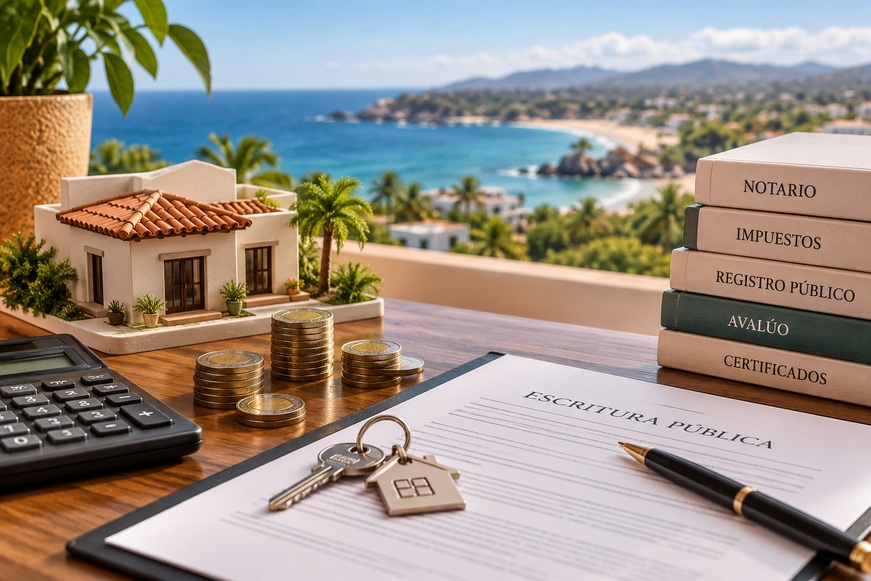
When buying property in Oaxaca, buyers typically pay property transfer tax, notary fees, appraisal costs, Public Property Registry fees, and various administrative and certification expenses. These costs are separate from the purchase price and should be considered before signing a purchase agreement.
As a general guideline for 2026, you should budget approximately 4% to 7% of the property's value for closing costs, although the final amount depends on the municipality, the characteristics of the transaction, and the services required.
For example, if you purchase a house for MXN $2,000,000, you may need an additional MXN $80,000 to $140,000 to complete the legal transfer of ownership. This is an estimated range, not an official fee schedule.
What Closing Costs Must Property Buyers Pay?
Property purchase expenses in Oaxaca generally fall into four categories: taxes, notary services, registration fees, and documentation costs.
1. Property Transfer Tax
Property transfer tax is one of the main taxes buyers must pay when purchasing a house, condominium, or plot of land.
In Oaxaca, the Municipal Treasury Law establishes that property transfer tax is calculated using the rates specified in the applicable municipal revenue laws.
As a general rule, the taxable base is determined using the higher of the cadastral value and the value declared by the taxpayer, subject to any special provisions that may apply.
How much is the tax? Several municipalities in Oaxaca apply a 2% rate, although buyers must verify the current municipal revenue law for the location of the property.
For example, if the taxable base is MXN $2,000,000 and the applicable tax rate is 2%, the transfer tax would be MXN $40,000.
This tax is paid when acquiring the property and is separate from notary fees.
2. Notary Public Fees
The buyer generally pays the professional fees of the notary public responsible for formalizing the property transaction.
The notary's responsibilities include reviewing the legal aspects of the transaction, preparing the deed, calculating applicable taxes, and formalizing the transfer of ownership.
The amount depends on the property's value, the legal procedures involved, and the applicable fee schedule. Value-added tax (IVA) is also charged on professional fees.
It is important to distinguish the notary's professional fees from the taxes and government charges that the notary may also collect and process on behalf of the authorities.
3. Public Property Registry Fees
After the property deed has been formalized, it must be registered with the Oaxaca State Property Registry Institute (Instituto de la Función Registral del Estado de Oaxaca).
This process officially records the transfer of ownership and helps protect the new owner's property rights against third parties.
Buyers generally pay the registration fees, which are calculated according to the current official fee schedule.
Registration costs should not be confused with property transfer tax, as they are separate expenses.
4. Property Appraisal
A property appraisal determines the value of a property through an authorized professional.
An appraisal may be required for tax, cadastral, or mortgage purposes, depending on the transaction.
If you are purchasing property with financing from a bank, Infonavit, or Fovissste, you will generally need an appraisal that meets the lender's requirements.
The cost depends on factors such as the property type, size, location, and purpose of the appraisal.
5. Certificates, Official Records, and Administrative Procedures
During a real estate transaction, additional documents may be required to verify the property's legal and tax status.
These may include:
-
Certificate confirming whether the property is free of liens or encumbrances.
-
Property tax clearance certificate.
-
Water service payment clearance certificates.
-
Cadastral documentation.
-
Property registration history.
-
Certified copies and other required legal documents.
Not all these expenses are automatically the buyer's responsibility. Some documents and outstanding debt settlements may be the seller's responsibility, depending on the nature of the expense and the agreement between the parties.
For this reason, the notary's cost estimate should clearly indicate who is responsible for each item.
How Much Extra Money Do You Need to Buy Property in Oaxaca?
To prepare an initial budget, the following table uses an estimated closing cost range of 4% to 7% of the property's purchase price.
| Property Purchase Price | Estimated Closing Costs (4%–7%) |
|---|---|
| MXN $1,000,000 | MXN $40,000–$70,000 |
| MXN $1,500,000 | MXN $60,000–$105,000 |
| MXN $2,000,000 | MXN $80,000–$140,000 |
| MXN $3,000,000 | MXN $120,000–$210,000 |
| MXN $5,000,000 | MXN $200,000–$350,000 |
These figures are estimates intended for purchase planning. They are not official notary quotations and may not include all the expenses associated with financing, a bank trust, or unusual legal circumstances.
For a more detailed explanation of how these expenses are calculated, read our guide on how much it costs to obtain a property deed in Oaxaca.
Which Closing Costs Are the Seller's Responsibility?
Although buyers generally cover most closing costs, not every expense associated with a real estate transaction is their responsibility.
The seller is typically responsible for:
-
Capital gains income tax (ISR): When income tax is payable on the sale and no applicable exemption is available.
-
Removal of existing liens: If the property has a mortgage that must be canceled to transfer ownership free of that encumbrance.
-
Outstanding debts: Unpaid property taxes, water bills, or other obligations for which the seller is responsible.
-
Real estate agent commission: When the seller has hired an agent and agreed to pay the brokerage fee.
The allocation of certain expenses can be negotiated between the parties. However, private agreements do not eliminate tax obligations assigned to specific taxpayers under Mexican law.
Before signing, the purchase agreement should clearly establish which expenses will be paid by the buyer and which will be covered by the seller.
Are There Additional Costs When Buying Property With a Mortgage?
Yes. Purchasing property with financing may involve additional expenses beyond standard closing costs.
Depending on the lender's terms, these may include loan origination fees, bank appraisals, insurance, and expenses associated with formalizing and registering the mortgage lien.
Some banks offer promotions that waive certain fees, but this does not necessarily mean they cover all taxes and notary expenses.
Request both a detailed mortgage cost breakdown and a notary closing estimate to calculate the amount of money you will need to contribute.
Additional Costs When Buying Property in Puerto Escondido
In Puerto Escondido, it is particularly important to identify the municipality where the property is located, since properties may fall within the jurisdictions of San Pedro Mixtepec or Santa María Colotepec.
This information matters when determining the applicable municipal tax regulations and reviewing cadastral and property registration records.
Another important consideration is the property's legal ownership status. Before calculating closing costs, buyers should verify that the property can legally be transferred through the proposed transaction.
If the transaction involves possession rights, agrarian rights, or property awaiting legal regularization, the procedures and expenses may differ from those involved in purchasing properly registered private property.
Foreign buyers purchasing residential real estate within Mexico's constitutionally restricted zone may also need to establish a bank trust, known as a fideicomiso. This involves additional setup and ongoing administration costs.
How Can You Avoid Unexpected Closing Costs?
The most practical way to determine your total expenses is to request an itemized closing cost estimate from a notary before committing to the purchase.
The estimate should identify taxes, professional fees, IVA, registration charges, appraisals, certificates, and any other required procedures.
You should also verify that:
-
The seller has the legal authority to transfer ownership.
-
The property deed information matches the registration and cadastral records.
-
There are no outstanding liens or debts that could affect the transaction.
-
The purchase agreement specifies which expenses are the buyer's responsibility and which belong to the seller.
-
You understand any additional costs associated with mortgage financing.
At Viva México Inmobiliaria, we recommend reviewing these details before making substantial payments toward a property in Oaxaca, particularly when purchasing land or real estate in rapidly developing areas.
Understanding closing costs from the beginning allows you to establish a realistic purchase budget and avoid committing funds that you will need to complete the legal transfer of ownership.