
What's the first thing I should do to sell my house?

If you are wondering what is the first thing I should do to sell my house, the answer is simple: before listing it, you need to understand the actual situation of your property. This means confirming that you can legally sell it, gathering the required documentation, identifying any outstanding debts or potential issues, and obtaining an objective reference of how much it may be worth in the market.
Listing a property without completing this preliminary review may result in receiving offers that cannot ultimately be completed, setting an uncompetitive price, or discovering documentation problems after you already have an interested buyer.
Selling a house does not begin with photographs or with the listing. It begins by properly preparing the property to enter the market.
1. Confirm that you can legally sell the property
The first step is to verify who is legally registered as the owner of the property.
The deed or property title identifies the legal owner and is one of the fundamental documents in a real estate transaction. It will also be necessary to review the information registered for the property and determine whether there is any situation that must be resolved before completing the sale.
For example, before getting started, you should be able to answer questions such as:
- Is the property deed registered in your name?
- Does the information in the deed accurately match the property?
- Is there an active mortgage?
- Are there any liens on the property?
- Is the property owned by more than one person?
- Was it acquired during a marriage?
- Is there any pending inheritance or probate process?
- Is the property currently rented?
These circumstances do not necessarily mean that the property cannot be sold, but they may change the steps required to complete the transaction.
2. Gather the property documents
You do not need to wait until you find a buyer to start looking for the required documents. Doing this from the beginning allows you to identify missing items and resolve them before entering into negotiations.
Some of the documents that may normally be required during the process include:
- Deed or property title.
- Official identification of the owner.
- Property registry information.
- Receipts related to property tax payments.
- Water service payment receipts.
- Documentation related to other utilities.
- Marriage certificate, when applicable.
- Documentation related to an existing mortgage, if applicable.
- Lease agreement if the property is rented.
- Plans, sketches, or cadastral documentation when necessary.
The exact documents may vary depending on the location, characteristics, and legal status of the property, so they should be confirmed during the sale process.
Why should you review the documents before listing the property?
Because finding a buyer does not automatically mean that the transaction can be completed.
Imagine receiving a good offer and later discovering that there is a discrepancy in the documentation, that a previous mortgage still needs to be canceled, or that you need to complete a property registry procedure.
The buyer may not be willing to wait, and the transaction could be lost.
That is why a preventive review can help avoid problems when the time comes to sell.
3. Find out how much your house is really worth
Once you understand the property’s documentation status, one of the most important decisions comes next:
How much should I sell my house for?
One common mistake is setting the price based solely on the amount you need to receive or on what someone else is asking for a nearby property.
The price should be analyzed by considering factors such as:
- Location.
- Land area.
- Square meters of construction.
- Age of the property.
- Condition of the property.
- Layout.
- Number of bedrooms and bathrooms.
- Available services.
- Amenities.
- Characteristics of the area.
- Current real estate inventory.
- Similar properties currently for sale.
- Comparable transactions when information is available.
A real estate appraisal is a tool used to determine the value of a property by analyzing its characteristics and other relevant elements. BBVA notes, for example, that factors such as land size, construction, materials, installations, access to services, and location may be considered.
4. Do not confuse listing price with market value
This point is especially important.
Just because a house is listed for $5 million pesos does not mean that someone will actually pay $5 million for it.
Real estate portals mainly show asking prices. They are useful for understanding the competition, but they do not necessarily represent the final price at which transactions are completed.
That is why it is helpful to analyze several comparable properties and observe:
- How long they have been listed.
- What features they have.
- What condition they are in.
- What advantages they offer.
- How similar they really are to your property.
The goal should not simply be to list at the highest possible price, but rather to establish a price that can be justified to real buyers.
5. Review the physical condition of the house
After reviewing the documents and price, look at the property as someone who has never lived there would.
BBVA recommends conducting a general inspection to identify defects and determine which repairs are worth making before putting the property on the market.
You do not need to turn the house into a brand-new property.
However, some details can significantly affect the first impression:
- Visible moisture or dampness.
- Leaks.
- Worn or damaged paint.
- Doors that do not work properly.
- Damaged installations.
- Plumbing leaks.
- Poor lighting.
- Overcrowded spaces.
- Neglected gardens or outdoor areas.
A clean, organized, and properly presented property makes it easier for a buyer to imagine living there.
6. Define how much you are willing to negotiate
Before receiving your first offer, it is helpful to establish three figures:
Listing price: the amount at which the property will be placed on the market.
Target price: the amount you reasonably expect to receive.
Minimum acceptable price: the amount below which you would prefer not to proceed with the transaction.
Having these figures defined helps prevent impulsive decisions during negotiations.
It also allows you to create a more consistent marketing strategy.
7. Calculate how much money you would actually receive from the sale
The sale price will not necessarily be the same amount of money you ultimately receive.
Depending on the characteristics of the transaction, there may be expenses, taxes, professional fees, commissions, outstanding debts, or other costs related to the sale.
That is why it is useful to think in terms of the net amount.
For example:
Sale price
minus transaction-related expenses
minus outstanding debts that must be paid
minus other applicable costs
= estimated net amount for the owner
Before accepting an important offer, it is advisable to review the transaction with the appropriate professionals in order to understand its legal and tax implications.
8. Decide whether you will sell on your own or work with a real estate agency
A property can be sold directly by its owner or through real estate professionals.
Selling it yourself may give you greater control over certain parts of the process, but it also means handling:
- Market research.
- Setting the price.
- Preparing photographs.
- Creating listings.
- Marketing the property.
- Answering calls and messages.
- Qualifying buyers.
- Coordinating property showings.
- Negotiating offers.
- Reviewing documentation.
- Coordinating the transaction with the professionals involved.
A real estate agency can handle a significant portion of the marketing and guidance process in exchange for the agreed fees or commission. BBVA specifically includes this decision among the steps a property owner should consider before selling. BBVA Mexico
9. Prepare the property for listing
Once the legal, documentation, and commercial aspects have been reviewed, you can begin preparing the listing.
Photographs are especially important because they often represent the buyer’s first contact with the property.
The presentation should properly show:
- Facade.
- Living room.
- Dining room.
- Kitchen.
- Bedrooms.
- Bathrooms.
- Garden or terrace.
- Parking area.
- Amenities.
- Views.
- Common areas, when applicable.
The information must also be accurate.
A useful listing should include, among other details:
- Property type.
- Location.
- Land area.
- Construction area.
- Bedrooms.
- Bathrooms.
- Parking.
- Amenities.
- Special features.
- Price.
Digital marketing has become a central part of the real estate sales process, and properly presenting the property helps attract the attention of potential buyers.
10. Do not look only for interested people: look for real buyers
Receiving many messages does not necessarily mean you are close to selling.
During the marketing process, you may encounter:
- People who are only comparing prices.
- Curious prospects.
- Buyers who do not yet have financing.
- People whose purchasing power is below the asking price.
- Prospects seeking aggressive negotiations.
- Buyers with the actual ability to complete the transaction.
That is why it is useful to qualify prospects before moving too far into negotiations or property showings.
The goal is not to receive the highest possible number of messages.
The goal is to find a buyer who has genuine interest, financial capacity, and the conditions required to complete the transaction.
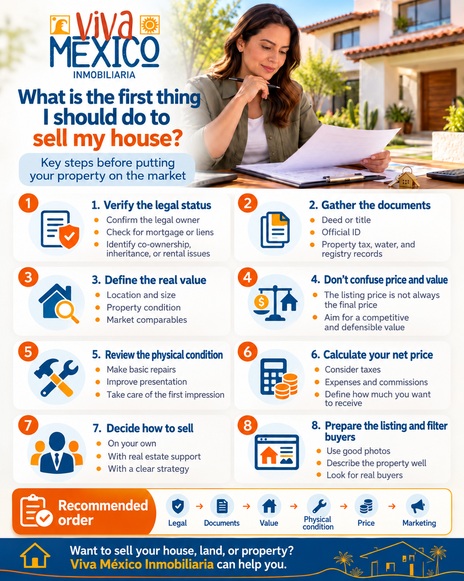
So, what should I do first to sell my house?
If you want a practical answer, start in this order:
- Confirm the legal status of the property.
- Gather the available documentation.
- Identify outstanding debts, mortgages, or unresolved issues.
- Determine how much the property may actually be worth.
- Calculate how much you need to receive from the transaction.
- Inspect and physically prepare the property.
- Define your price and negotiation margin.
- Decide how you will market the property.
- Prepare professional photographs and information.
- Begin looking for buyers.
This order helps prevent one of the most common mistakes: listing first and trying to resolve everything else only after an interested buyer appears.
Do you want to sell a house, land, or other property?
If you own a property and do not want to handle pricing, marketing preparation, prospecting, negotiations, and coordination of the entire process through the notarial closing on your own, you can also work with real estate professionals.
At Viva México Inmobiliaria, we offer a service for property owners who want to sell houses, land, and other real estate, with a process that includes assessment and valuation, property preparation, marketing to buyers and investors, and support throughout the negotiation and closing process.
You can learn how our property sales service with Viva México Inmobiliaria works and request a valuation of your property.
If you still do not know how much to sell for or what you need to get started, that assessment may be precisely the first step before listing your property.
Mistakes you should avoid when selling a house
Listing it without knowing its value
A price that is too high can significantly reduce interest from real buyers. A price that is too low can cause you to lose part of the property’s value.
Waiting until you have a buyer to review the documents
Documentation problems tend to become more complicated when there is already pressure to complete the transaction.
Hiding problems with the property
Transparency supports a professional negotiation process and helps prevent future disputes.
Using any offer as a reference for the property’s value
An offer only represents what one person is willing to pay under certain conditions. It should be evaluated together with the market and the characteristics of the transaction.
Neglecting photographs and presentation
A property may have excellent features and still receive little attention if its digital presentation does not communicate them properly.
Negotiating without knowing your limit
Determine in advance the minimum price you are willing to accept and the conditions under which you would proceed with the transaction.
Frequently asked questions about how to start selling a house
What should I do before putting my house up for sale?
The first step is to review the property’s legal and documentation status. Confirm ownership, identify possible liens or outstanding debts, gather the necessary documents, and analyze how much the property may be worth in the market. After doing this, you can set a price and begin a marketing strategy with greater confidence.
Do I need an appraisal to sell my house?
An appraisal can provide a professional reference for the value of the property and may be required in certain transactions, especially when financing is involved. In addition to the appraisal, it is useful to analyze comparable properties, location, physical characteristics, and real estate market conditions.
What documents do I need to sell a property?
The required documentation depends on the property and the transaction, but commonly requested documents may include the deed or property title, owner identification, registry information, property tax documentation, water service records, and other documents related to marital status, mortgages, leases, or specific characteristics of the property.
Can I sell a house that still has a mortgage?
Having a mortgage does not necessarily mean that the property cannot be sold, but the transaction requires reviewing the outstanding balance and the applicable process for paying off or canceling the lien. It is advisable to review the specific case with the lender and the professionals involved in the transaction.
Is it better to sell a house on my own or with a real estate agency?
Both options are possible. Selling directly means handling pricing, advertising, prospects, showings, negotiations, and documentation coordination yourself. A real estate agency can take on a significant portion of that process in exchange for agreed fees. The decision depends on your available time, experience, and the level of support you need.
When should I start advertising my property?
It is advisable to begin once you have a clear understanding of the property’s documentation status, a well-supported price, defined negotiation conditions, and suitable materials for presenting it. Listing the property before completing these steps may generate interest that ultimately cannot be converted into a completed sale.