Communal Property: Examples
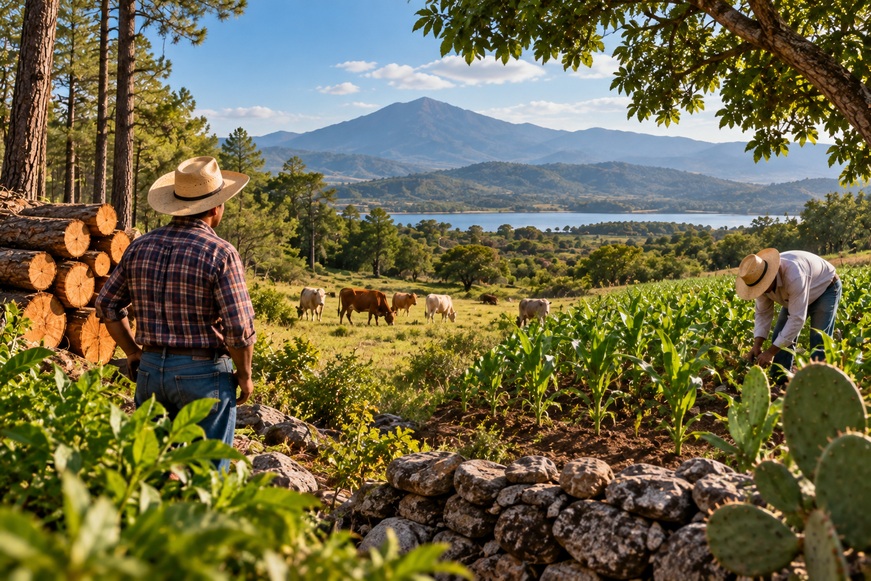
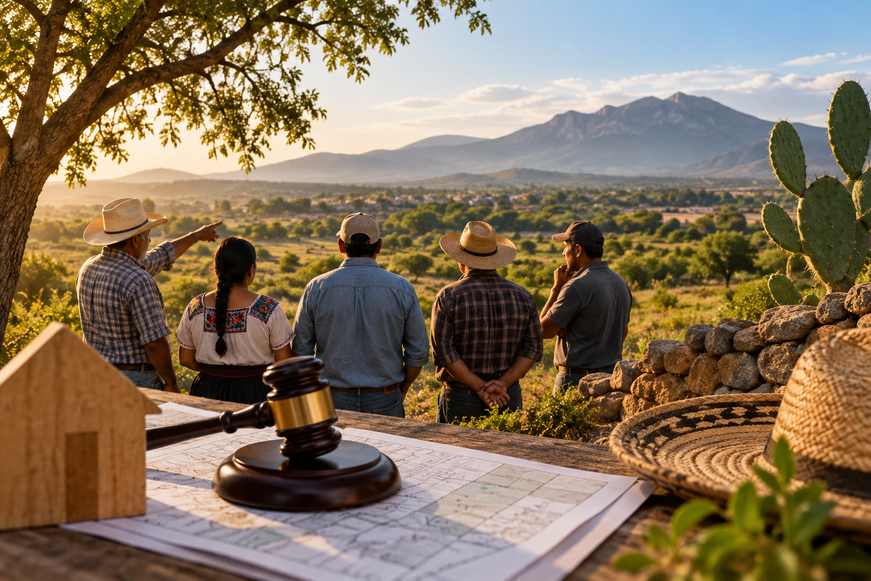
Communal property can include land, forests, grazing areas, forestry resources, and other areas whose use belongs to a community rather than exclusively to a single individual.
Although the concept may seem complicated, it becomes much easier to understand when we look at it through examples.
At Viva México Inmobiliaria, we want to explain what communal property is, give you easy-to-understand examples, and, especially, show you what it means when you encounter this term while researching land in Mexico.
What is communal property?
In general terms, communal property refers to assets or resources whose use, enjoyment, or ownership belongs collectively to a community.
However, its legal meaning varies depending on the country and the context.
For example, in Spain there is specific regulation governing communal property associated with assets whose use belongs to the residents of a community. Historical examples include forests, grazing lands, water resources, and land used collectively.
In Mexico, when we talk about communal property within the agrarian context, it should primarily be associated with agrarian communities and social property.
The Agrarian Law recognizes:
-
the legal personality of the community;
-
the community's ownership of its lands;
-
the existence of the Commissariat of Communal Property;
-
and the rights and obligations of community members.
In addition, the community is responsible for determining how its land is used, dividing it according to different purposes, and organizing the use of its assets.
Communal property: easy-to-understand examples
Some examples of communal property, depending on the organization and characteristics of each community, may include:
1. Communal forests
A forest belonging to an agrarian community may be used collectively by its members.
For example, a community may organize activities related to:
-
forest management;
-
timber production;
-
resin collection;
-
environmental conservation;
-
ecotourism.
A real example is Nuevo San Juan Parangaricutiro, Michoacán, whose community has carried out community forestry management activities for decades, along with businesses related to timber, resin, furniture, and ecotourism.
Therefore, a forest can be a very clear example of communal property.
2. Grazing land
Another example is land used by members of a community to feed livestock.
Imagine a community that owns an area of 5,000 hectares.
One part may be used for agriculture, while another remains as a collective grazing area.
Instead of belonging individually to one person, that land may be used according to rules established by the community.
3. Agricultural land
There may also be land belonging to a community that is designated for agricultural activities.
For example:
Community A → 3,000 hectares of communal territory
Within that area, there could be:
-
agricultural land;
-
parcels used by specific families;
-
collective-use land;
-
forest areas;
-
internal roads.
The fact that a person cultivates a particular area does not necessarily mean that the person privately owns that land.
They may hold usage rights within the communal property regime.
4. Communal woodlands
Woodlands are another traditional example of property used collectively.
They may be used for:
-
forestry activities;
-
collection of products;
-
grazing;
-
conservation;
-
community economic activities.
Historically, woodlands and forests are among the most common examples when studying the concept of communal property.
5. Forestry resources
We should not think only about the land itself.
The resources found within communal lands may also be used through community-based arrangements.
For example, a community may manage:
-
timber;
-
resin;
-
forest products;
-
natural resources;
-
tourism activities related to the forest.
The Agrarian Attorney's Office has documented Mexican communities that collectively manage these types of resources and develop community-owned businesses around them.
6. Conservation areas
A community may also decide to preserve certain areas instead of using them directly for productive activities.
For example:
10,000 hectares of communal land
could be distributed as follows:
-
3,000 hectares of forest;
-
2,000 hectares for agriculture;
-
2,000 hectares for grazing;
-
1,000 hectares designated for settlements;
-
2,000 hectares for conservation.
This is only an illustrative example, but it shows how a community may assign different purposes to its land.
The Agrarian Law specifically allows the community to determine its use and organization.
7. Roads used by the community
Within a communal area, there may be roads and access routes used to connect different parts of the territory.
For example, a road may allow community members to reach:
-
parcels;
-
cultivation areas;
-
forest areas;
-
grazing areas;
-
settlements.
Depending on the organization of the agrarian nucleus, these spaces may form part of the infrastructure used collectively.
8. Land used for community projects
Communities may also use part of their property to develop productive projects.
For example:
-
an ecotourism center;
-
forestry projects;
-
community workshops;
-
agricultural production;
-
processing facilities;
-
livestock projects.
The Agrarian Law even provides for the possibility that communities may create companies, enter into partnerships with third parties, or temporarily grant the use and enjoyment of certain assets in order to improve their utilization.
A simple example of communal property
Imagine the following situation:
A community called San Pedro has 4,000 hectares legally recognized as communal land.
Within that land there are:
| Property or area | Use |
|---|---|
| 1,500 hectares | Forest |
| 800 hectares | Agriculture |
| 600 hectares | Grazing |
| 500 hectares | Parcels used by community members |
| 300 hectares | Conservation |
| 200 hectares | Settlements |
| 100 hectares | Roads and community facilities |
All of these areas could be located within land belonging to the community.
The community determines how to organize and use its territory in accordance with agrarian law and its own internal rules.
Examples of communal property in Mexico
In addition to hypothetical examples, there are Mexican communities whose collective management of their territory has been widely documented.
Nuevo San Juan Parangaricutiro, Michoacán
This community is known for its community forestry management model.
The Agrarian Attorney's Office states that the community has community-owned businesses and carries out activities related to:
-
resin processing;
-
furniture manufacturing;
-
forest management;
-
ecotourism.
It is an example of how assets belonging to a community can become productive resources managed collectively.
Ixtlán de Juárez, Oaxaca
Another documented example is Ixtlán de Juárez.
The Agrarian Attorney's Office has highlighted the community organization of this locality in Oaxaca for managing and protecting its social property and communal territory.
These cases show that communal property is not merely a historical concept.
It remains part of the agrarian and economic reality of many regions of Mexico.
Can land be communal property?
Yes.
In fact, for someone interested in real estate, this is probably the most important example.
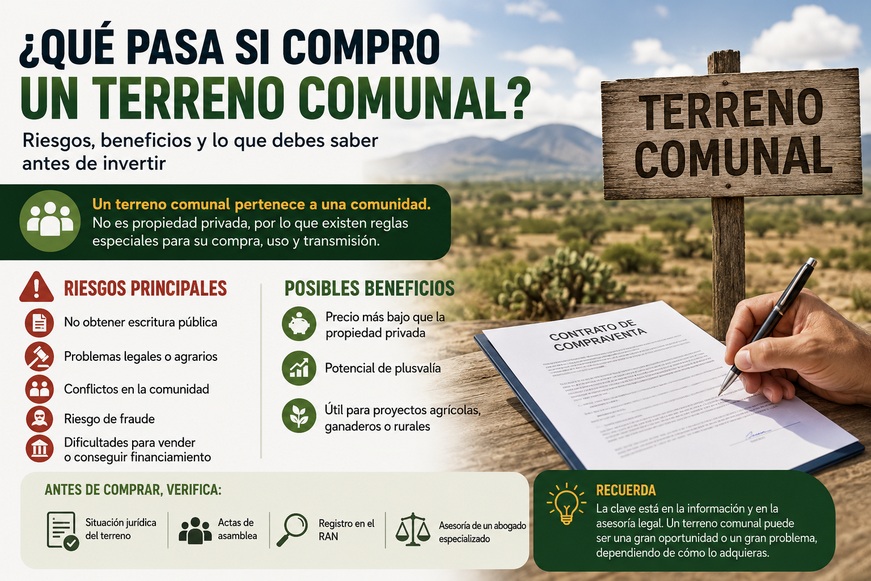
A parcel of land may be located within land belonging to an agrarian community.
Suppose you find this listing:
“600 m² lot for sale. Communal possession.”
Visually, it may look exactly like any other parcel of land.
Legally, however, it could be completely different.
Before buying, you would need to investigate:
-
who owns the land;
-
what rights the person offering the land has;
-
whether that person is recognized as a community member;
-
how the area is identified;
-
what document proves that right;
-
and what legal procedure is intended to be used to transfer it.
Does communal property belong to everyone?
This expression can cause confusion.
Communal property does not necessarily mean that anyone can use it.
When we talk about a Mexican agrarian community, there are officially recognized community members and rules governing the administration and use of the land.
The Agrarian Law expressly recognizes the rights and obligations of community members and the existence of representative bodies within the community.
Therefore:
communal property ≠ ownerless property.
The community has legal personality and ownership over its lands.
Are communal property and public property the same thing?
Not necessarily.
A public park, for example, may belong to a municipality or the State and be designated for public use.
Communal property may belong to a specific community and be used by its members under certain rules.
Therefore, although both may be used collectively, their ownership and legal regimes may be different.
Are communal property and common areas in a condominium the same thing?
No.
This is another important distinction, especially in the real estate sector.
In a building or residential development, there may be common property or common areas such as:
-
elevators;
-
stairs;
-
hallways;
-
gardens;
-
swimming pool;
-
shared parking areas;
-
lobby;
-
recreational areas.
These spaces belong to or serve the co-owners in accordance with the condominium property regime.
Different Latin American laws use the concept of common property precisely to describe facilities and shared spaces within condominiums.
But this does not turn the building into an agrarian community or those areas into agrarian communal property.
They are different legal concepts.
Communal property vs. condominium common area
| Concept | Example |
|---|---|
| Agrarian communal property | Forest belonging to a community |
| Agrarian communal property | Grazing land |
| Agrarian communal property | Territory managed by a community |
| Agrarian communal property | Community forestry resources |
| Condominium common area | Swimming pool |
| Condominium common area | Elevator |
| Condominium common area | Hallway |
| Condominium common area | Shared garden |
This distinction is especially important when researching real estate.
Who manages communal property?
Mexican agrarian communities have specific organizational and representative bodies.
The Agrarian Law recognizes the Commissariat of Communal Property as the body responsible for representing and administratively managing the community members' assembly.
There is also the community members' assembly, which plays a fundamental role in decisions related to the community.
For this reason, certain decisions regarding the territory do not depend exclusively on one person.
Can communal property be sold?
This question must be approached carefully.
Communal lands are subject to special legal protection.
Article 99 of the Agrarian Law establishes that communal lands are inalienable, not subject to adverse possession, and exempt from seizure, except in the case provided for by the legislation itself regarding their contribution to companies.
This does not mean that legal acts involving communal rights can never exist.
It means that communal land should not be treated as though it were automatically conventional private property that its supposed owner can simply sell to anyone.
Therefore, when someone advertises land as:
“Communal property for sale”
you should investigate exactly what is being offered.
Why is it important to understand these examples if you want to buy land?
Because one of the biggest mistakes when buying land is assuming that all land works the same way legally.
It does not.
You may encounter:
-
private property;
-
ejido land;
-
communal land;
-
possessory interests;
-
land undergoing regularization;
-
land with different agrarian backgrounds.
The difference may determine what you are buying, what documents you will receive, and what you will be able to do with the land afterward.
How can you identify whether land belongs to communal property?
Its physical appearance will not tell you.
Communal land may have:
-
walls;
-
buildings;
-
utilities;
-
nearby streets;
-
neighbors;
-
vehicle access.
None of these characteristics, by themselves, determine its legal regime.
Before completing a transaction, the corresponding documents should be reviewed and, when there is a possible agrarian background, the information should be verified with institutions such as the National Agrarian Registry and the competent authorities.
It may also be necessary to review:
-
the Public Registry of Property;
-
the Cadastre Office;
-
the Agrarian Attorney's Office;
-
community documentation;
-
agrarian maps;
-
certificates;
-
the land's legal history.
Examples of questions to ask before buying communal land
If you find a property related to communal land, you can start by asking:
-
Is the land private property, ejido land, or communal land?
-
Who is legally listed as the owner?
-
What document does the seller have?
-
Is the seller officially recognized as a community member?
-
Is the area officially identified?
-
Is it registered with the National Agrarian Registry?
-
What right exactly is intended to be transferred?
-
Is there any dispute involving the land?
-
Is the community members' assembly involved?
-
Does a private property deed actually exist?
These questions can help you distinguish a conventional real estate transaction from one that requires a more in-depth agrarian legal review.
Conclusion: examples of communal property
Communal property can take many forms.
Some of the easiest examples to understand include forests, woodlands, agricultural land, grazing areas, forestry resources, land, and areas designated for community projects.
In Mexico, when these assets belong to an agrarian community, they form part of a social property legal regime and should not be confused with private property or with common areas in a condominium.
Therefore, if you are researching land and come across terms such as “communal property”, “communal land”, or “communal rights”, this does not automatically mean that there is a problem, but it is a sign that you should understand exactly what type of ownership exists and what right is intended to be transferred.
If you are looking for land or properties in Mexico, at Viva México Inmobiliaria you can explore different real estate options. Before buying any land related to communal property or communal lands, review its documentation and legal regime so you know exactly what you are acquiring.