Law on Communal Lands

If you are researching a piece of land and someone tells you that it is communal, one of your first questions will probably be which law regulates this type of property and what rights exist over it.
At Viva México Inmobiliaria, we want to explain it to you in a simple way: in Mexico there is no law officially called the “Communal Land Law”. The main regulation is found in the Agrarian Law, particularly in the chapter dedicated to communities.
Understanding these rules is important because communal land does not operate legally in the same way as private property, nor should it automatically be confused with ejido land.
What law regulates communal land in Mexico?
The main law governing communal land in Mexico is the Agrarian Law.
Within Title Three, called “Ejidos and Communities”, Chapter V specifically regulates communities through Articles 98 to 107.
These articles establish, among other matters:
-
how a community is legally recognized;
-
who owns communal lands;
-
what legal protection these lands have;
-
what the community may do with them;
-
what rights community members have;
-
how they may organize internally;
-
and how an ejido may be transformed into a community or a community into an ejido.
Therefore, when someone searches for the law governing communal land, they are usually referring to these provisions of the Agrarian Law.
What does Article 98 of the Agrarian Law say?
Article 98 explains how an agrarian community may be legally recognized.
Recognition may arise, among other circumstances, from:
-
an action for restitution of land;
-
a voluntary jurisdiction proceeding when there is no dispute;
-
a judicial ruling when there is a controversy;
-
or the transformation of an ejido into a community.
Once recognized, the corresponding act must be registered both with the Public Registry of Property and the National Agrarian Registry.
This is important because an agrarian community does not arise simply because several people say that a particular piece of land is communal.
There must be legal recognition.
What does Article 99 establish regarding communal lands?
Article 99 is one of the most important provisions for understanding this legal regime.
The Agrarian Law establishes that recognition of a community produces several legal effects.
Among them:
-
The community acquires legal personality.
-
The community owns its lands.
-
There is a Commissariat of Communal Property.
-
Community members acquire rights and obligations.
-
Communal lands receive special legal protection.
This last characteristic is especially important for anyone interested in buying land.
Can communal lands be sold?
As a general rule, the Agrarian Law establishes that communal lands are:
inalienable, not subject to adverse possession, and exempt from seizure.
This is expressly stated in Article 99 of the Agrarian Law. There is an exception related to certain cases involving the contribution of land to companies under Article 100.
In simplified terms, these legal concepts mean:
-
Inalienable: they cannot be freely transferred like ordinary private property.
-
Not subject to adverse possession: the mere passage of time does not allow someone to acquire ownership through prescription.
-
Exempt from seizure: they cannot be seized under the ordinary rules applicable to other types of property.
Therefore, if someone tells you:
“I am selling you communal land just like any private property”
you should carefully investigate what right they actually intend to transfer.
So, can a community member transfer any rights?
Yes, there may be legal acts involving communal rights, but it is necessary to distinguish between selling property owned by the community and transferring certain rights held by a community member.
Article 101 establishes that community member status may allow its holder to:
-
use and enjoy their parcel;
-
make use of common-use property;
-
and transfer rights over their parcel to family members and recognized residents, in accordance with the applicable rules.
In addition, anyone who validly receives those rights acquires the status of a community member.
This demonstrates why a transaction should not be oversimplified by simply saying:
“It is communal land for sale.”
The correct legal question is:
What right is being transferred and under what procedure?
Who owns communal land?
Ownership belongs to the community.
Article 99 expressly recognizes the ownership of the population nucleus over its lands.
This means that a community member may have rights of use, enjoyment, or exploitation over a specific parcel without this necessarily meaning that they are the individual private owner of that area.
For example:
A community owns 2,000 hectares.
Within that land, a community member uses a 1,000 m² parcel.
The fact that they have worked that parcel for many years does not necessarily mean they can sell it through a conventional deed as though it were an independent private property.
It would first be necessary to determine what legally recognized right they actually hold.
Who decides what happens with communal lands?
The community itself has significant authority over the organization and use of its lands.
Article 100 establishes that the community may determine:
-
the use of its lands;
-
their division into different portions;
-
the purposes assigned to those areas;
-
and the way its assets are used.
It may also form companies, enter into partnerships with third parties, delegate management, or temporarily grant the use and enjoyment of certain assets in order to improve their utilization.
Therefore, many important decisions do not depend individually on a single community member.
What is the Community Members' Assembly?
The assembly is one of the fundamental governing bodies of the community.
Recognized community members participate in it, and decisions regarding the administration and organization of communal lands are made in accordance with the Agrarian Law, the community bylaws, and the applicable rules.
There is also the Commissariat of Communal Property, which acts as the representative and administrative management body of the assembly.
For this reason, a person who claims to be a community member does not necessarily have the authority to make any decision they wish regarding community lands.
What rights does a community member have under the Agrarian Law?
Article 101 establishes some of the main rights.
Depending on the situation of each community, a community member may have:
-
use and enjoyment of a parcel;
-
use of common-use property;
-
rights arising from their status as a community member;
-
the possibility of transferring certain rights in the cases permitted by law.
When there is no dispute, the Agrarian Law also presumes the legitimacy of parcel allocations that already exist in practice within the community.
However, this does not automatically mean that those parcels have become private property.
What happens if there are no individual parcels?
Article 102 addresses this situation.
When there is no individual allocation of parcels within a community, it is presumed that community members have equal rights, unless there is evidence to the contrary.
This once again demonstrates that communal lands can be organized very differently from a conventional private residential development where each lot has an individual owner.
Can an ejido become a community?
Yes.
The Agrarian Law allows an ejido to adopt the communal property regime.
Article 103 establishes the corresponding procedure and states that the transformation takes legal effect once the resolution is registered with the National Agrarian Registry.
Conversely, Article 104 allows a community to adopt the ejido regime through a decision of its assembly and compliance with the requirements established by law.
For this reason, the legal regime of a parcel of land may have changed historically and should be verified through documentation.
What documents must be registered with the National Agrarian Registry?
The Agrarian Law also establishes various documents and legal acts that must be registered with the National Agrarian Registry.
Article 152 includes, among others:
-
resolutions recognizing or modifying communal rights;
-
certificates or titles relating to common-use land and parcels;
-
original community land titles;
-
maps and boundary delimitations;
-
documents related to the rural cadastre;
-
decrees for the expropriation of communal property.
For this reason, the RAN is a fundamental institution when you need to verify the status of land with a communal background.
Does a certificate of possession replace agrarian documents?
Not necessarily.
A certificate of possession may prove a particular possessory situation, but it should not automatically be assumed to be equivalent to a private property title.
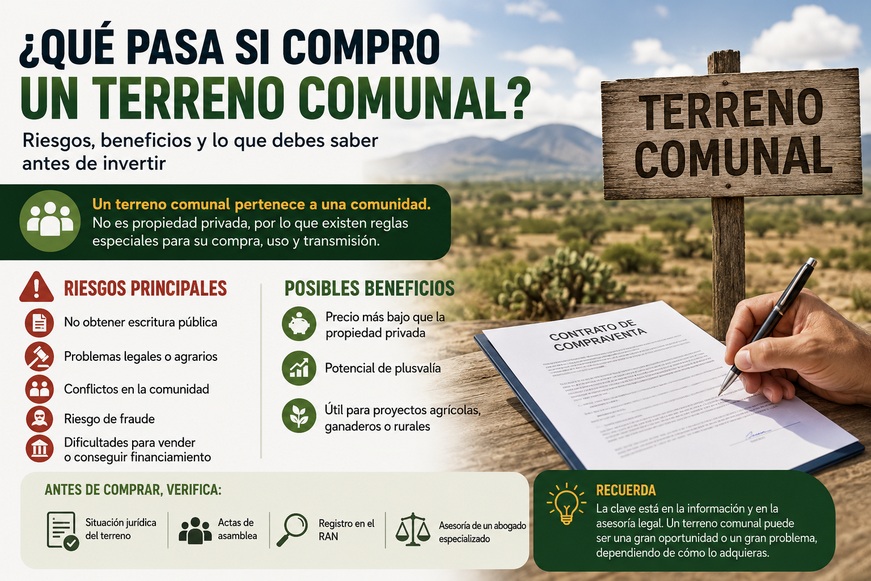
Before buying land, you should identify:
-
who issued the document;
-
what right it recognizes;
-
whose name appears on it;
-
what area it covers;
-
whether it matches the land being offered;
-
and whether there is information registered with the National Agrarian Registry.
The name of the document matters less than the legal right it actually proves.
Does the Agrarian Law allow communal land to be deeded as private property?
There is no general rule under which any communal parcel can simply be taken to a notary and converted into private property.
The situation depends on the legal regime of the community, the existing rights, and the procedures that may apply.
For this reason, statements such as:
“Buy now and we will give you the deed later”
should be carefully analyzed.
The future existence of a deed should not be accepted merely as a verbal promise.
There must be a legally viable procedure and documentation supporting it.
Difference between communal land and private property
| Topic | Communal land | Private property |
|---|---|---|
| Main owner | Community | Individual or legal entity |
| Main law | Agrarian Law | Civil and property registration law |
| Relevant registry | National Agrarian Registry | Public Registry of Property |
| Individual rights | Community member rights | Ownership rights |
| Transfer | Subject to the agrarian legal regime | Purchase and sale under applicable law |
| Special protection | As a general rule, inalienable, not subject to adverse possession, and exempt from seizure | Ordinary property regime |
This difference is fundamental when you are evaluating a purchase.
Is the law governing communal land the same as the law governing ejido land?
They share the same main law: the Agrarian Law.
However, ejidos and communities are different legal structures.
The Agrarian Law dedicates several chapters to the organization and operation of ejidos and then specifically regulates communities in Articles 98 through 107.
In addition, Article 107 establishes that many provisions applicable to ejidos may also apply to communities as long as they do not conflict with the specific rules contained in the chapter dedicated to communities.
Therefore:
ejido land and communal land are not synonymous.
What law should you review before buying communal land?
The main reference is:
Mexico's Agrarian Law.
Within it, it is especially useful to review:
| Article | Main topic |
|---|---|
| 98 | Recognition of communities |
| 99 | Ownership and protection of communal lands |
| 100 | Use and exploitation of the land |
| 101 | Rights of community members |
| 102 | Rights when no parcels have been assigned |
| 103 | Conversion from ejido to community |
| 104 | Conversion from community to ejido |
| 105 | Internal organization |
| 106 | Protection of land belonging to Indigenous groups |
| 107 | Supplementary application of ejido rules |
These articles form the core legal framework for understanding how communities operate under the Agrarian Law.
What should you review before buying communal land?
If you are evaluating a real estate transaction involving communal land, it is advisable to answer these questions first:
-
Does the land actually belong to a community?
-
What is the name of the agrarian nucleus?
-
Is it registered with the National Agrarian Registry?
-
Who is listed as the holder of the rights?
-
Is the seller officially recognized as a community member?
-
What document proves their rights?
-
Is the parcel officially identified?
-
What right is intended to be transferred?
-
Does the transfer require involvement of the assembly?
-
Is there any agrarian dispute?
-
Can the transaction be legally registered?
-
Is private property being offered, or only agrarian rights?
Answering these questions before handing over money can help prevent many problems later.
What happens if I buy communal land through a private contract?
A private contract does not by itself change the legal regime of the land.
Signing a document between a buyer and a seller does not automatically convert communal land into private property.
That is why you should distinguish between:
a signed contract
and
a legally transferable and properly registered right.
Some transactions may require additional legal acts, involvement of agrarian governing bodies, or registration with the corresponding authorities.
What authorities are involved with communal land?
Depending on the issue or procedure, different institutions may be involved.
Among the most relevant are:
-
National Agrarian Registry;
-
Agrarian Attorney's Office;
-
Agrarian Courts;
-
Public Registry of Property;
-
municipal or state authorities;
-
the representative bodies of the community itself.
Each institution performs different functions.
For this reason, the review of communal land should be carried out according to the specific transaction that is intended.
Is buying communal land illegal?
You should not automatically reach that conclusion.
Communal lands form part of a property regime expressly recognized by the Agrarian Law.
What matters is determining whether the specific legal act being proposed is legally valid.
The problem is not simply that the land is communal.
Problems may arise when:
-
something is presented as private property when it is not;
-
someone sells rights they do not actually have;
-
a deed is promised without legal basis;
-
there are disputes over possession;
-
or a transaction is attempted without following the required legal procedure.
Conclusion
When we talk about a law governing communal land in Mexico, the fundamental law to consult is the Agrarian Law, especially Articles 98 through 107.
This legislation recognizes that the community owns its lands, establishes special protection over them, regulates the rights of community members, and determines how communal assets may be organized and used.
For this reason, communal land should not be treated as though it were automatically conventional private property.
If you are considering buying land related to an agrarian community, first verify what rights the seller actually holds, what documentation proves those rights, and whether the proposed transaction is permitted under the law.
At Viva México Inmobiliaria, you can explore land and property options in Mexico. If a property has an ejido or communal background, before making a deposit or signing any contract, it is advisable to carry out a documentary and legal review to confirm exactly what you are acquiring.