What is communal land?
If you are looking for land to buy in Mexico, at some point you may come across listings that mention terms such as “communal land”, “communal rights”, “communal possession”, or even “for sale with a certificate of possession”. Before handing over any money, it is important to understand what these terms actually mean.
At Viva México Inmobiliaria, we want to help you understand the differences between the various types of property so that you can better investigate any land you may be considering purchasing.
Communal land does not operate legally in the same way as private property, nor should it automatically be confused with ejido land. Below, we explain what communal land is, who owns it, what rights a community member has, and what you should review before considering a transaction involving this type of land.
What is communal land?
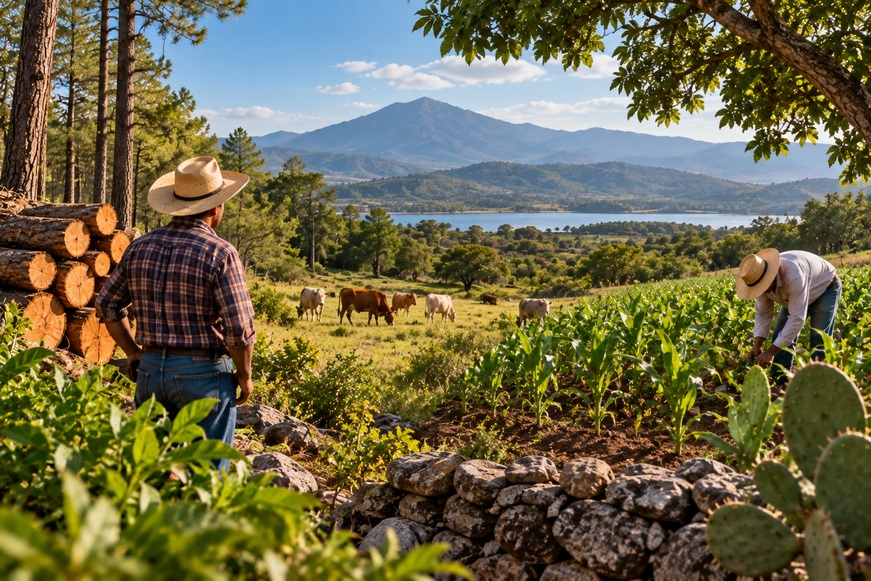
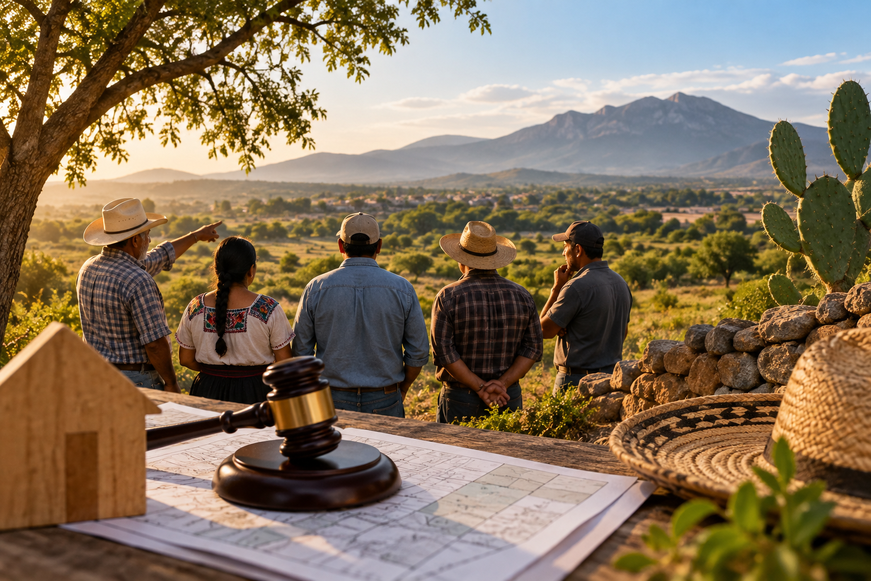
Communal land is an area of land that belongs to an agrarian community, rather than directly to an individual as private property.
In Mexico, the Agrarian Law recognizes legal personality for agrarian communities constituted as communities and also recognizes their ownership of the land. Communal lands are also subject to special legal protection.
This means that although a person may have rights as a community member over certain lands or may use a parcel within the community, that person is not necessarily the private owner of the land in the same sense as someone who owns real estate supported by a public deed of private property.
The National Agrarian Registry includes communities, along with ejidos, within what is known as social property in Mexico.
Therefore, if someone offers to sell you land and tells you that it is communal land, one of the first questions you should ask is:
What exactly are they selling me: private ownership of the land or certain agrarian rights over it?
The difference is fundamental.
Who owns communal land?
Legally, the land belongs to the agrarian nucleus recognized as a community.
The Agrarian Law establishes that recognition of a community produces, among other effects, recognition of:
-
the legal personality of the population nucleus;
-
the community's ownership of its lands;
-
the existence of the Commissariat of Communal Property;
-
the rights and obligations of community members.
In addition, the community determines how its lands are used and the manner in which they may be exploited.
Therefore, the fact that a person has used a particular area of land for many years does not automatically mean that the person privately owns it.
What is a community member?
A community member is a person officially recognized as a member of an agrarian community who holds the corresponding rights under the Agrarian Law and the bylaws of that community.
A community member may have the right to use and enjoy a parcel of land and may also have rights to use common-use property.
The Agrarian Law also provides that certain rights may be transferred under the circumstances established by the legislation itself, but this should not be confused with a conventional sale of private property.
For this reason, statements such as:
“I'm selling you my communal land”
should be examined carefully.
The correct question would be:
What legal rights does that person actually have over the land, and what legal act do they intend to use to transfer those rights?
Does communal land have deeds?
This is where one of the greatest sources of confusion arises.
Communal land may have documentation that legally establishes the existence of the community, its boundaries, its rights, and the corresponding allocations, but this agrarian documentation should not automatically be confused with an individual public deed for private property.
The National Agrarian Registry is precisely the institution responsible for the registration, control, and documentary security related to ejido and communal property.
Documents that may exist in relation to social property lands include resolutions, boundary delimitation records, maps, certificates, certifications, and various documents registered with the National Agrarian Registry.
Therefore, the fact that a seller shows you “documents” is not enough.
You need to determine what the document is, who issued it, what right it certifies, and whether it corresponds exactly to the land being offered.
Can communal land be sold?
This question requires a more precise answer than simply saying yes or no.
Communal lands are subject to a special legal regime.
Article 99 of the Agrarian Law establishes special protection for communal lands, making them inalienable, not subject to adverse possession, and exempt from seizure, except in the cases expressly established by the law itself.
In addition, the legislation regulates the rights of community members, the use of parcels, and the mechanisms through which certain acts involving those rights may be carried out.
Therefore:
you should not assume that because someone possesses or uses a communal parcel, they can sell it as though it were a privately owned lot with a deed.
Each transaction must be analyzed according to the specific legal status of the land and the rights held by the person seeking to transfer it.
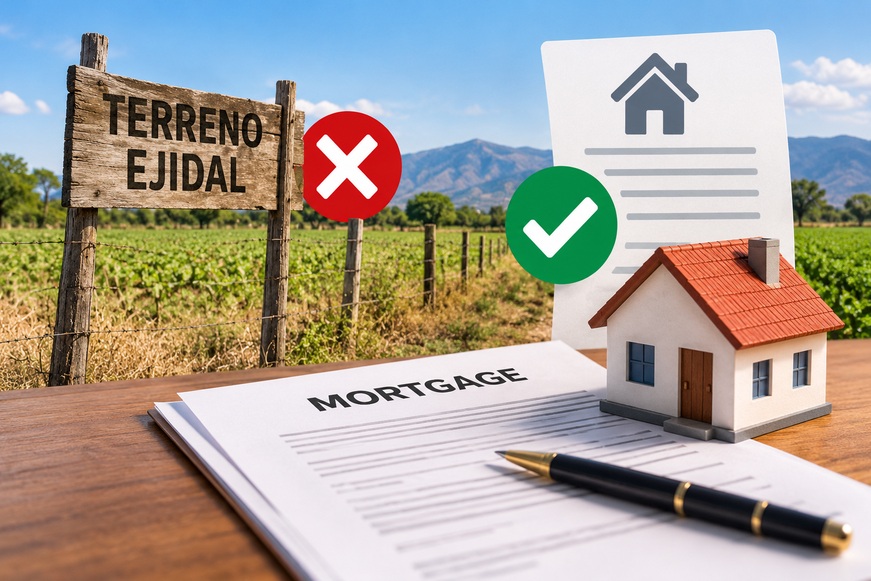
What is the difference between communal land, ejido land, and private property?
Although ejido and communal lands are both part of the social property system, legally they are not exactly the same.
| Type of land | Main characteristic |
|---|---|
| Communal | It belongs to an agrarian community and is governed by the Agrarian Law and decisions made by the community. |
| Ejido | It belongs to an ejido nucleus, and its lands may be divided, depending on their designated use, into parcels, human settlement areas, and common-use lands. |
| Private property | It belongs directly to an individual or legal entity under the private property regime and is normally evidenced by a title registered with the Public Registry of Property. |
The National Agrarian Registry itself identifies ejidos and communities as the two main forms that make up the country's social property system.
Therefore, the terms “ejido” and “communal” should not be used interchangeably.
A simple example of communal land
Imagine an agrarian community that legally owns 2,000 hectares.
Within that area, there are different sections used by members of the community.
One of the community members has used a particular area for many years and later advertises:
“500 m² lot for sale. I have a certificate of possession.”
The certificate may demonstrate some type of possession or right, but this does not automatically mean that there is an individually owned 500 m² private property that can be transferred through a conventional sale and subsequently deeded in the buyer's name.
Before handing over any money, it would be necessary to review, among other things:
-
how the land is registered;
-
whether it forms part of an agrarian community;
-
what rights the seller has;
-
whether the seller is officially recognized by the National Agrarian Registry;
-
what document supports those rights;
-
what is permitted under the Agrarian Law and the community's bylaws;
-
and exactly what procedure would be used to transfer the right.
Is buying communal land illegal?
Not necessarily.
The existence of communal land is completely legal and is expressly recognized under Mexican law.
The problem arises when a communal right is presented as though it were private property, when deeds that do not yet legally exist are promised, or when someone attempts to sell a right they do not have the legal authority to transfer.
That is why it is important to distinguish between two concepts:
Communal land ≠ irregular land.
A property may legally belong to a formally recognized agrarian community and have documentation registered with the agrarian authorities.
What needs to be analyzed is what right you are acquiring and under what legal regime.
What are the risks of buying communal land?
The main risk is not simply that the land is communal, but rather buying without understanding the actual legal status of the property.
Some situations that should prompt you to investigate more thoroughly include:
-
the seller claims that you will immediately receive an individual deed but only shows a certificate of possession;
-
the seller says that “everyone buys this way” instead of providing legal documentation;
-
the seller cannot demonstrate that they hold recognized rights over the land;
-
there are discrepancies between the area being offered and the documents;
-
they refuse to provide information that would allow you to verify the property with the authorities;
-
there is only a private contract presented as supposed proof of ownership;
-
they promise that the property “will soon be regularized” without documentation supporting that process;
-
or they pressure you to make a deposit before conducting a legal review.
None of these situations proves by itself that fraud is taking place, but they do justify conducting real estate and agrarian due diligence before making any payment.
How can I find out whether land is communal?
A photograph of the land, a Google Maps location, or even a private contract is not enough to determine the legal regime of a property.
When there are questions regarding ejido or communal lands, one of the key institutions for verifying information is the National Agrarian Registry (RAN).
The RAN is responsible for registration and cadastral functions related to social property and maintains information about ejidos, communities, and the legal acts associated with them.
Depending on the case, it may also be necessary to review information with:
-
the corresponding Public Registry of Property;
-
the Cadastre Office;
-
the municipality;
-
the Agrarian Attorney's Office;
-
and other agrarian or urban development authorities.
The appropriate review will depend on the location and nature of the property.
Does a certificate of possession prove that I am the owner?
Not necessarily.
Possession and ownership are different legal concepts.
A person may possess or hold certain rights over a parcel of land without necessarily being its private owner.
Therefore, when someone offers land by simply stating:
“I have a certificate of possession.”
the next question should be:
What right does that certificate actually establish, and who legally owns the land?
This distinction can completely change the nature of a real estate transaction.
Can you build on communal land?
The fact that a person has rights over land does not automatically mean that they can develop any type of project on it.
In addition to the agrarian regime, other factors may be involved, including:
-
land use regulations;
-
urban development;
-
municipal permits;
-
environmental impact requirements;
-
density restrictions;
-
access to utilities;
-
subdivision requirements;
-
access roads;
-
environmental restrictions;
-
and other land-use regulations.
Therefore, before buying land with the intention of building a home, developing apartments, marketing lots, or carrying out any type of real estate project, it is advisable to verify both the agrarian status and the urban development feasibility of the property.
What should I ask before buying communal land?
If you are evaluating this type of property, these questions can help you quickly determine whether further investigation is necessary:
-
Is the land private property, ejido land, or communal land?
-
Who is legally listed as the owner?
-
What document proves the seller's rights?
-
Is the seller officially recognized as a community member?
-
Is the land identified within the National Agrarian Registry?
-
Is there any agrarian dispute involving the land?
-
What exactly is being transferred: ownership, possession, or agrarian rights?
-
Does the transaction require authorization or involvement from the community members' assembly?
-
Can the transfer be legally registered?
-
Is there actually a legal possibility of obtaining private ownership and a deed, or is this merely a future promise?
If the seller avoids answering these questions or asks you for money before allowing the documentation to be reviewed, the safest approach is not to proceed until the situation has been verified.
So, is it a good idea to buy communal land?
The answer depends on what you want to acquire, what you intend to use it for, and the specific legal status of the land.
Not all communal lands represent a problem, nor should communal property automatically be considered irregular simply because it falls under this legal regime.
However, it should not be purchased under the assumption that it works exactly like private property.
The key issue is understanding what right you are actually acquiring.
If you are looking for land to build on, invest in, resell, or develop as a real estate project, understanding its ownership regime from the beginning can help you avoid problems later.
Conclusion
Communal land is land that belongs to an agrarian community and forms part of the social property regime recognized under Mexican law. Community members may have rights of use and enjoyment and, depending on the specific case, rights related to parcels, but this does not automatically mean that they hold individual private ownership that can be sold and deeded through a conventional real estate transaction.
Therefore, before buying, it is not enough to ask how large the land is, where it is located, or how much it costs. You should also ask:
Who is the legal owner, and what right am I actually acquiring?
That simple question can help prevent many problems.
If you are looking for land or properties in Mexico, at Viva México Inmobiliaria you can explore real estate options and learn about the characteristics of each property before making a decision. Particularly when a property has an ejido or communal background, the recommendation is always to verify the corresponding legal documentation before making deposits or signing contracts.