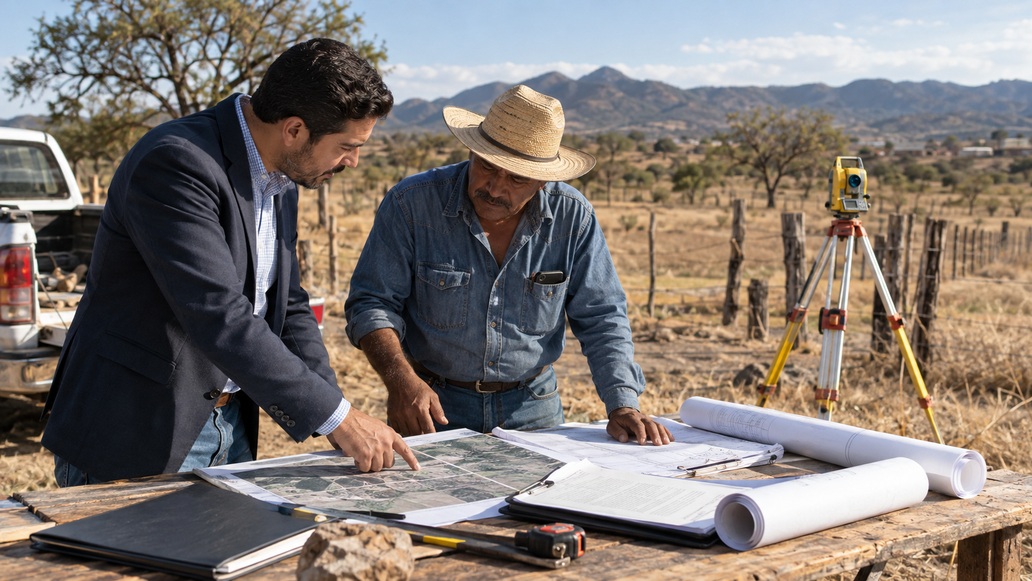
How do you register a piece of land in Oaxaca?
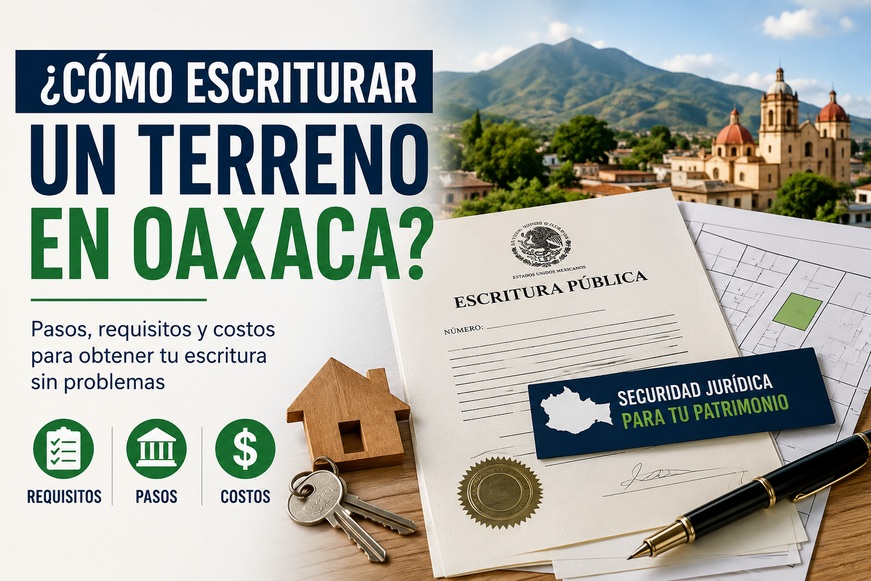
Deeding a lot in Oaxaca is the legal process through which a property is formally registered in the owner’s name by means of a public deed executed before a notary public and recorded with the Public Registry of Property. This procedure provides legal certainty, protects your assets, and facilitates future transactions such as sales, inheritances, or loan applications.
Although each case may have specific circumstances, the general procedure follows a series of steps involving the seller, buyer, notary public, cadastral authorities, and property registration authorities.
What does it mean to obtain a deed for a lot?
Obtaining a deed for a lot means formalizing the transfer or recognition of ownership through a public deed prepared by a notary public. The document is then recorded with the Public Registry of Property so that the new owner is legally recognized.
Without a deed, possession of a lot may be insufficient to prove ownership before third parties or government authorities.
Requirements for obtaining a deed for a lot in Oaxaca
The required documents may vary depending on the origin and legal status of the property, but the following are normally requested:
- Deed or document proving the seller’s ownership.
- Valid official identification for the buyer and seller.
- CURP identification numbers of the parties involved.
- Proof of address.
- Current property tax statement.
- Cadastral certificate or record.
- Survey or sketch of the lot, when necessary.
- Receipts proving payment of taxes and government fees.
- Purchase agreement, donation agreement, or other document establishing the transfer of ownership.
For purchase and sale transactions, the Oaxaca State Cadastral Institute requires documentation related to the property, identification of the buyers, property tax statements, and signed applications for the ownership transfer procedures.
Step-by-step process for obtaining a deed for a lot in Oaxaca
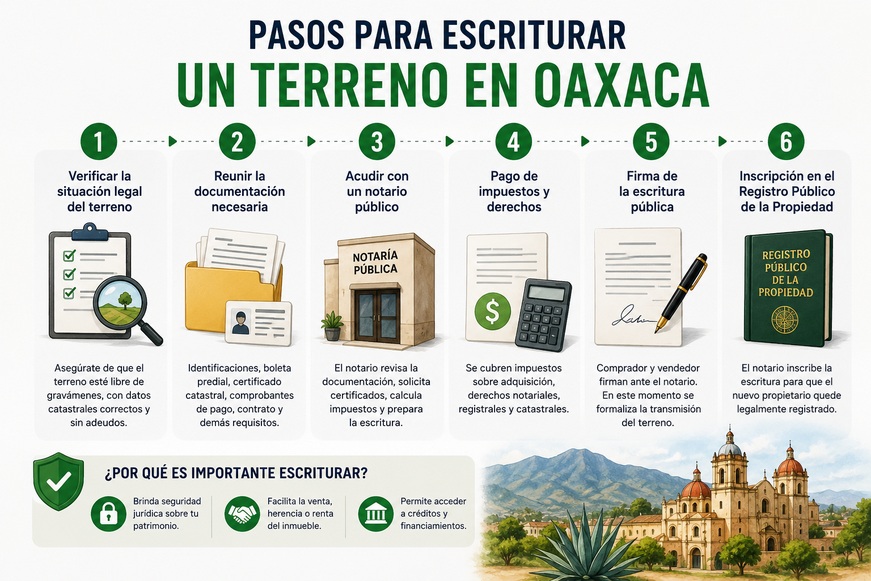
1. Verify the legal status of the lot
Before beginning the process, it is essential to verify that:
- The seller is the legitimate owner.
- The lot is free of liens or legal disputes.
- The cadastral information matches the physical characteristics of the property.
- There are no outstanding property taxes or other unpaid assessments.
This review helps prevent problems later in the deed process.
2. Gather the required documentation
Once the legal status of the lot has been confirmed, all documents required by the notary’s office must be collected.
If there are discrepancies in the measurements, surface area, or cadastral information, corrections or updates may need to be completed with the Oaxaca State Cadastral Institute before the deed process can continue.
3. Consult a notary public
The notary public is responsible for:
- Reviewing the documentation.
- Requesting certificates and registry searches.
- Calculating taxes and government fees.
- Preparing the public deed.
- Certifying the transaction.
The notary will also verify that the property can be legally transferred.
4. Payment of taxes and fees
The deed process involves several costs, including:
- Real estate acquisition tax.
- Property registration fees.
- Cadastral fees.
- Notary fees.
- Certificates and official records.
The total amount depends on the transaction value, the location of the lot, and the rates in effect at the time the procedure is completed.
5. Signing the deed
Once the notarized document has been prepared and the corresponding payments have been made, the buyer and seller appear before the notary to sign the public deed.
At that point, the transfer of the lot is legally formalized.
6. Registration with the Public Registry of Property
After the deed is signed, the notary arranges for it to be recorded.
This step is essential because it makes the legal transaction enforceable against third parties and creates an official record identifying the property owner.
What happens if I only have a private agreement?
Many people possess lots through private purchase agreements, assignments of rights, or possession certificates.
Although these documents may serve as supporting records, they generally do not replace a public deed. Depending on the circumstances, a property regularization process may be required to obtain an ownership title and subsequently complete the deed process. In Oaxaca, certain properties may qualify for regularization programs and procedures administered by specialized state agencies.
Special cases in Oaxaca
Ejido or communal land
Land governed by an ejido or communal property system requires procedures that differ from those applicable to private property.
Before beginning any deed process, it is essential to verify the property’s legal regime and the documentation issued by the corresponding agrarian authorities.
Lots under possession but without a deed
When a person has possessed a lot for several years but does not have a deed, it may be necessary to prove possession through specific documents and complete a property regularization process before obtaining the deed.
How much does it cost to obtain a deed for a lot in Oaxaca?
There is no single fee that applies to every case. The cost depends on factors such as:
- Value of the lot.
- Municipality where it is located.
- Applicable taxes.
- Notary fees.
- Registration fees.
- Required cadastral procedures.
For this reason, the best option is to request a quote directly from a notary’s office, since each transaction may involve different costs.
Tips for avoiding problems during the deed process
- Verify that the lot is properly registered.
- Request certificates showing that the property is free of liens.
- Confirm that the measurements match the cadastral records.
- Keep all payment receipts.
- Complete the procedure only through authorized notaries public.
- Avoid paying large amounts without first obtaining legal advice.
Frequently asked questions
Is it mandatory to use a notary public to obtain a deed for a lot in Oaxaca?
Yes. The public deed must be executed before a notary public for it to have legal validity and subsequently be recorded with the Public Registry of Property. Without this step, the property transfer is not properly formalized.
How long does the deed process take?
The timeframe may vary depending on the complexity of the case, the availability of documents, and the processing times of the cadastral and public registry authorities. Simple transactions usually take several weeks, although some cases may take longer.
Can I obtain a deed for a lot that only has a private agreement?
Yes, but the property’s legal status must first be reviewed. In some cases, it will be necessary to regularize the property or prove possession before obtaining a final public deed.
What documents must the seller provide?
The seller must generally provide the document proving ownership, valid official identification, a current property tax statement, and any other documents requested by the notary to verify the legality of the transaction.
What happens if the lot has errors in its measurements or surface area?
The information must be corrected before the corresponding cadastral authorities. Depending on the circumstances, surveys, boundary determinations, or cadastral update procedures may be required before the deed can be completed.
Does the deed guarantee that I am the legal owner?
Yes. Once the public deed has been executed and recorded with the Public Registry of Property, you have the primary legal document proving your ownership rights over the lot.