Is it expensive to live in Oaxaca?
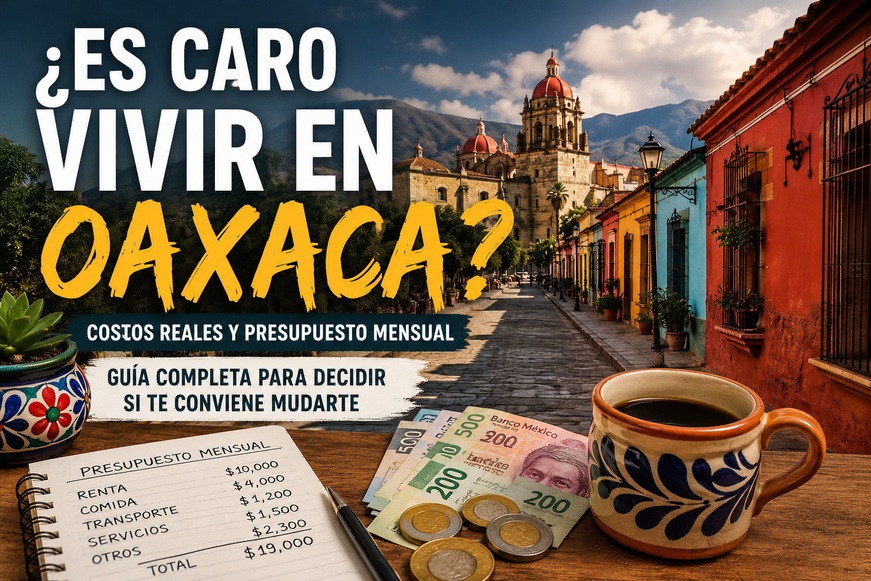
Yes, living in Oaxaca can be expensive, especially if you want to rent in Oaxaca de Juárez, the Historic Center, Jalatlaco, Xochimilco, Reforma, or San Felipe del Agua. Although some daily expenses, such as local food, public transportation, and basic utilities, may be more affordable than in Mexico’s largest cities, rent has increased significantly and is the expense that most raises the cost of living.
The direct answer is: Oaxaca is not always expensive to visit, but it can be expensive to live in, especially if you earn a local income, want centrally located housing, or seek a comfortable lifestyle without moving far from the city.
Quick answer: How much does it cost to live in Oaxaca?
A single person may need approximately $12,000 to $25,000 pesos per month to live in Oaxaca, depending on the area, type of housing, and lifestyle.
In general:
- Tight budget: $10,000 to $14,000 pesos per month.
- Moderate budget: $15,000 to $25,000 pesos per month.
- Comfortable budget: $26,000 pesos or more per month.
- Family of 3 or 4: from $35,000 to more than $50,000 pesos per month, depending on rent, school, transportation, and food.
Living in Oaxaca is more expensive when you rent near downtown, frequently eat at tourist restaurants, or depend on taxis and a private car. It is more affordable if you live in outlying areas, shop at local markets, and have a stable income.
Why has Oaxaca become more expensive?
Oaxaca has become more expensive because of a combination of factors: increased tourism demand, growth in short-term accommodations, the arrival of digital nomads, real estate investment, and a shortage of affordable housing in central areas.
The problem is not simply that there are more visitors. The key issue is that many properties that were previously rented to local families are now used for short-term rentals, tourist accommodations, restaurants, boutique hotels, or furnished apartments for short stays.
This has made living in traditional areas of Oaxaca de Juárez increasingly difficult for people earning local incomes.
Rent: the largest expense in Oaxaca
Rent is the main factor that determines whether Oaxaca will be expensive or affordable for you.
In central or high-demand areas, a small apartment may cost considerably more than in neighborhoods farther away. In areas such as the Historic Center, Jalatlaco, Xochimilco, Reforma, or San Felipe del Agua, prices can rise quickly because of tourism and residential demand.
Approximate rental prices in Oaxaca
These are approximate ranges for Oaxaca de Juárez and the surrounding area:
- Basic room or bedroom: $3,000 to $6,000 pesos per month.
- Small apartment outside downtown: $7,000 to $10,000 pesos per month.
- One-bedroom apartment in a central area: $10,000 to $15,000 pesos per month.
- Large apartment or house in a high-demand area: $18,000 to $35,000 pesos per month.
- Premium properties in high-appreciation areas: may exceed $50,000 pesos per month.
In practice, the difference between living downtown and living on the outskirts can be substantial. Downtown offers proximity, cultural life, restaurants, and walkability, but it also has higher prices. Outlying areas may be less expensive, although they sometimes require longer commutes, offer less access to services, or have water supply problems.
How much does food cost in Oaxaca?
Eating in Oaxaca can be inexpensive or costly depending on where you shop and eat.
If you shop at markets, cook at home, and buy local products, your expenses can remain moderate. However, if you frequently eat at downtown restaurants, specialty coffee shops, or tourist areas, your budget can increase quickly.
Approximate food expenses
- Set lunch or simple menu: $80 to $150 pesos.
- Meal at an inexpensive restaurant: $120 to $180 pesos.
- Meal for two at a mid-range restaurant: $500 to $800 pesos.
- Coffee or cappuccino: $45 to $70 pesos.
- Monthly groceries for one person: $3,000 to $5,500 pesos.
- Monthly groceries for a couple: $6,000 to $9,000 pesos.
One advantage of Oaxaca is that it still has markets, small local restaurants, and traditional food options at reasonable prices. The disadvantage is that tourist areas have raised the price of coffee, breakfast, dinner, and dining experiences.
Transportation: affordable if you use public routes, expensive if you depend on taxis
Public transportation in Oaxaca can be inexpensive, but it is not always comfortable, fast, or sufficient for every area. If you live near your workplace or main activities, you can save considerably. If you live far away and depend on taxis, motorcycle taxis, apps, or a private car, your monthly expenses increase.
Common transportation costs
- Public transportation per trip: approximately $10 pesos.
- Short taxi ride: from $60 to $100 pesos, depending on the area and time.
- Gasoline: approximately $25 pesos per liter.
- Monthly public transportation expenses: $500 to $1,200 pesos.
- Monthly expenses when frequently using taxis: $2,500 pesos or more.
Living far from downtown may reduce your rent, but it may also increase transportation expenses. For this reason, you should calculate the full cost, not only the monthly rent.
Basic utilities, internet, and water
Basic utilities in Oaxaca are generally manageable, although they depend greatly on the type of housing. In many cases, the main problem is not only the cost but also availability.
Water is an important issue. Some neighborhoods have an irregular supply, and families must purchase water from tanker trucks, which increases monthly expenses. This should be checked before renting.
Approximate monthly expenses
- Home internet: $400 to $700 pesos.
- Cell phone plan: $200 to $500 pesos.
- Electricity, water, gas, and basic maintenance: $800 to $2,000 pesos.
- Water delivery by tanker truck, if needed: variable cost depending on the neighborhood and consumption.
Before moving, ask how often water is supplied, whether the property has a cistern, rooftop water tank, or pump, and whether water service is included in the rent.
Expensive areas to live in Oaxaca
The most expensive areas are usually the most central, tourist-oriented, or residential. These include:
- Historic Center
- Jalatlaco
- Xochimilco
- Reforma
- San Felipe del Agua
- Bosque San Felipe
- Rufino Tamayo
- Certain areas of San Andrés Huayápam and Etla
These areas are attractive because they offer better locations, urban appearance, restaurants, coffee shops, services, perceived safety, or proximity to green spaces. However, they are also the areas that have experienced the greatest real estate pressure.
More affordable areas to live in Oaxaca
If you want to spend less, consider areas outside the main tourist districts. More affordable options can often be found in nearby municipalities or neighborhoods such as:
- Santa Cruz Xoxocotlán
- San Jacinto Amilpas
- Santa Lucía del Camino
- San Sebastián Tutla
- Tlalixtac de Cabrera
- Ánimas Trujano
- Certain areas of Etla
These areas may offer lower rents, but you should evaluate transportation, safety, water supply, commute times, and access to services. A low rent may become expensive if it requires substantial spending on taxis, gasoline, or water delivery.
Is Oaxaca expensive compared with other Mexican cities?
Oaxaca may be less expensive than Mexico City, Monterrey, or certain areas of Guadalajara when comparing transportation, local food, and some services. However, central housing may feel equally or even more expensive in relation to local incomes.
The important issue is the proportion between rent and income. A rent of $12,000 pesos may seem normal to someone earning a remote salary from another city or country, but it may be very high for someone earning a local salary.
For this reason, Oaxaca is perceived in two different ways:
- For tourists or people with outside income, it may seem affordable.
- For residents earning local incomes, it may feel increasingly expensive.
Monthly budget for living in Oaxaca
Tight budget for one person
This budget applies to someone renting a room or simple apartment, cooking at home, and using public transportation.
- Rent: $4,000 to $7,000
- Food: $3,000 to $4,500
- Utilities and internet: $800 to $1,500
- Transportation: $500 to $1,000
- Personal expenses: $1,500 to $2,500
Approximate total: $10,000 to $16,500 pesos per month.
Moderate budget for one person
This scenario includes a small apartment, occasional outings, and greater comfort.
- Rent: $8,000 to $13,000
- Food: $4,500 to $6,500
- Utilities and internet: $1,200 to $2,000
- Transportation: $1,000 to $2,500
- Personal expenses and entertainment: $2,500 to $5,000
Approximate total: $17,000 to $29,000 pesos per month.
Budget for a couple
A couple may save money by sharing rent and utilities, but expenses increase if they want to live in a central area.
- Rent: $10,000 to $18,000
- Food: $7,000 to $10,000
- Utilities and internet: $1,500 to $2,500
- Transportation: $1,500 to $4,000
- Personal expenses: $5,000 to $8,000
Approximate total: $25,000 to $42,500 pesos per month.
Budget for a family
A family must consider larger housing, school, healthcare, transportation, and higher food consumption.
- Rent: $14,000 to $25,000
- Food: $10,000 to $16,000
- Utilities and internet: $2,000 to $4,000
- Transportation: $3,000 to $7,000
- School, healthcare, and family expenses: $8,000 to $18,000
Approximate total: $37,000 to $70,000 pesos per month.
Is moving to Oaxaca worthwhile?
Moving to Oaxaca may be worthwhile if you are looking for a city with a rich cultural life, excellent food, pleasant weather, traditions, walkability in certain areas, and access to nature. However, it should not be idealized: living there is not the same as visiting for a few days.
Before moving, consider:
- Having a stable income before arriving.
- Reviewing several areas, not only downtown.
- Asking about the water supply.
- Calculating the real transportation cost from your home.
- Comparing annual rent, not only monthly rent.
- Avoiding informal agreements or contracts without clear terms.
- Trying living there for one month before making a permanent decision.
Oaxaca can be an excellent city to live in if your budget is calculated carefully. A common mistake is assuming that, because it is located in southern Mexico, it will automatically be inexpensive.
So, is living in Oaxaca expensive?
Yes, living in Oaxaca is expensive if you want to live in central, tourist, or residential areas, especially if you depend on a local salary. Rent is the expense that has increased the most and has the greatest impact on the monthly budget.
However, Oaxaca may still be affordable if you choose the area carefully, cook at home, shop at local markets, reduce travel, and have a stable income. To live comfortably, a single person should consider at least $18,000 to $25,000 pesos per month. Living on less will require moving away from downtown and adjusting your lifestyle.
The best conclusion is this: Oaxaca is not inexpensive or expensive for everyone; it is a city with highly unequal prices. It may be affordable for someone living simply and away from the most sought-after areas, but it can be very expensive for someone seeking a central location, comfortable housing, and reliable services.
Frequently asked questions about living in Oaxaca
How much money do I need to live in Oaxaca?
A single person needs approximately $12,000 to $25,000 pesos per month, depending on the area and lifestyle. With shared rent and controlled expenses, it is possible to live on less, but for a comfortable lifestyle in Oaxaca de Juárez, a budget closer to $20,000 pesos per month is advisable.
What is the most expensive cost of living in Oaxaca?
Rent is the most expensive cost, especially in areas such as the Historic Center, Jalatlaco, Reforma, Xochimilco, and San Felipe del Agua. Prices have increased because of tourism demand, short-term rentals, and the arrival of people earning outside incomes, which has reduced affordable housing options for local residents.
Is Oaxaca a good city to live in?
Oaxaca can be an excellent city to live in if you value culture, food, a relaxed lifestyle, traditions, and proximity to nature. However, you should also consider issues such as high rents, low local wages, irregular water supply, and limited transportation in certain areas.
Where is it cheaper to live in Oaxaca?
The most affordable areas are generally outside downtown, in municipalities such as Santa Cruz Xoxocotlán, San Jacinto Amilpas, Santa Lucía del Camino, or certain areas of Etla. Before choosing, evaluate commute times, safety, water availability, and the actual cost of transportation.
Is living in Oaxaca’s Historic Center worthwhile?
Living in the Historic Center may be worthwhile if you want to walk, stay close to restaurants, culture, work, or tourist activities. However, it is generally one of the most expensive and competitive areas. For many people, living near downtown rather than inside it may offer a better balance between price and quality of life.
Is Oaxaca inexpensive for foreigners or digital nomads?
For foreigners or digital nomads earning income in dollars, euros, or salaries from large cities, Oaxaca may seem affordable. For people earning local incomes, the same prices may be high. This difference in purchasing power is one of the reasons housing has become more expensive.