Real Estate in Puerto Escondido: A Guide for Foreign Buyers

Foreign nationals can buy real estate in Puerto Escondido, Oaxaca, including houses, apartments and land. However, because Puerto Escondido is on the coast, purchasing residential property generally requires a Mexican bank trust (fideicomiso) under Mexican law.
Puerto Escondido has become an appealing destination for international buyers seeking a second home, a retirement property, a vacation home, or a real estate investment.
Its beaches, tourism offerings, and connections to other destinations in Oaxaca appeal to buyers from the United States, Canada, Europe, and elsewhere.
Nevertheless, buying property in Mexico as a foreign national means understanding constitutional restrictions, verifying the property's legal status, and accounting for the costs involved in the transaction.
This guide explains how foreign buyers can purchase property in Puerto Escondido, which documents they need, how the bank trust works, and the main risks to avoid.
Can Foreigners Buy Property in Puerto Escondido?
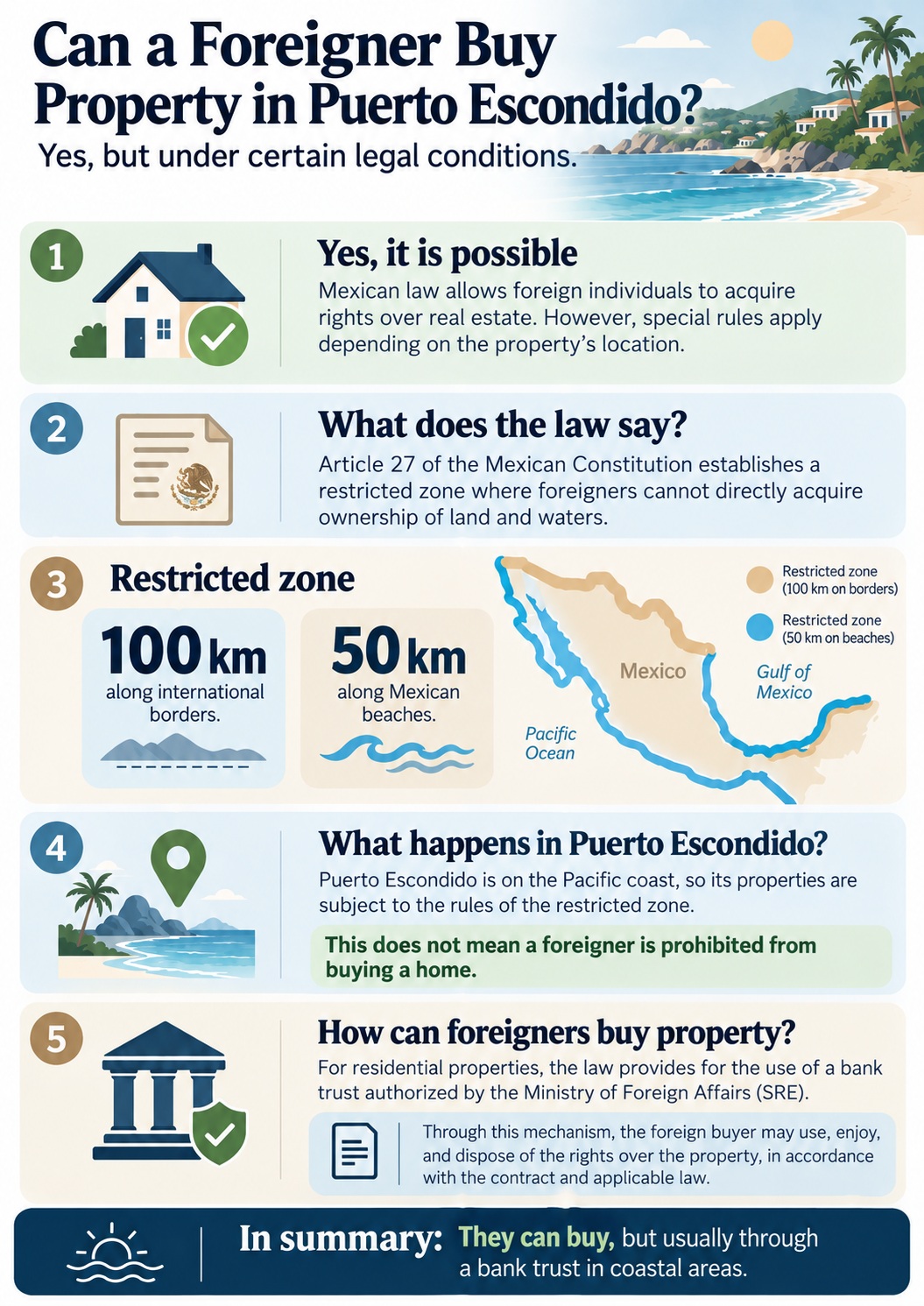
Yes. Mexican law allows foreign nationals to acquire rights to real estate, although specific requirements apply depending on the property's location.
Article 27 of the Political Constitution of the United Mexican States establishes a restricted zone in which foreigners cannot directly acquire ownership of land and waters.
This zone extends:
-
100 kilometers along Mexico's international borders.
-
50 kilometers inland from Mexico's coastlines.
Puerto Escondido is on the Pacific coast, so properties there are subject to restricted-zone regulations.
This does not mean that foreigners are prohibited from buying a home.
For residential properties, Mexican law provides for the use of a bank trust (fideicomiso) authorized by the Ministry of Foreign Affairs (SRE).
Through this arrangement, a foreign buyer may use, enjoy, and exercise the rights granted over the property, subject to the trust agreement and applicable law.
What Is a Real Estate Bank Trust (Fideicomiso), and How Does It Work in Mexico?
A fideicomiso is a legal arrangement that allows foreigners to acquire rights to residential properties located within Mexico's restricted zone.
Three main parties are involved:
-
Settlor (fideicomitente): the party transferring the property or rights into the trust, usually the seller.
-
Trustee (fiduciario): a Mexican banking institution authorized to hold legal title to the property in trust.
-
Beneficiary (fideicomisario): the foreign buyer who receives the benefits and rights established in the trust agreement.
The bank holds legal title as trustee, while the foreign buyer may exercise the rights established in the trust.
What Can a Foreigner Do With Property Held in a Bank Trust?
Depending on the agreement, applicable law, and relevant authorizations, the beneficiary may:
-
Live in the property.
-
Use it as a second home.
-
Rent it to third parties.
-
Make authorized improvements and renovations.
-
Transfer their rights.
-
Sell the property through the applicable procedures.
-
Name successor beneficiaries for inheritance purposes.
The trust does not make the bank an owner free to use the home for its own purposes.
The trustee bank must act in accordance with the trust agreement and its legal obligations.
How Long Does a Real Estate Bank Trust Last?
Mexico's Foreign Investment Law establishes a maximum initial term of 50 years for trusts created within the restricted zone.
The law provides a procedure for extending that term.
Therefore, the 50-year term does not automatically mean the buyer loses their rights when the initial period expires, provided the required extension procedures are completed on time.
Extensions must be arranged in accordance with the applicable legal and contractual requirements.
Is It Safe to Buy Property Through a Fideicomiso?
A fideicomiso is a mechanism recognized under Mexican law.
However, holding property through a bank trust does not, by itself, guarantee that the property is free of legal issues.
Before establishing the trust, buyers need to verify the seller's ownership, any liens or encumbrances, the property's title and registration history, and whether it can legally be transferred.
The trust agreement's obligations, fees, powers, and termination provisions should also be carefully reviewed.

Can Foreigners Buy Property Directly Without a Bank Trust?
That depends on the property's location and intended use.
Outside the restricted zone, foreigners may purchase real estate directly, subject to the applicable constitutional, administrative, and legal requirements.
Inside the restricted zone, including Puerto Escondido, foreign individuals generally purchase residential property through a fideicomiso.
Another option requires a different legal analysis: a Mexican corporation.
Buying Through a Mexican Corporation
The Foreign Investment Law establishes specific rules for Mexican companies with foreign ownership.
Under certain conditions, these companies may directly acquire properties intended for nonresidential use in the restricted zone, subject to applicable notices and requirements.
However, forming a company is not an automatic solution for buying a home for personal use.
A corporation carries corporate, accounting, and tax obligations, along with restrictions related to the property's intended use.
Before choosing a Mexican corporation instead of a bank trust, it is essential to review the proposed structure with an attorney and tax advisor.
How to Buy a Home in Puerto Escondido as a Foreigner: Step by Step
The buying process can be divided into several stages. Although requirements vary by property, the following steps outline the main checks involved.
Step 1. Define Your Buying Goals
Before looking for properties, decide whether you want to buy in order to:
-
Live in Mexico permanently.
-
Spend vacations or part of the year there.
-
Retire in Puerto Escondido.
-
Earn rental income.
-
Build a home.
-
Hold a long-term real estate investment.
Your goals will influence your choice of neighborhood, property type, budget, and legal ownership structure.
For example, a vacation rental requires a different assessment from a family residence.
Step 2. Set Your Total Budget
A property's advertised price is not necessarily its final acquisition cost.
In addition to the purchase price, you should budget for notary fees, taxes, registration fees, and costs associated with the bank trust.
If you are buying from abroad, you may also incur bank charges, currency conversion costs, and professional fees.
Before signing, request a written estimate covering every expense.
Step 3. Choose a Property and Evaluate Its Location
Puerto Escondido offers different types of real estate, from completed homes to lots intended for residential development.
Evaluate the location based on:
-
Legal access to the property.
-
Availability of water and electricity.
-
Road infrastructure.
-
Medical and commercial services.
-
Safety conditions.
-
Zoning and permitted land use.
-
Natural hazards.
-
Distance to places of interest.
It is also advisable to visit the property in person or hire an independent inspector.
Step 4. Conduct Legal Due Diligence Before Paying Any Money
This is one of the most important stages.
The review must confirm that the seller has the legal right and authority to transfer the property.
Documents to examine include:
-
The notarized deed or property title.
-
Records from the Public Registry of Property.
-
A certificate showing whether any liens or encumbrances exist.
-
The seller's identification.
-
Cadastral records.
-
Property tax status.
-
Surveys, measurements, and property boundaries.
-
Building permits, where applicable.
-
Agrarian land tenure documents, where applicable.
You should also determine whether any dispute or restriction could prevent the sale from going through.
Step 5. Make an Offer or Sign a Preliminary Agreement
Once you have sufficient information about the property, you can negotiate the price and terms of the transaction.
If you sign a purchase commitment or preliminary agreement, clearly establish:
-
The price and payment currency.
-
The payment schedule.
-
Conditions for establishing the bank trust.
-
Documents the seller must provide.
-
The expected closing and deed-signing date.
-
Responsibility for fees and taxes.
-
What happens if legal problems are discovered.
-
Conditions for refunding the deposit.
Significant payments should ideally be conditional on completing the agreed legal checks.
Step 6. Arrange the Bank Trust
For a residential purchase within the restricted zone, you must select an authorized trustee bank.
The process requires information about the buyer, seller, and property.
The relevant permit application is filed with Mexico's Ministry of Foreign Affairs through the official channels.
Required details include the property's location, area, boundaries, purpose of the trust, and information about the parties.
The notary and trustee bank generally help coordinate the process.
Step 7. Sign the Public Deed Before a Notary
A Mexican notary public must be involved in formally completing the transaction.
The notary reviews transaction documents, participates in formalizing the legal act, and carries out the procedures required under applicable law.
When a bank trust is used, the trust agreement must be formalized in a public deed.
The final documents must accurately reflect the rights acquired, the parties involved, and the property's characteristics.
Step 8. Confirm Registration and Keep Your Documents
After signing, follow up to ensure the relevant legal acts are properly registered.
Request copies of the final documents and keep proof of payments, taxes, and government fees.
It is also wise to keep track of future obligations, such as property tax, maintenance, and trustee bank fees.
What Documents Does a Foreigner Need to Buy Property?
The specific documents depend on the trustee bank, the notary, the transaction, and the buyer's circumstances.
You may generally be asked for:
|
Document |
Purpose |
|---|---|
|
Valid passport |
Verify identity and nationality |
|
Proof of address |
Identification and bank compliance requirements |
|
Tax information |
Comply with applicable obligations |
|
Source-of-funds information |
Bank verification and anti-money-laundering compliance |
|
Marital status documents |
Determine property rights and marital assets, where relevant |
|
Successor beneficiary details |
Establish succession provisions within the trust |
|
Banking documents |
Process and verify the transaction |
Depending on the situation, additional documents, translations, legalization, or apostilles may be required.
Request the exact list of requirements in advance to avoid delays.
How Much Does a Fideicomiso Cost for Foreigners in Mexico in 2026?
Establishing a bank trust can involve several expenses.
One is the government fee for the permit issued by the Ministry of Foreign Affairs.
According to the SRE's published 2026 information, the permit to establish a trust in the restricted zone involves the following government fees:
|
Item |
Published amount |
|---|---|
|
Receipt and review of the application |
$10,510 MXN |
|
Issuance of the permit |
$21,650 MXN |
These amounts are government fees and do not necessarily represent the full cost of establishing a fideicomiso.
Additional expenses may include trustee bank fees, notary fees, registration charges, and other costs related to the purchase.
Does a Fideicomiso Have an Annual Fee?
Yes. Trustee banks generally charge fees to administer the trust.
However, there is no single annual rate that applies to every bank or transaction.
The amount depends on each bank's terms and the agreement signed.
Before choosing a bank, request written details of:
-
Initial trust setup fee.
-
Annual administration fee.
-
Fees for amendments.
-
Costs of changing beneficiaries.
-
Fees for assigning rights.
-
Costs associated with terminating the trust.
Do not confuse these bank fees with government charges.
What Taxes Do Foreigners Pay When Buying Property in Oaxaca?
Buying real estate in Mexico may create tax obligations regardless of the buyer's nationality.
One of the most important is the local real estate acquisition tax. Its calculation must be verified based on current law and the specific circumstances of the transaction.
Additional expenses may include:
-
Notary fees.
-
Appraisal fees.
-
Public Registry fees.
-
Certificates and official records.
-
Bank trust establishment.
-
Registration of the relevant legal acts.
It is not appropriate to automatically apply a fixed percentage to every transaction without reviewing the relevant tax law and the legally applicable valuation.
Taxes After Purchasing
Owning a property or holding beneficial rights in it can create ongoing obligations.
These include property tax and, if the property generates income, taxes on rental earnings.
If the property is rented to tourists, lodging-related taxes, value-added tax (VAT), and income tax may apply, depending on the activity and tax regime.
Foreign nationality does not remove these obligations.
Buyers must also consider the tax rules in their country of residence, since some jurisdictions require the reporting of certain foreign-held assets or income.
Can Foreigners Buy Ejido Land in Puerto Escondido?
This is one of the areas that requires particular caution when investing on Oaxaca's coast.
Mexico has several forms of land tenure, including private, ejido, and communal ownership.
Ejido land should not be treated as privately owned land backed by a deed registered with the Public Registry of Property.
Rights to ejido parcels are governed by the Agrarian Law, including restrictions on who may acquire them and the procedures required to transfer them.
What Is Full Ownership (Dominio Pleno)?
Dominio pleno is a legal process through which certain ejido parcels can become private property after the applicable requirements have been met.
The process may involve assembly resolutions, procedures before the National Agrarian Registry (RAN), issuance of titles, and registration with the Public Registry of Property.
However, not all ejido parcels can be converted automatically, and communal lands do not necessarily follow the same process.
For foreign buyers, it is essential to confirm that the land can legally be transferred under the proposed acquisition structure.
Warning Signs When Buying Land
Before making any payment, be especially cautious if:
-
The seller only provides a certificate of possession.
-
An ejido parcel is marketed as though it were privately owned land.
-
The transaction depends on future regularization with no guarantees.
-
There is insufficient documentation to identify the legal rights holder.
-
The seller promises a deed only after full payment.
-
The advertised area does not match the documents.
-
The land has access or boundary disputes.
A property with irregular documentation may be difficult to finance, resell, build on, or legally transfer.
Best Areas of Puerto Escondido for Foreign Buyers
Puerto Escondido has a variety of residential and tourist areas. The best location depends on your budget, lifestyle, and investment goals.
Bacocho: Residential Homes and Second Homes
Bacocho may appeal to buyers looking for a residential property near the coast.
The area offers homes, lots, and properties suitable for permanent or vacation use.
Before buying, check access to utilities, the property's condition, and its legal status.
Rinconada: Amenities and Residential Living
Rinconada combines shops, restaurants, and convenient access to several attractions.
It may suit foreigners who want to settle in Puerto Escondido while remaining close to everyday amenities.
Consider traffic, street conditions, and the immediate surroundings of each property.
La Punta Zicatela: Tourism and Vacation Rental Investment
La Punta is known for its tourist atmosphere, restaurants, and surfing culture.
It may interest buyers seeking a vacation property or a rental investment.
However, tourism appeal does not guarantee profitability.
Before investing, check the documentation, permits, utility availability, and competition among rental properties.
Zicatela: Tourism-Oriented Properties
Zicatela is one of the areas internationally recognized for its surfing scene.
Its characteristics may appeal to buyers interested in accommodations and commercial ventures.
However, prospective buyers should assess tourism demand, land-use restrictions, and operating expenses before purchasing.
Centro: Access to Shops and Services
Centro may be convenient for buyers who prioritize everyday living and easy access to businesses.
Depending on the location, properties may be available for residential and various business uses.
The decision should account for the property's condition, access, noise, and the surrounding area.
Is Investing in Puerto Escondido Real Estate Profitable?
Puerto Escondido has attracted interest due to its tourism activity, natural attractions, and regional accessibility.
The Barranca Larga–Ventanilla highway, inaugurated in 2024, improved road connections with Oaxaca City and is an important factor in regional accessibility.
However, real estate profitability depends on factors that must be evaluated individually.
These include:
-
Purchase price.
-
Property location and characteristics.
-
Demand for housing or accommodations.
-
Actual rental income.
-
Operating and maintenance costs.
-
Applicable taxes.
-
Vacancy periods.
-
Competition in the real estate market.
-
Resale potential.
Buying to Live In vs. Buying to Rent Out
A property intended as a permanent residence is assessed primarily for comfort, services, accessibility, and quality of life.
By contrast, a vacation rental investment requires estimates of revenue, occupancy, management, and expenses.
For example, a home near tourist attractions may appeal to visitors but may not offer the residential environment a retiree is looking for.
Marketing projections of property appreciation should not be mistaken for guaranteed returns.
Can You Buy Property in Mexico Without Living There?
Yes. A foreign national may purchase real estate without necessarily making Mexico their primary place of residence.
However, the transaction must comply with all applicable legal, banking, tax, and notarial requirements.
In some circumstances, it may be possible to act through a duly authorized representative.
Powers of attorney executed abroad must meet the formal requirements necessary to be valid for use in Mexico.
It is also important to distinguish purchasing a home from obtaining immigration authorization to live in the country.
Being a beneficiary of a real estate bank trust does not automatically grant temporary or permanent residency in Mexico.
Immigration status is handled under separate requirements.
Common Mistakes Foreigners Make When Buying Property in Mexico
Paying a Deposit Without Verifying the Property
Never assume that a property listing or private contract guarantees a legitimate transaction.
Before transferring significant funds, verify the seller's identity, the property documents, and the payment conditions.
Assuming a Fideicomiso Solves Every Legal Problem
A bank trust is an ownership arrangement, not a way to automatically correct defective deeds, lawsuits, or agrarian land disputes.
Legal due diligence must take place before the transaction is finalized.
Failing to Account for Additional Costs
Acquisition costs can significantly change your overall budget.
Also account for annual bank fees, maintenance, taxes, and potential expenses in your country of residence.
Buying Pre-Construction Property Without Researching the Developer
Pre-construction purchases require a review of the land's legal status, permits, project specifications, and contractual obligations.
You should also assess what would happen in the event of delays, changes, or failure to perform.
Relying on Promises of Returns
Marketing claims about guaranteed appreciation or rental income should be supported by contracts and verifiable evidence.
A real estate investment can generate profits, but it can also result in losses.
Skipping Independent Legal Advice
A real estate agent can help with your property search and negotiations, but that does not replace an independent attorney's review or the notary's role.
Working with qualified professionals reduces the risk of overlooking important issues.
Checklist for Foreign Property Buyers in Puerto Escondido
Before closing a transaction, confirm that:
Frequently Asked Questions About Buying Property in Puerto Escondido as a Foreigner
Can Americans or Canadians Buy a Home in Puerto Escondido?
Yes. U.S., Canadian, and other foreign nationals may acquire rights to residential properties in Puerto Escondido through arrangements allowed under Mexican law. Because the city is on the coast, a bank trust (fideicomiso) is generally used. Buyers should verify the property's legal history and the applicable requirements before purchasing.
Do I Need Mexican Residency to Buy Property?
Not necessarily. Buying real estate and obtaining immigration residency are separate processes. Foreigners may acquire property rights in compliance with applicable laws even if they normally live in another country. Banks, notaries, and authorities may nevertheless require additional documents depending on the transaction.
Can I Buy Property in Puerto Escondido From the United States?
Yes. Some stages of the purchase process may be handled remotely through duly authorized representatives and legally valid arrangements. However, powers of attorney, contracts, and other documents must meet the formal requirements applicable in Mexico. Coordinate with the trustee bank and notary in advance to identify any steps that require your personal participation.
What Happens to My Property When the 50-Year Trust Term Ends?
Mexican law provides procedures to extend the term of a fideicomiso. It is therefore important to check the expiration date and arrange an extension in time, in accordance with the applicable requirements. Do not assume the trust renews automatically or leave the process until after its expiration.
Can I Rent Out My Puerto Escondido Home on Airbnb as a Foreigner?
In principle, property held through a bank trust may be rented out if the trust agreement, authorizations, and applicable regulations allow it. However, you must review tax obligations, lodging regulations, and any restrictions affecting the property or development. The ability to list a property does not guarantee rental profitability.
Which Is Safer for a Foreign Buyer: Land or a Completed Home?
Both can be legally viable, but they involve different risks. With a completed home, you can inspect its physical condition; with land, you must pay particular attention to zoning, utilities, and whether construction is legally and practically feasible. In either case, verifying ownership, registration history, and the legal conditions of the acquisition is essential.
Conclusion: How to Invest in Puerto Escondido as a Foreigner
Buying real estate in Puerto Escondido as a foreign national is legally possible and may be an attractive option for those seeking a residence, vacation home, or long-term property investment.
However, a location's tourist appeal is no substitute for legal and financial due diligence.
For residential purchases in the restricted zone, the bank trust is one of the most important legal mechanisms. Establishing it should go hand in hand with a thorough review of the property and the terms of the transaction.
It is also essential to distinguish between privately owned, ejido, and communal land, particularly when exploring investments along the Oaxaca coast.
The key to buying more safely is to verify the property first, understand the legal ownership structure, and calculate the full acquisition cost before committing money.
With sufficient information and professional guidance, foreign buyers can make better-informed decisions about investing in Puerto Escondido real estate.