Risks of Buying Cheap Land on the Oaxaca Coast
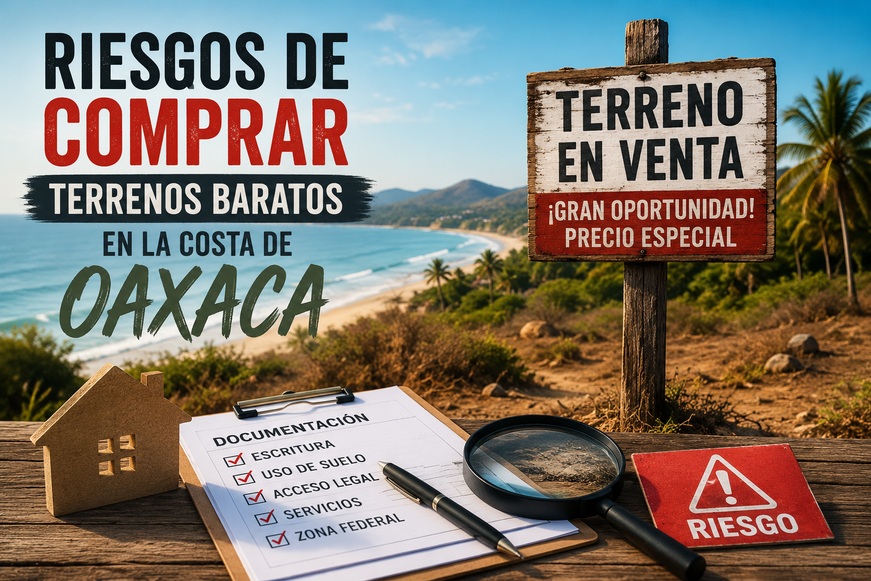
The risks of buying inexpensive land on the Oaxaca coast usually arise when an attractive price conceals legal problems, a lack of utilities, environmental restrictions, ejido disputes, or a genuine inability to build. Before investing, it is essential to verify that the property has legal certainty, legal access, compatible land use, and properly registered documentation.
Buying a lot in areas such as Puerto Escondido, Mazunte, Zipolite, Huatulco, Chacahua, or nearby communities may seem like an excellent opportunity, especially when the price is significantly below market value. However, not every inexpensive property on the Oaxaca coast is a good investment.
Some properties cannot be deeded, others are governed by an ejido system, some are located in protected areas or federal zones, and others lack water, electricity, drainage, roads, or construction permits. Therefore, the real cost of inexpensive land is not always the purchase price, but what may happen afterward.
Why is some land on the Oaxaca coast so inexpensive?
Land may be sold at a low price for legitimate reasons: it is far from the beach, has no utilities, requires investment in access, or is located in an area with little development. However, the low price may also be caused by a hidden risk.
The most common reasons include:
- Lack of a public deed.
- Ejido land without full ownership status.
- A promise of sale without sufficient legal validity.
- Problems involving measurements and boundaries.
- Lack of legal access.
- Environmental restrictions.
- Lack of residential or tourism land use authorization.
- Encroachments or community disputes.
- Location within or near a federal zone.
- Nonexistent basic utilities or utilities that are extremely expensive to install.
A low price does not always mean an opportunity. In real estate, especially in coastal areas, it may be a warning sign.
Direct answer: Is it safe to buy inexpensive land on the Oaxaca coast?
Buying inexpensive land on the Oaxaca coast can be safe only when the property has verifiable documents, a legitimate owner, correct measurements, compatible land use, legal access, and a realistic possibility of obtaining a deed. If any of these elements are missing, the risk of fraud, financial loss, or an inability to build increases considerably.
Main risks of buying inexpensive land on the Oaxaca coast
1. Buying ejido land without understanding its limitations
One of the most common risks is buying ejido land while believing that you are acquiring private property. Many communities in Oaxaca have ejido or communal land, and not all of it can be sold like ordinary private property.
Ejido land may have certificates, records, or internal agreements, but these are not always equivalent to a public deed recorded with the Public Registry of Property.
Before purchasing, verify:
- Whether the land is ejido, communal, or private property.
- Whether it has full ownership status.
- Whether it is properly registered.
- Whether the ejido assembly legally authorized the change in ownership regime, when applicable.
- Whether the seller is genuinely authorized to transfer the rights.
Purchasing ejido rights without reviewing their legal status may leave you without a deed, unable to obtain mortgage financing, and facing difficulties when reselling.
2. Signing an assignment of rights while believing it is a deed
On the Oaxaca coast, it is common to find offers where the sale is promised through an “assignment of rights,” a “private agreement,” or a “possession certificate.” These documents may be useful in certain situations, but they do not automatically replace a public deed.
The problem is that many people purchase believing that they are already the owners when, in reality, they only have a private document that may be difficult to enforce against third parties.
A secure purchase should undergo notarial review, verification of the owner, and, when dealing with private property, registration with the corresponding Public Registry.
Quotable section: private document vs. public deed
A private agreement or assignment of rights does not provide the same security as a registered public deed. The deed formally proves the transfer of ownership, while a private document may require additional procedures to prove rights, correct the legal history, or regularize the property.
3. The seller may not be the true owner
Another significant risk is purchasing from someone who does not hold legal title to the property. This may occur when the seller is only the possessor, an heir whose rights have not been regularized, an intermediary, a relative of the owner, or a representative without sufficient legal authority.
Before providing any money, review:
- The seller’s official identification.
- The deed or underlying legal document.
- Whether the owner’s name matches the seller’s name.
- A power of attorney, if a representative is selling.
- The property’s registration history.
- The inheritance status, if the owner has died.
- Outstanding debts or liens.
If the seller pressures you to close quickly, requests cash deposits, or avoids notarial review, the most prudent decision is to stop the transaction.
4. Problems involving measurements, boundaries, and actual location
For inexpensive properties, the advertised measurements do not always match the physical or legal reality. There may be discrepancies between what the seller states, what appears on surveys, what neighboring owners occupy, and what the registry recognizes.
This may cause boundary disputes, partial encroachments, loss of square meters, or an inability to build according to the intended project.
Before purchasing, request:
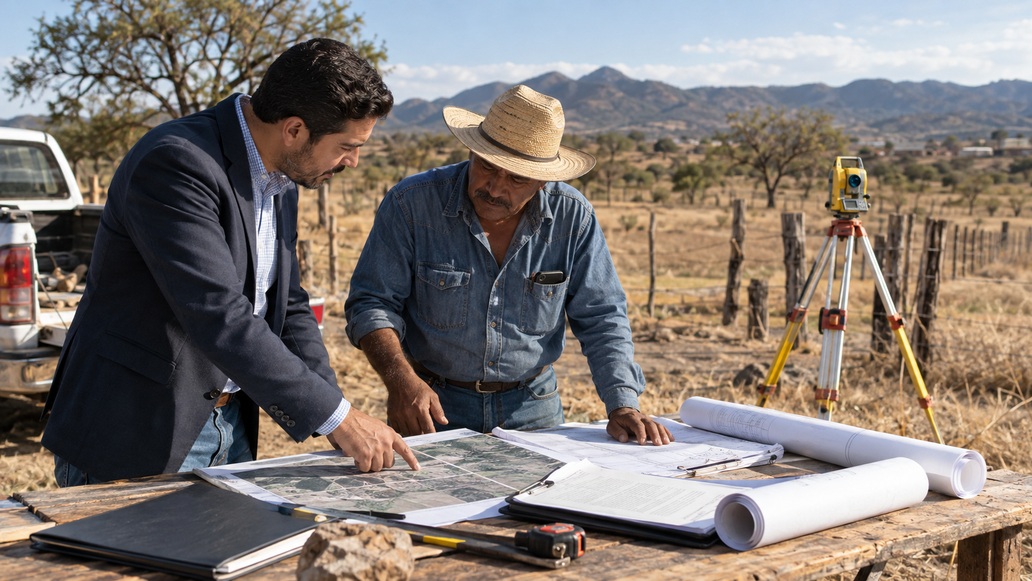
- A current topographic survey.
- A survey with coordinates.
- A boundary review.
- A physical inspection of the property.
- A comparison between the deed, survey, and physical reality.
- A technical opinion from a local surveyor.
An “inexpensive” property may no longer be inexpensive if you later have to pay for lawsuits, walls, corrections, or agreements with neighbors.
5. Lack of legal access to the property
The existence of a trail, dirt road, or passage used by neighbors is not enough. Access must be legally recognized. Some properties are sold cheaply because they are landlocked or depend on informal permission for entry.
This risk is particularly significant in rural areas, beaches, hills, or communities where access arrangements change according to internal agreements.
Before purchasing, confirm:
- Whether the property borders a public road.
- Whether a formal right-of-way easement exists.
- Whether the access is documented.
- Whether machinery can enter.
- Whether the road remains passable during the rainy season.
- Whether there are community disputes over access.
Land without legal access may be difficult to use, develop, rent, or sell.
6. Restrictions related to the Federal Maritime-Terrestrial Zone
In Mexico, beaches and the Federal Maritime-Terrestrial Zone are subject to special rules. ZOFEMAT consists of a 20-meter strip of firm, passable land adjacent to the beach. This area cannot be purchased like ordinary private property, and its use requires the corresponding concession or authorization.
This is essential when a property is advertised as “oceanfront,” “a few meters from the beach,” or offering “private beach access.”
Before purchasing land near the ocean, verify:
- Whether it encroaches on or borders the federal zone.
- Whether a current concession exists.
- Whether the concession is registered in the seller’s name.
- Whether the authorized use matches your project.
- Whether there are construction restrictions.
- Whether unrestricted public access to the beach is respected.
Purchasing without reviewing ZOFEMAT requirements may result in closures, fines, disputes, or loss of the property’s supposed oceanfront value.
7. Restrictions for foreign buyers in the restricted zone
The Oaxaca coast is located within the coastal area where special rules apply to foreign buyers. In Mexico, foreign nationals cannot directly own real estate within 50 kilometers of the coastline; they generally must use an authorized bank trust.
This does not prevent investment, but it requires the correct legal structure.
A foreign buyer should review:
- Whether a bank trust is required.
- Which trustee bank will participate.
- Initial and annual costs.
- The corresponding permit.
- Substitute beneficiaries.
- Permitted use of the property.
- Rules for selling, renting, or inheriting the property.
If someone offers to issue a deed directly to a foreign buyer in a coastal area without explaining the bank trust, the transaction should be reviewed more carefully.
8. Lack of basic utilities
Many inexpensive properties on the Oaxaca coast do not have water, electricity, drainage, internet, waste collection, or adequate roads. This is not always a problem, provided that the buyer knows and includes the necessary costs in the budget.
The risk arises when the property is marketed as “ideal for building” without having the minimum required infrastructure.
Before purchasing, review:
- Distance to the nearest electricity pole.
- Feasibility of an electrical connection.
- Availability of potable water.
- Possibility of drilling a well or installing rainwater collection.
- Suitability of the soil for a septic tank or biodigester.
- Access for water trucks, construction materials, and machinery.
- Cell phone signal and internet availability.
- The actual cost of installing infrastructure.
An inexpensive property may require substantial investment simply to make it habitable.
9. Land use that is incompatible with the project
Not all land can be used for a house, hotel, villas, apartments, restaurant, or tourism development. Permitted land use depends on municipal, environmental, community, and territorial planning regulations.
Purchasing without reviewing this issue may prevent the project from proceeding from the outset.
Before investing, confirm:
- Permitted land use.
- Construction density.
- Maximum height.
- Environmental restrictions.
- Required setbacks.
- Municipal permits.
- Community rules.
- Compatibility with vacation rentals or commercial use.
A lot may be attractive because of its location but useless for the business you have in mind.
10. Environmental and construction risks
The Oaxaca coast includes mangroves, wetlands, dunes, rivers, natural drainage channels, hillsides, conservation areas, and locations vulnerable to storms. Inexpensive land may be located where construction is costly, restricted, or unfeasible.
Before purchasing, review:
- Flood risk.
- The slope of the land.
- Soil type.
- Proximity to streams or bodies of water.
- Protected vegetation.
- Restrictions under ecological planning regulations.
- Need for environmental studies.
- Risk of erosion or landslides.
- Orientation, ventilation, and sun exposure.
The cost of preparing the property may exceed the initial savings.
Warning signs before buying inexpensive land
Be cautious if any of the following situations occur:
- The seller refuses to meet with a notary.
- The seller only accepts cash.
- The seller says the property “will be regularized later.”
- The seller does not allow document review.
- The seller’s name does not match the owner’s name.
- The price is substantially below comparable properties.
- There is no survey or topographic assessment.
- The property has no clear access.
- It is advertised as having a “private beach.”
- Guaranteed appreciation is promised.
- The seller does not explain whether the land is ejido, communal, or private property.
- There is excessive pressure to sign quickly.
A legitimate real estate opportunity can withstand legal, technical, and financial review. A poor transaction usually depends on urgency and a lack of information.
What to review before buying land on the Oaxaca coast
Legal documentation
Request and review:
- Public deed.
- Property registration history.
- Certificate confirming the property is free of liens.
- The owner’s identification.
- Property tax statements, when applicable.
- Certificate confirming no outstanding debts.
- Power of attorney, if a representative is selling.
- Assembly record, if the land is governed by an ejido or communal system.
- Full ownership documents, when applicable.
- Registration with the competent authorities.
Physical and technical review
Before signing, verify:
- Exact location.
- Actual surface area.
- Boundaries.
- Topography.
- Access.
- Available utilities.
- Flood risks.
- Soil conditions.
- Construction feasibility.
- Infrastructure costs.
Review of the surrounding area
Also analyze:
- Safety of the area.
- Community disputes.
- Proximity to the beach, highway, or services.
- Planned urban development.
- Noise, dust, or neighboring activities.
- Water availability.
- History of encroachments.
- Actual tourism growth.
Quotable section: minimum checklist for a secure purchase
Before buying inexpensive land on the Oaxaca coast, verify three things: legal certainty, technical feasibility, and total cost. Legal certainty confirms who is selling and what is being sold; technical feasibility shows whether construction is possible; total cost reveals how much you will need to invest after the purchase.
Common mistakes when buying inexpensive land in Oaxaca
Buying solely because of the price
The low price should not be the main reason to purchase. A more expensive property with a deed, access, utilities, and clear land use authorization may be a better investment than an inexpensive lot without legal certainty.
Failing to obtain a professional review
Many losses occur because buyers try to save money on a notary, attorney, surveyor, or local administrative specialist. A prior review costs less than correcting a problem afterward.
Believing that appreciation is automatic
Not every coastal property increases in value. Appreciation depends on location, access, utilities, legal certainty, actual demand, permits, and orderly development.
Failing to calculate construction costs
Purchasing the land is only one part of the investment. You must also budget for permits, architectural plans, studies, leveling, foundations, utilities, access, security, and maintenance.
Ignoring the rainy season
A property may look perfect during the dry season but develop runoff, mud, impassable roads, or flooding during the rainy season. Visiting at different times helps identify these risks.
When can buying inexpensive land be worthwhile?
Buying inexpensive land on the Oaxaca coast may be a good decision when the discount has a clear and manageable explanation rather than a hidden problem.
It may be worthwhile if:
- It has complete documentation.
- The low price is caused by a lack of utilities, but installing them is feasible.
- Legal access is guaranteed.
- Permitted land use allows your project.
- There are no community disputes.
- The surface area and boundaries are clear.
- There is genuine development potential.
- You have the budget to install infrastructure and build.
- You can wait for the long term.
In other words, inexpensive land may be an opportunity when the risk has been measured, documented, and included in the budget.
How to reduce risks before investing
To purchase with greater security, follow this process:
- Compare actual prices in the area. If the property costs significantly less, determine why.
- Request documents before negotiating. Do not make down payments without a review.
- Verify the owner. Confirm that the seller has legal rights.
- Consult a notary. The transaction must be capable of being properly formalized.
- Review the property ownership system. Distinguish between private, ejido, and communal land.
- Obtain a topographic survey. Do not purchase based only on an informal sketch.
- Confirm permitted land use. Make sure you can build what you are planning.
- Calculate utilities and infrastructure. Include water, electricity, access, and drainage.
- Verify coastal restrictions. Review ZOFEMAT, protected areas, and ecological planning regulations.
- Do not purchase under pressure. A secure investment allows sufficient time for review.
Conclusion
Inexpensive land on the Oaxaca coast may represent an opportunity, but it can also be one of the greatest real estate risks when purchased without proper review. A low price must be analyzed carefully, especially when there are questions about the deed, ejido status, access, utilities, permitted land use, or environmental restrictions.
The best purchase is not the least expensive one, but the one with legal certainty, construction feasibility, and clear costs. Before investing, review the documents, verify the owner, confirm the type of land, physically inspect the property, and calculate how much it will cost to make it usable. In a high-demand coastal area, legal security is as valuable as location.
Frequently asked questions
What documents should I request before buying land on the Oaxaca coast?
You should request the public deed, the owner’s identification, registration history, a certificate confirming the property is free of liens, a survey or topographic assessment, available payment records, and documents proving the land’s legal regime. If it is ejido or communal property, a more extensive review is required before providing any money.
Is it advisable to buy ejido land in Oaxaca?
It may be viable only if you understand exactly which rights you are acquiring and whether the land has completed the legal process required for a valid transfer. The greatest risk is assuming that an assignment of rights is equivalent to private property. Before purchasing, review the case with a notary and an agrarian law specialist.
Can I build on any property near the beach?
No. Even if the land is privately owned, it may be subject to restrictions involving permitted land use, the Federal Maritime-Terrestrial Zone, ecological planning, environmental protection, access, or authorized density. Before purchasing, confirm with the relevant authorities and specialists whether your planned project is legally and technically feasible.
Why can coastal land be significantly less expensive than other properties?
It may be inexpensive because of a lack of utilities, poor location, difficult access, a steep slope, or distance from the beach. It may also have more serious problems, such as a lack of a deed, ejido disputes, encroachments, environmental restrictions, or an inability to build. A low price should always be investigated before payment.
What happens if I buy land using only a private agreement?
A private agreement may not provide the same security as a registered public deed. If the seller was not the owner, if there are liens, or if possession disputes exist, you may face difficulties obtaining a deed, building, selling, or defending your rights over the property. The transaction should be properly formalized.
Can a foreign national buy land on the Oaxaca coast?
Yes, but the purchase must use the appropriate legal structure. Because the property is located within the restricted coastal zone, an authorized bank trust is generally required so that the foreign national can hold rights to use, sell, rent, and inherit the property without acquiring direct ownership.