What are the three documents that protect your property?

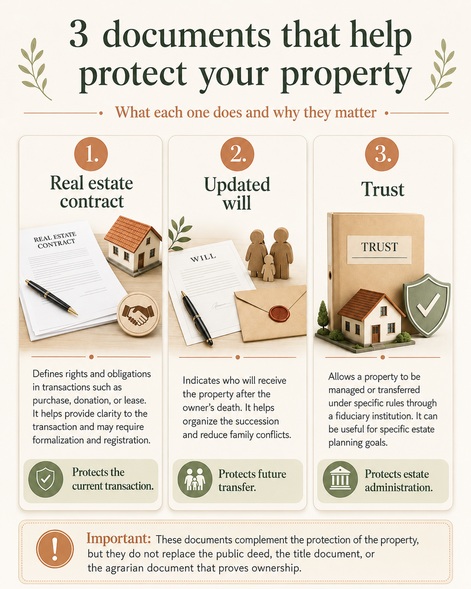
What are the three documents that protect your property? At Viva México Inmobiliaria, we explain it in practical terms: a properly formalized real estate agreement, an up-to-date will, and, when the estate-planning strategy requires it, a trust.
Each instrument serves a different purpose. The agreement protects the current transaction, the will establishes what will happen to the property after the owner's death, and the trust makes it possible to manage or transfer the assets under specific conditions.
However, none of them replaces the public deed, property title, or corresponding agrarian document. These documents prove ownership, while the three instruments mentioned above help prevent disputes related to the use, transfer, administration, and inheritance of the property.
Direct answer: the three documents that protect a property
The three legal instruments that can strengthen the protection of a property are:
-
Formalized and registered real estate agreement: establishes the rights and obligations of the persons involved in a purchase, gift, lease, mortgage, or other transaction.
-
Up-to-date will: determines who will receive the property and under what conditions after the owner's death.
-
Trust: allows the property to be designated for a specific purpose and places its administration in the hands of an authorized fiduciary institution.
Comprehensive protection of real estate begins with a document that legally proves ownership, but it is strengthened through clear agreements, proper succession planning, and estate-management mechanisms.
Are deeds not enough to protect a property?
A public deed is one of the most important documents for proving private property ownership. It contains the transaction authorized by a notary public, identifies the parties, describes the property, and establishes how it was acquired.
However, simply keeping a deed does not automatically resolve every risk related to the property. It is also necessary to verify that the corresponding act was registered with the Public Registry of Property when required.
Registry filing provides public notice of the act and makes it enforceable against third parties. This can be decisive when there is a subsequent sale, attachment, mortgage, ownership dispute, or any other right related to the property.
In addition, deeds do not establish by themselves:
-
Who will receive the property when the owner dies.
-
How the property must be managed in the future.
-
What conditions the beneficiaries must meet.
-
How certain obligations between co-owners will be resolved.
-
What will happen to the assets in the event of certain family circumstances.
Therefore, the deed should be considered the documentary basis of private property, but not necessarily the only element of estate protection.
Public deed, property title, and parcel certificate: are they the same?
Not all properties in Mexico are subject to the same legal regime. The appropriate document for proving rights will depend on whether the property is private, ejido, communal, or subject to another type of ownership regime.
Public deed
This is the instrument authorized by a notary public that records a legal transaction, such as a purchase, gift, adjudication, or creation of a mortgage.
When required by law, it must be registered with the corresponding Public Registry of Property.
Property title
This is a broad concept that identifies the document or legal act through which a person proves their right over real estate. It may arise from a public deed, administrative resolution, court judgment, or regularization procedure.
Parcel certificate
This document proves rights over a parcel of land subject to the ejido regime. Its registration and oversight correspond to the National Agrarian Registry, not the Public Registry of Property used for privately owned real estate.
A certificate of possession, private agreement, or municipal certificate should not automatically be considered equivalent to a private property deed. Its legal scope will depend on the property's ownership regime, the authority that issued the document, and the existing registrations.
1. Formalized real estate agreement
The agreement is the document that defines the transaction carried out in relation to a property. It may be used to transfer ownership, authorize the use of the property, establish collateral, or determine the obligations of several persons.
The most common real estate agreements include:
-
Purchase and sale.
-
Gift.
-
Exchange.
-
Lease.
-
Loan for use.
-
Mortgage.
-
Co-ownership.
-
Promise to purchase and sell.
-
Assignment of rights.
How does an agreement protect the parties?
A well-drafted agreement clearly establishes what the persons involved have agreed upon. This reduces contradictory interpretations and makes it easier to demand compliance with the obligations assumed.
Depending on the transaction, it should specify:
-
Name and identification of the parties.
-
Legal capacity and the capacity in which they participate.
-
Description, location, measurements, and boundaries of the property.
-
Ownership history.
-
Price and payment method.
-
Delivery date and transfer of possession.
-
Existence of liens, outstanding debts, or restrictions.
-
Tax obligations and notarial expenses.
-
Penalties for noncompliance.
-
Procedure for resolving disputes.
-
Conditions for formalizing and registering the transaction.
The importance of registering the agreement
An agreement may produce certain effects between the persons who sign it, but registration is essential when the act must be enforced against other persons.
Registrable documents that are not filed may lose their effectiveness against third parties. For this reason, signing a private agreement and making payment is not enough: it is necessary to determine whether the transaction must be formalized through a public deed and registered with the corresponding registry.
A private agreement and a public deed are not equivalent
A private agreement documents the arrangement between the buyer and seller, but it does not always comply with the formalities required to transfer and register ownership of a property.
Before paying a deposit or the full price, you should verify:
-
That the seller is actually the legal owner.
-
That the property matches the documentation.
-
That there are no liens, attachments, or lawsuits.
-
That the land use permits the intended project.
-
That the transaction can be legally formalized.
-
That the ownership regime allows the transfer.
2. Up-to-date will
A will is a personal, voluntary, and revocable legal act through which a person establishes what will happen to their assets and rights after their death.
Its main purpose is to provide certainty regarding the distribution of the estate and reduce disputes between family members or potential heirs.
How does a will protect a property?
Through a will, the owner can:
-
Designate one or more heirs.
-
Leave a specific property as a legacy.
-
Appoint the person who will act as executor.
-
Designate substitute beneficiaries.
-
Acknowledge obligations or rights.
-
Define how the estate will be distributed.
-
Prevent the succession from depending exclusively on the order established by law.
A will does not eliminate every succession procedure, but it makes the owner's intentions easier to identify and may reduce family disagreements.
A will should be kept up to date
A will may be modified during the person's lifetime. Generally, the most recent validly executed will is the one that is taken into account.
It is advisable to review it when any of the following changes occur:
-
Marriage or divorce.
-
Birth or adoption of children.
-
Death of an heir.
-
Purchase or sale of properties.
-
Significant change in the estate.
-
Change in family relationships.
-
Appointment of a new executor.
-
Creation or termination of a marital property regime.
A will does not replace the deed
Only rights that actually belonged to the deceased person can be transferred through a will. If the property has not been regularized or there is a dispute regarding ownership, the heirs will also inherit that documentation problem.
Therefore, before preparing or updating a will, it is advisable to verify that the property is correctly identified and that the registry history matches the actual situation.
3. Real estate trust
A trust is an agreement through which a person transfers the ownership or title of certain assets or rights to a fiduciary institution so that they may be used for a lawful and specific purpose.
The main participants in this instrument are:
-
Settlor: contributes the property or rights.
-
Fiduciary institution: manages the assets in accordance with the established instructions.
-
Beneficiary: receives the benefits of the trust.
The fiduciary institution cannot freely use the property. It must act in accordance with the purpose, rules, and restrictions established in the agreement.
When can a trust be useful?
It may be used to:
-
Manage a family property.
-
Establish conditions for transferring a property.
-
Protect the interests of minor beneficiaries.
-
Organize investments among several persons.
-
Develop a real estate project.
-
Secure certain obligations.
-
Manage rent or other income.
-
Establish rules for selling, preserving, or commercially using a property.
-
Plan the orderly transfer of an estate.
Is a trust suitable for every property owner?
Not necessarily. Creating a trust may generate fiduciary fees, notarial expenses, registration fees, tax obligations, and recurring administrative costs.
Before using one, the following must be clearly defined:
-
The estate-planning objective.
-
The duration.
-
The beneficiaries.
-
The fiduciary institution's authority.
-
The conditions for selling or transferring the property.
-
The grounds for termination.
-
The tax consequences.
-
The initial and recurring costs.
When the trust involves real estate, it must be recorded in writing and registered with the corresponding Public Registry in order to produce effects against third parties.
How do these three documents complement one another?
The three instruments address different stages and risks:
| Instrument | Main purpose | Stage protected |
|---|---|---|
| Real estate agreement | Defines the rights, obligations, and conditions of a transaction | Current acquisition, use, or transfer |
| Will | Establishes who will receive the estate | Succession after death |
| Trust | Manages or transfers assets under specific rules | Present and future administration |
A person may use only one, combine two, or use all three. The decision will depend on the type of property, family circumstances, the value of the estate, and the owner's objectives.
Additional documents that should be reviewed
Although they are not part of the three main instruments, other documents help verify the legal status of the property:
-
Public deed or corresponding title.
-
Real property folio or proof of registration.
-
Certificate of no liens or certificate showing existing liens.
-
Property tax payment receipts.
-
Cadastral code and documentation.
-
Plans, measurements, and boundaries.
-
Land-use certificates.
-
Utility receipts.
-
Proof of condominium fee payments.
-
Court or administrative resolutions.
-
Parcel certificate, for ejido land.
-
Certificate confirming the validity of agrarian rights.
A property tax receipt, utility payments, or proof of address do not by themselves replace the legal property title. They may serve as supplementary evidence, but their primary function is not to transfer ownership.
Steps for legally protecting a property
1. Identify the legal regime
Determine whether the property is private, ejido, communal, federal, or subject to a regularization procedure.
2. Verify who is listed as the owner
Review the deed, title, corresponding certificate, and registry filings. The owner's information must match the person attempting to carry out the transaction.
3. Request information regarding liens
Verify whether mortgages, attachments, ownership restrictions, lawsuits, usufructs, trusts, or other registered rights exist.
4. Review measurements and boundaries
The physical surface area must match the deed, registry records, and cadastral information. A discrepancy may delay the transaction or require a correction procedure.
5. Properly formalize the agreement
The document must correspond to the type of transaction and the property's ownership regime. Avoid using generic templates that do not address the property's particular characteristics.
6. Complete the corresponding registration
Once the transaction has been formalized, verify that it was submitted to and registered with the Public Registry of Property or the National Agrarian Registry, as applicable.
7. Update your will
Include the property in a succession plan that is consistent with your family and financial circumstances.
8. Evaluate whether you need a trust
Do not establish one solely because it appears to offer greater protection. First define the objective, analyze the costs, and request a legal and tax review.
Mistakes that can put a property at risk
Believing that possession always equals ownership
Living in, caring for, or paying the utilities of a property does not automatically make a person its owner. Possession and ownership are different legal concepts.
Buying exclusively through a private agreement
A private agreement may document the transaction, but it may not be sufficient to formalize and register the transfer of the property.
Failing to verify the Public Registry
The deed presented by the seller must be compared with the current registry information. Liens, annotations, and restrictions must also be reviewed.
Relying only on property tax payments
Payment of property tax may demonstrate compliance with a tax obligation, but it does not necessarily prove ownership by itself.
Failing to update the will
An old will may benefit persons who are no longer part of the owner's life or omit significant changes in the estate.
Creating a trust without a defined purpose
A poorly designed trust may generate costs and obligations without addressing the actual needs of the family or real estate project.
Conclusion
The three documents that help protect a property are a formalized real estate agreement, an up-to-date will, and a trust when there is a specific estate-planning need.
The deed or corresponding title proves the origin of ownership; the agreement governs current transactions; the will organizes succession; and the trust makes it possible to manage or transfer the property under defined rules.
Effective protection does not depend on accumulating documents, but on ensuring that each one is valid, corresponds to the property's legal regime, and is properly formalized and registered.
If you are considering purchasing one of the houses in Oaxaca, review the documentary and registry status before paying deposits or signing commitments. A secure purchase begins with clear information about the property.
Frequently asked questions
Is a public deed enough to prove that a house belongs to me?
A deed is one of the main documents for proving private property ownership, but its registration with the Public Registry must also be reviewed. Registry information makes it possible to verify who is listed as the owner, which acts have been carried out, and whether mortgages, attachments, or other restrictions affect the property.
Does a private purchase agreement protect the buyer?
A private agreement documents the arrangement and may create obligations between the parties, but it does not always comply with the formalities required to register the transfer. The buyer must verify whether the transaction requires a public deed, notarial involvement, and registration with the Public Registry of Property in order to produce effects against third parties.
Is it better to protect a property with a will or a trust?
They do not serve the same purpose. A will expresses how assets will be distributed after death. A trust allows a property to be managed or transferred under specific rules from the time it is created. The best alternative will depend on the estate, the beneficiaries, the costs, and the family's objectives.
Is it mandatory to register a purchase with the Public Registry?
Registration is essential when the right over the property must be recognized against third parties. Although an agreement may produce certain effects between those who signed it, a lack of registration may leave the buyer in a vulnerable position in the event of attachments, subsequent sales, or disputes related to the property.
Which document proves ownership of ejido land?
Rights over an ejido parcel are generally proven through the parcel certificate and the information registered with the National Agrarian Registry. These documents should not be confused with a private property deed. Any purchase, assignment, or change of ownership regime must comply with the formalities established by the applicable agrarian legislation.