What happens if I buy a plot of land with a transfer of rights in Oaxaca?
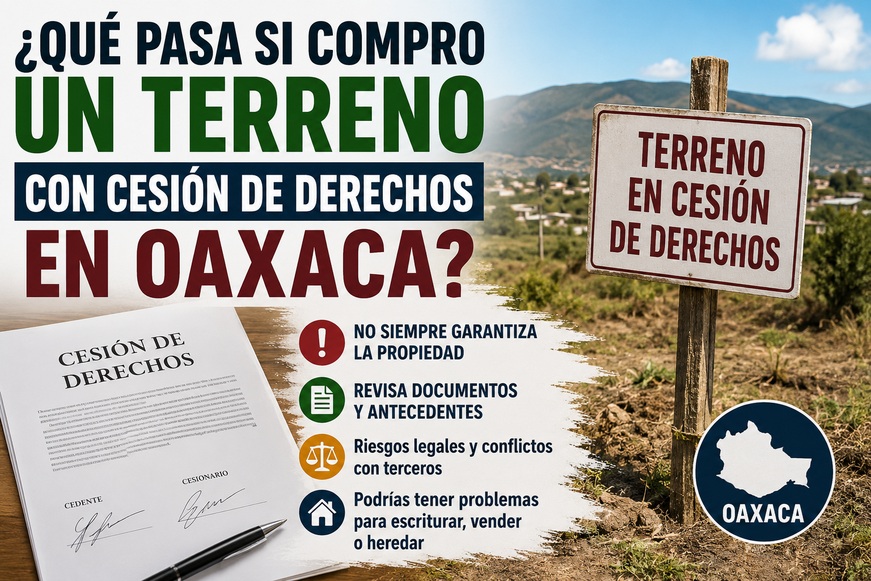
If you buy land through an assignment of rights in Oaxaca, you do not necessarily become the legal owner of the property. In many cases, you only acquire possession, an expectation of regularization, or agrarian rights, but not a deeded property officially registered in your name.
The main consequence is that you could pay for land that you are later unable to deed, sell, formally inherit, mortgage, or defend against third-party claims. Therefore, before signing, the most important step is to determine what type of land you are purchasing: private property, ejido land, communal land, irregular possession, or property undergoing regularization.
Direct answer
Buying land through an assignment of rights in Oaxaca can be risky if the seller does not have a deed, registered title, or valid agrarian rights. An assignment does not always transfer ownership; in many cases, it only transfers the legal position held by the seller.
Before paying, you must verify:
- Whether the land is registered with the Public Registry of Property or the National Agrarian Registry.
- Whether the seller is legally authorized to assign those rights.
- Whether there is a legal path to obtaining a deed.
- Whether there are liens, lawsuits, heirs, communal disputes, or multiple sales.
- Whether the transaction can be formalized before a notary or the appropriate agrarian authority.
What it means to buy through an assignment of rights
An assignment of rights is a legal act through which one person transfers to another the rights they hold over an asset, procedure, possession, or legal expectation.
In the case of land, it may refer to several situations:
- Assignment of possession rights.
- Assignment of inheritance rights.
- Assignment of parcel rights.
- Assignment of rights under a private agreement.
- Assignment of rights within a regularization process.
- Assignment of rights over ejido or communal land.
The problem is that not all of these rights are equivalent to full ownership. A person may possess land for years, pay property taxes, or have municipal certificates, but that does not always mean they are the legal owner.
An assignment of rights is not the same as a deed
A registered public deed provides legal certainty regarding private ownership. An assignment of rights, by contrast, may only be a private document in which someone claims to transfer whatever rights they believe they have.
The difference is crucial:
| Transaction | What you receive | Security level |
|---|---|---|
| Purchase with a registered deed | Formal ownership of the property | High |
| Notarized assignment with a clear legal history | Reviewed and formalized rights | Medium |
| Private assignment without registration | Possession or an expectation | Low |
| Unreviewed assignment of ejido or communal land | Uncertain agrarian rights | High risk |
In Oaxaca, real estate sales must normally be formalized through a public deed, except in specific regularization cases or other situations provided by law. If you only sign a private document, you should not assume that you have already become the owner.
What can happen if you buy without conducting a proper review
Buying land through an assignment of rights may work only when the documentation is complete, the origin of the property is clear, and there is a realistic path to obtaining a deed. Without proper verification, these are the most common risks.
You may pay for something that is not legally owned
If the seller has no deed or valid title, they may not be selling land ownership, but merely possession. In that case, you are also acquiring the seller’s legal problem.
An owner with stronger legal rights may appear
A third party may have a deed, court judgment, agrarian certificate, inheritance rights, or a prior registration. If that person proves a stronger legal claim, your assignment may not be sufficient to defend your rights over the land.
You may remain outside the Public Registry
If the land cannot be registered in your name, you will face problems selling it, inheriting it, using it as collateral, applying for a mortgage loan, or proving ownership before government authorities.
It may be ejido or communal land
This is particularly important in Oaxaca. Many properties belong to agrarian communities, ejidos, or communal groups. In these cases, a private assignment is not enough; certificates, records, assembly decisions, agrarian rights, and registration with the National Agrarian Registry must be reviewed.
There may be disputes with heirs
If the property comes from an unfinished inheritance proceeding, unrecognized or excluded heirs may file claims. Purchasing inheritance rights without reviewing the succession case may leave you trapped in a lengthy legal process.
You may be unable to obtain construction permits
Even if you physically possess the land, you may have difficulty obtaining street alignment approval, an official address, utility services, a construction permit, or subdivision authorization if the property has not been regularized.
How to determine whether the land is private, ejido, or communal property
Before purchasing, identify the legal regime governing the land. This review changes everything.
Privately owned land
It should have a deed, registry history, property folio, or registration with the Oaxaca State Institute of Registry Functions.
You should request:
- A copy of the public deed.
- A certificate confirming whether the property is free of or subject to liens.
- A property tax statement.
- The cadastral identification number.
- A survey or the property’s measurements and boundaries.
- The owner’s identification.
- A marriage certificate, when applicable.
- Certificates confirming there are no outstanding debts, when applicable.
Ejido land
It may be supported by a parcel certificate, agrarian rights certificate, or documents from the National Agrarian Registry. It is not reviewed in the same way as private property.
You must confirm:
- That the assignor is an ejido member, recognized resident, or legally acknowledged rights holder.
- That the parcel certificate exists and corresponds to the land.
- That the right of first refusal has been respected when applicable.
- That the transaction is registered with the National Agrarian Registry.
- That the ejido governing body and assembly have no disputes concerning the property.
- Whether the parcel has obtained full ownership status or remains ejido land.
Communal land
For communal property, the risk may be greater because decisions generally depend on the community and its agrarian governing bodies. A local certificate is not always sufficient to transfer rights.
You must review:
- Official recognition as a community member.
- Assembly records.
- The community bylaws.
- A survey and the property’s location.
- Authorization from the appropriate agrarian governing body.
- Registration or legal history with the National Agrarian Registry.
When buying through an assignment of rights may be worthwhile
It may only be worthwhile when the price reflects the risk and there is a clear legal path to regularization.
An assignment may be acceptable when:
- The property has a verifiable legal history.
- The seller holds rights that can legally be assigned.
- There are no disputes with heirs, ejido members, communal landholders, or third parties.
- A notary or agrarian attorney confirms that the transaction is legally viable.
- Payment is conditional upon proper execution and the corresponding registration.
- There is a realistic possibility of obtaining a deed or final title.
Buying cheaply is useless if you cannot later prove ownership. The discount should compensate for the risk, not conceal it.
When it is better not to buy
Avoid purchasing if you identify any of these warning signs:
- The seller says, “There is no deed, but everyone buys this way.”
- The seller provides only a municipal certificate or payment receipts.
- The seller does not allow you to inspect the original documents.
- The seller refuses to meet with a notary or attorney.
- The land is in an ejido or communal area, but there are no documents from the National Agrarian Registry.
- There are several supposed owners or family members involved.
- You are promised that the property will later enter a regularization program.
- There are no clear measurements, boundaries, or survey.
- The price is nearly the same as that of deeded land.
If no one has been able to obtain a deed after many years, there is probably an underlying legal reason.
Documents you should request before signing
Before providing any money, request a complete file. Photographs sent through WhatsApp are not enough.
For private property
- Public deed.
- Registry history.
- Certificate confirming whether the property is free of or subject to liens.
- Current property tax statement.
- The owner’s official identification.
- CURP and RFC identification numbers.
- Marriage certificate, when applicable.
- Survey, measurements, and boundaries.
- Certificates confirming no outstanding utility debts, when services exist.
For ejido or communal land
- Parcel certificate or agrarian document.
- Certificate confirming that the rights remain valid.
- Assembly record, when applicable.
- Identification of the ejido or community member.
- Survey of the agrarian community or parcel.
- Confirmation from the National Agrarian Registry.
- Review by the ejido or communal property governing body.
- Verification of the right of first refusal, when applicable.
For inheritance rights
- Death certificate.
- Will or intestate succession filing.
- Appointment of the estate administrator.
- List of legally recognized heirs.
- Status of the succession proceeding.
- Inventory and appraisal.
- Judicial or notarial authorization, depending on the case.
Steps for purchasing with less risk
1. Identify the legal regime governing the land
First, confirm whether the property is privately owned, ejido land, communal land, or irregular possession. Do not sign anything without obtaining this answer.
2. Verify the seller
The person signing must be the individual who legally holds the right to sell or assign the property. If a family member, intermediary, or alleged representative signs, review the power of attorney and legal authority.
3. Review registration records
Search for records with the Public Registry of Property or the National Agrarian Registry, as applicable. Registration is what provides legal certainty against third parties.
4. Consult a specialist
For private property, consult a notary. For ejidos or communities, also consult an agrarian attorney. In Oaxaca, this distinction is essential.
5. Do not pay the full amount in advance
The safest approach is to make payments conditional upon delivery of the documents, formal signing, and registration. If the seller demands full payment in cash before the review, this is a warning sign.
6. Sign the correct legal instrument
Not every case can be resolved through a simple assignment. A deed, ratified agreement, succession proceeding, assembly resolution, agrarian registration, or regularization procedure may be required.
Quick risk assessment before purchasing
| Situation | Risk | Recommendation |
|---|---|---|
| The property has a registered deed and is free of liens | Low | Review with a notary |
| The property has a notarized assignment and a clear path to obtaining a deed | Medium | Purchase only under specific conditions |
| The property has a current parcel certificate | Medium | Review with an agrarian attorney |
| The property only has a municipal certificate | High | Do not pay without conducting an investigation |
| The property only has property tax receipts | High | Do not assume ownership |
| The land is communal and there is no valid assembly record | Very high | Avoid it or conduct an extensive review |
| There are unresolved heirs | High | Wait until the succession proceeding is completed |
| Future regularization is promised | High | Purchase only if the procedure is genuine and verifiable |
So, what actually happens if you buy?
If the transaction is properly reviewed, you may acquire valid rights and move toward obtaining a deed, title, or registration. However, if you purchase without proper verification, you may be left only with physical possession of the land and a document that is difficult to defend legally.
In practical terms, buying land through an assignment of rights in Oaxaca means assuming the same legal position held by the seller. If the seller had a solid legal right, you may move forward. If the seller had a problem, that problem is transferred to you.
Final recommendation before making a decision
Do not buy land through an assignment of rights simply because it is less expensive. Purchase only when you can verify which right is being assigned, who is assigning it, where it is registered, and what realistic path exists for converting it into legally secure ownership.
The question is not only how much the land costs. The correct question is: Can I legally become the owner and defend that right against any third party?
Frequently asked questions
Does an assignment of rights make me the owner of the land?
Not always. An assignment may transfer possession, inheritance rights, parcel rights, or an expectation of regularization. You will only become the full owner when there is a valid title that has been formalized and registered with the corresponding authority. For this reason, reviewing the legal origin of the property before paying is essential.
Can I obtain a deed for land purchased through an assignment of rights?
Yes, but only if the property has sufficient legal history and there is a viable regularization process. If the property is ejido, communal, inherited, or irregular, specific procedures must first be completed. Not all assignments can be converted into a deed, even if the seller promises otherwise.
Is it safe to buy ejido land through an assignment of rights in Oaxaca?
It may be risky if the transaction is not reviewed through the National Agrarian Registry and with agrarian legal counsel. For ejido land, a private agreement is not enough; the assignor’s rights, parcel certificate, right of first refusal, and corresponding registration must be validated. Buying without these safeguards may lead to disputes.
Is a municipal certificate sufficient for purchasing land?
A municipal certificate may help prove possession or location, but it does not replace a deed or agrarian certificate. By itself, it also does not prove that the seller is the owner. It should only be considered a supporting document and never the sole basis for paying for land.
What should I do if I already purchased through an assignment of rights?
Gather all documents, determine whether the land is private, ejido, or communal property, and consult a notary or agrarian attorney. Then verify whether registration, regularization, or legal proceedings are possible. Until the situation is clarified, avoid building, reselling, or investing additional money without legal protection.