What is the cadastral registration of a property in Oaxaca?
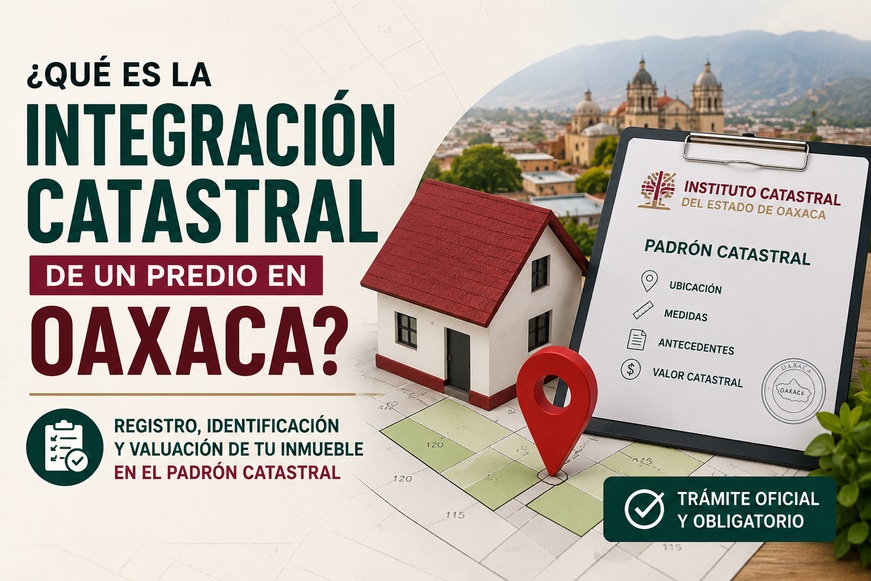
The cadastral integration of a property in Oaxaca is the procedure through which a property is entered for the first time into the cadastral registry of the Oaxaca State Cadastral Institute. In practical terms, it is used to identify, register, and assign the property tax account corresponding to real estate that does not yet appear in the cadastral system.
This procedure is important because it allows the property to formally exist within the state’s cadastral records, with basic information such as location, physical characteristics, possession or ownership history, and the elements required for its valuation.
Direct answer
The cadastral integration of a property in Oaxaca is the procedure used to register real estate in the cadastral registry for the first time. It applies when the property has no previous cadastral registration and allows the corresponding property tax account to be determined, without by itself granting ownership or possession rights.
What is cadastral integration used for?
Cadastral integration allows a property to be recognized within the territorial information system and cadastral registry. This enables the authorities to maintain organized information about the property and allows the owner or possessor to proceed with other property-related procedures.
Its main purposes include:
- Registering the property for the first time.
- Identifying its location and characteristics.
- Linking the property to a property tax account.
- Incorporating documentary, graphic, and alphanumeric information.
- Facilitating subsequent procedures before cadastral, municipal, or notarial authorities.
- Allowing cadastral valuation in accordance with applicable regulations.
When does a property need to be added to the cadastral registry?
This procedure is required when a property located in Oaxaca does not appear in the Territorial Information System of the Oaxaca State Cadastral Institute.
It may also be necessary when the property originates from a possession record, ejido or communal document, urban lot title, notarization, or first registration, provided that the property has not yet been assigned a property tax account.
In simple terms, if the property has never been registered with the cadastral authority, the appropriate procedure is generally its integration into the cadastral registry.
What it means for a property to be “hidden from the tax authority”
For cadastral purposes, a property may be considered hidden from the tax authority when it is not registered in the corresponding cadastral system. This does not necessarily imply bad faith; it may occur because of a lack of regularization, the age of the property, unreported changes, or the absence of a previous filing.
Cadastral integration seeks to correct this situation by adding the property to the registry and allowing its official identification for cadastral and tax purposes.
What information is incorporated into the cadastral registry?
The cadastral registry is not simply a list of properties. It is a territorial information system that collects documentary, graphic, and alphanumeric data about real estate.
Cadastral integration may include elements such as:
- Name of the rights holder, owner, or possessor.
- Location of the property.
- Approximate or documented surface area.
- Measurements and boundaries, when applicable.
- Location sketch.
- Possession or ownership history.
- Property classification.
- Cadastral value or the elements used to determine it.
- Assigned property tax account.
Types of cadastral integration in Oaxaca
The Oaxaca State Cadastral Institute recognizes several procedures related to the cadastral integration of real estate. These include:
- Communal integration.
- Ejido integration.
- First registration of real estate.
- Private property integration.
- Notarization.
- Urban lot title.
The difference between each type depends on the underlying documentation, the property’s legal regime, and the way possession or ownership is proven.
Requirements for the cadastral integration of a property in Oaxaca
The requirements may vary depending on the specific case, but documents are generally requested to identify the property, establish its legal history, and verify the identity of the rights holder.
The main documents are:
- A printed or completed cadastral procedure application signed by the taxpayer.
- A copy of the possession or ownership record.
- A location sketch of the property.
- A copy of the rights holder’s current official identification.
- Certified cadastral and real estate appraisals, when required under the regulations.
- Payment of the applicable fees.
- Any additional documents required to process the application.
Does cadastral integration prove ownership?
No. Cadastral integration does not by itself prove ownership or possession of real estate.
This point is essential: registering a property in the cadastral registry records it for administrative, tax, and territorial information purposes, but it does not replace a public deed, court judgment, agrarian title, valid agreement, or other legal document proving rights over the property.
The cadastral authority identifies and records information about the property; ownership must be proven through the corresponding legal documents.
Difference between cadastral integration and transfer of ownership
Cadastral integration and transfer of ownership are different procedures.
Cadastral integration is used when the property is not registered and must be added to the cadastral registry for the first time.
Transfer of ownership is carried out when a property already has a cadastral account and changes owners through a sale, donation, adjudication, or another legal act transferring ownership.
In summary, integration creates the initial property record, while a transfer updates the ownership information when a cadastral registration already exists.
Difference between cadastral integration and data updating
Cadastral integration applies when the property is not registered in the cadastral registry. A data update, by contrast, applies when the property already has a record but the information needs to be corrected or modified.
For example, an update may involve changes to measurements, construction, name, physical characteristics, or administrative information. If the property already exists in the cadastral registry, it should not be treated as a new integration, except in exceptional cases established by the authority.
Who can request cadastral integration?
It may generally be requested by the owner, possessor, or taxpayer who has a legitimate interest in the property and has documents proving their relationship to it.
A legal representative may also participate, provided that they have the documentation required to prove their authority. In some cases, the procedure may be connected to regularization processes, agrarian documents, notarial instruments, or actions by competent authorities.
General steps in the procedure
Although each case may require a specific review, the process generally follows this sequence:
- Gather the documents for the property and rights holder.
- Complete and sign the cadastral procedure application.
- Prepare the location sketch.
- Compile the possession or ownership records.
- Submit certified appraisals when applicable.
- Pay the applicable fees.
- Submit the application to the cadastral authority.
- Wait for the documentary and technical review.
- Receive the corresponding assignment or registration if the application is approved.
Cases in which the application may be rejected
Integration into the cadastral registry may be rejected if the property is already registered in the Territorial Information System of the Oaxaca State Cadastral Institute.
The procedure may also be suspended if documents are missing, if the submitted record does not sufficiently identify the property, if there are inconsistencies in the location or surface area, or if the authority requires additional information to continue the review.
Common mistakes when requesting cadastral integration
Common mistakes include:
- Confusing cadastral integration with a property deed.
- Attempting to integrate a property that already has a cadastral account.
- Submitting an incomplete or inaccurate location sketch.
- Failing to adequately prove the possession or ownership history.
- Failing to provide current official identification.
- Failing to include appraisals when the procedure requires them.
- Failing to pay the corresponding fees.
- Submitting documents containing inconsistent information.
Avoiding these mistakes helps reduce observations and delays during the review of the application file.
Importance of correctly integrating a property
Correctly adding a property to the cadastral registry helps organize territorial information and facilitates future procedures. It also allows the property to have an identifiable property tax account and to be included within the state’s cadastral administration.
For owners or possessors, this procedure may be an important step in regularization processes, document updates, payment of taxes, notarial transactions, or municipal procedures related to the property.
Frequently asked questions
Is cadastral integration the same as initially registering a property?
Yes. In practical terms, it may be understood as the initial registration of the property in the cadastral registry. Its purpose is to register for the first time real estate that does not appear in the cadastral system and assign the information necessary for its identification, including the corresponding property tax account.
Can I request cadastral integration if I only have possession?
It may be possible, provided that there is a valid possession record and the authority accepts it for the procedure. In Oaxaca, possession or ownership records may be submitted, but each application is reviewed according to its documents, location, property regime, and applicable requirements.
Does a property tax account prove that I own the property?
No. A property tax account is used to identify real estate within the cadastral registry for administrative or tax purposes. It does not replace a deed, title, court judgment, or legal ownership document. Cadastral registration does not by itself create ownership or possession rights.
What happens if the property is already registered with the cadastral authority?
If the property is already registered in the Territorial Information System, cadastral integration may be rejected. In that case, another procedure may apply, such as updating information, transferring ownership, reassigning the account, or correcting records, depending on the property’s circumstances.
What documents are essential to begin the procedure?
The basic documents are the signed cadastral procedure application, the possession or ownership record, a location sketch, the rights holder’s current official identification, payment of the applicable fees, and any additional documents requested by the authority. In certain cases, certified cadastral and real estate appraisals are also required.
Does cadastral integration allow a property to be sold?
Cadastral integration may facilitate subsequent procedures, but it is not by itself sufficient to legally sell real estate. A sale requires proof of ownership and compliance with the applicable notarial, registration, tax, and cadastral requirements, depending on the type of property and the available documentation.