Can communal land be sold?
Buying land in Mexico may seem straightforward, but when it involves communal or ejido land, the rules change completely. Many people believe that any property can be sold through a private agreement, but there are significant legal restrictions that can turn a purchase into a serious legal problem.
The direct answer is: yes, communal land can be sold in certain cases, but not in the same way as private property. Everything depends on the land's legal regime, whether it has already been regularized, and the rights held by the person attempting to sell it.
What is communal land?
Communal land is collectively owned property recognized under Mexican agrarian legislation. This type of land belongs to an agrarian community rather than to a single individual.
Members of the community have rights to use and benefit from the land, but this does not automatically mean that they can freely sell it.
Mexico primarily recognizes two similar forms of property:
- Communal land
- Ejido land
Although they are often confused, they are not exactly the same.
Difference between communal and ejido land
Ejido land belongs to an ejido, while communal land belongs to a historically recognized agrarian community.
Both are regulated by the Agrarian Law and share important characteristics:
- Ownership is originally collective
- There are restrictions on selling the land
- Specific legal procedures must be followed
- The National Agrarian Registry (RAN) is involved
Can communal land be sold?
Yes, but only under certain legal conditions.
Communal land cannot be freely sold like a house or privately owned urban property. For the sale to be legal, there must usually be a prior process involving regularization or the transfer of rights recognized by the agrarian authorities.
In many cases, what is actually being sold is not ownership of the land, but possession or usage rights.
When can it be legally sold?
There are circumstances in which the sale may be completed in accordance with the law.
When the land has already been regularized
If the land is no longer subject to the communal regime and has obtained full private ownership, it may be sold as private property.
This means that:
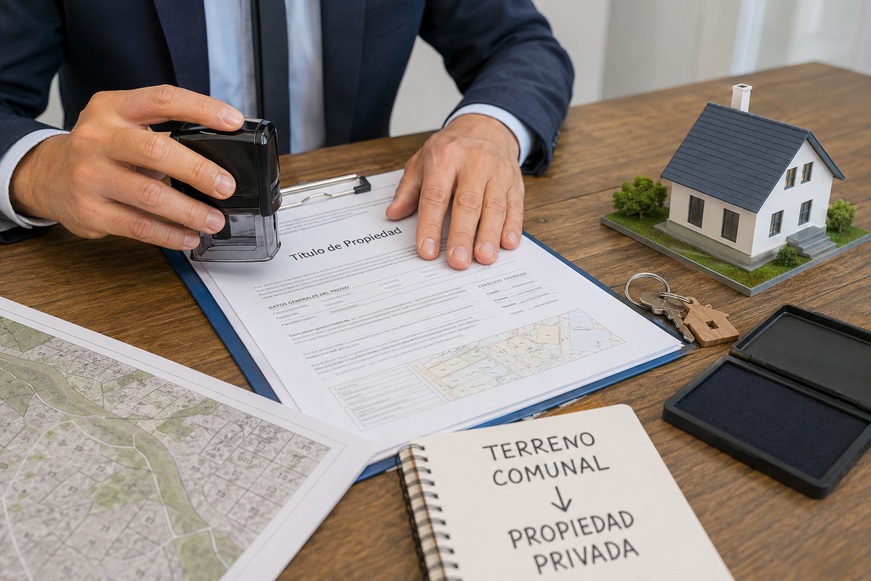
- The land already has a public title deed
- It is registered with the Public Registry of Property
- It has individual legal certainty
In this case, the transaction works practically the same as any other real estate purchase and sale.
When agrarian rights are transferred
In some agrarian communities, rights may be assigned between members of the community or even to authorized third parties.
However:
- The transaction must be approved in accordance with the Agrarian Law
- Authorization from the communal assembly may be required
- It must be registered with the RAN
If these steps are not completed, the transaction may be invalid.
When can it NOT be sold?
There are many cases in which alleged sales of communal land are illegal or extremely risky.
Sale without regularization
One of the most common mistakes is purchasing land solely through:
- Private agreements
- Simple receipts
- Informal assignments
- Possession letters
These documents do not guarantee legal ownership.
Sale made by someone without legal rights
In many cases, the seller:
- Is not a recognized comunero
- Does not appear in agrarian records
- Does not have authorization from the assembly
In these situations, the buyer is vulnerable to disputes and possible financial losses.
Occupied land or property under litigation
Some communal lands may also have:
- Boundary disputes
- Internal conflicts
- Agrarian lawsuits
- Multiple sales of the same property
Buying without conducting proper research can result in a legal problem lasting for years.
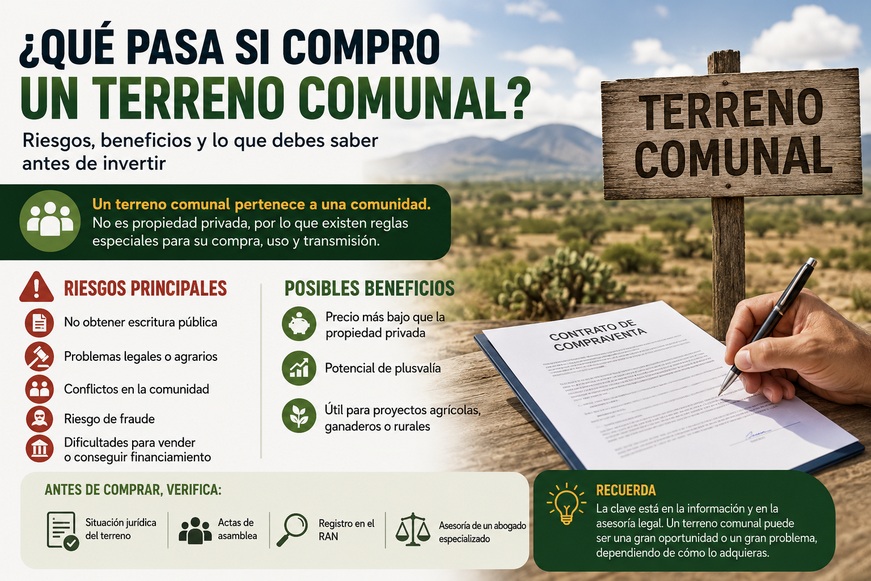
Risks of purchasing communal land
Before acquiring this type of property, it is essential to understand the risks.
Lack of title deeds
Many communal parcels do not have individual title deeds, which makes it difficult to:
- Sell the property later
- Obtain financing
- Transfer it through inheritance legally
- Regularize buildings or construction
Possible invalidation of the purchase
If the transaction does not meet agrarian requirements, the sale may be challenged.
Even after several years, another person could claim rights over the land.
Problems obtaining construction authorization
In certain cases:
- Permits cannot be obtained
- Public utilities are unavailable
- Land-use restrictions apply
This affects the true value of the investment.
How to determine whether communal land can be sold
Before purchasing, several legal matters should be reviewed.
Verify the property regime
It is essential to confirm whether the land is:
- Private
- Ejido
- Communal
- National land
This information can be verified with the National Agrarian Registry.
Request official documentation
Always request:
- Parcel certificate
- Property title
- Agrarian resolutions
- RAN certificate
Never rely solely on the seller's statements.
Verify whether full private ownership has been obtained
Full private ownership means that the land has left the agrarian regime and may now be freely sold.
Without this process, the transaction may be subject to significant restrictions.
What does Mexico's Agrarian Law say?
The Agrarian Law establishes that communal lands receive special legal protection.
Unrestricted sales are not permitted because the purpose is to preserve the collective heritage of agrarian communities.
For this reason:
- The assembly has significant decision-making authority
- Specific procedures must be followed
- The RAN participates in many administrative processes
Ignoring these rules can result in the transaction being declared legally invalid.
Is it advisable to purchase communal land?
It depends entirely on the land's legal status.
It may be a good opportunity if:
- It has been regularized
- Complete documentation exists
- There is legal certainty
- It has been reviewed by a specialist
However, if everything is handled only through verbal promises or private agreements, the risk is high.
Thousands of people in Mexico face legal problems because they purchased communal land without proper legal advice.
Recommendations before purchasing
Before signing any document:
- Verify the land's legal status
- Consult the National Agrarian Registry
- Request the property's legal history
- Check whether there are any pending disputes
- Consult an attorney specializing in agrarian law
- Do not transfer money before validating the documents
A preventive legal review can help avoid significant losses.
Frequently asked questions
Can a comunero freely sell their land?
Not always. It depends on the land's legal regime and whether the required agrarian authorizations exist. In many cases, only rights may be transferred, rather than full ownership of the land.
What happens if I purchase communal land through a private agreement?
A private agreement does not guarantee legal ownership. If the land remains subject to the communal regime, the transaction may be challenged or declared invalid by the agrarian authorities.
How can I determine whether land has obtained full private ownership?
There must be a public title deed and registration with the Public Registry of Property. This may also be verified with the National Agrarian Registry.
Are ejido and communal lands the same?
Not exactly. Both are governed by the agrarian property regime, but they have different legal and historical characteristics. However, both are subject to restrictions on their sale.
Can communal land receive a title deed?
Yes, but it must normally be regularized first and removed from the communal regime through the legal procedures established by the Agrarian Law.
Is it risky to purchase inexpensive communal land?
Yes. Many low prices are caused by legal problems, missing title deeds, or agrarian disputes. Before purchasing, it is essential to review all documentation.