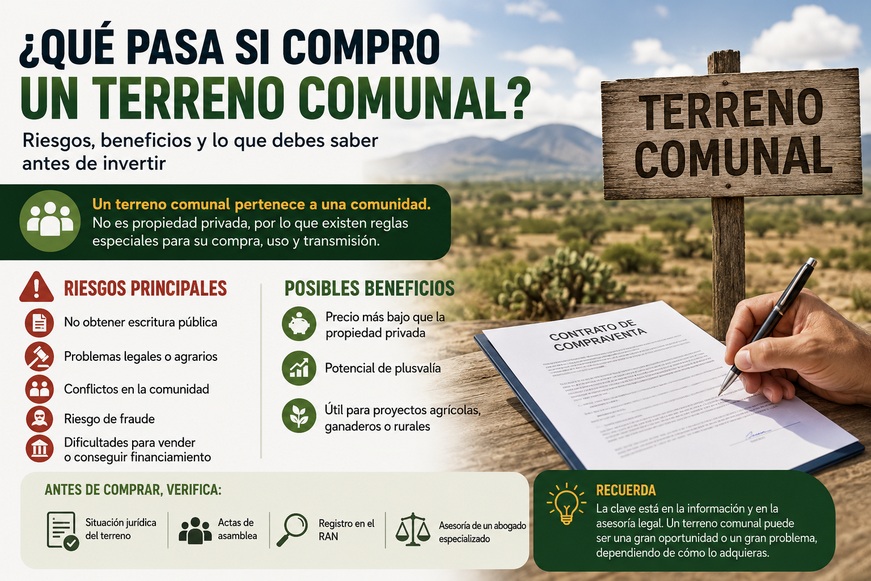
How do you convert communal land into private property?
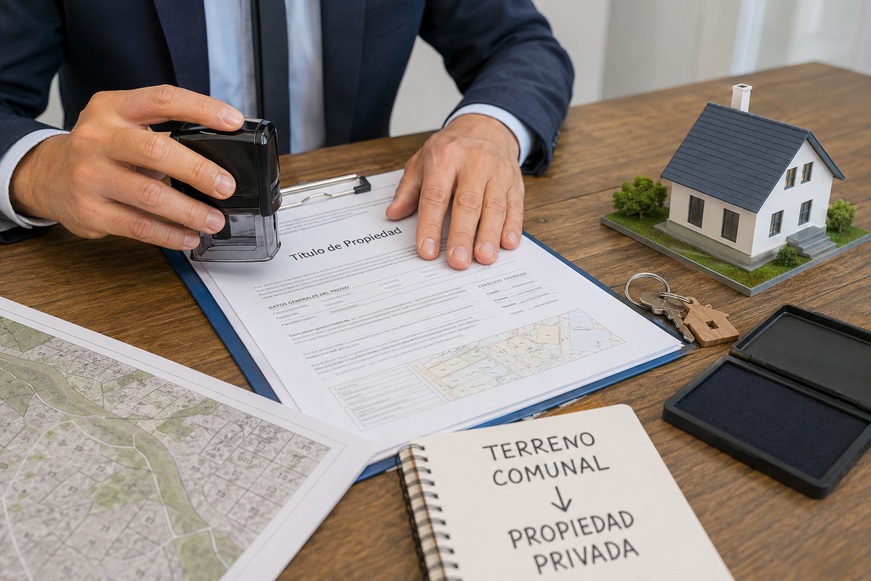
How can communal land be converted into private property? In Mexico, not all communal land can be converted directly into private property. First, it is necessary to confirm whether the property belongs to an agrarian community, an ejido, an individual parcel, an urban lot, or common-use land. Then, depending on the specific case, approval from the assembly, registration with the National Agrarian Registry, and, in certain circumstances, the issuance of a property title may be required.
The key is to correctly identify the type of land. Communal land is not regularized in the same way as an ejido parcel or a lot located within the urban area of an agrarian community.
Direct answer
To convert communal land into private property, its agrarian status must be verified with the National Agrarian Registry, the existence of recognized rights must be reviewed, it must be confirmed whether the assembly can authorize the change in property regime, and the corresponding registration process must be completed. If the property is protected communal or common-use land, individual privatization may not be legally possible.
Difference between communal land, ejido land, and private property
Before beginning any procedure, it is essential to distinguish between these concepts:
- Communal land: belongs to an agrarian community and is normally intended for collective use.
- Ejido land: forms part of an ejido and may be divided into individual parcels, urban lots, and common-use land.
- Ejido parcel: may be converted to full private ownership if it meets the legal requirements.
- Urban lot: a lot located within the urban area of an ejido or community that may qualify for titling if it is legally recognized.
- Private property: real estate registered with the Public Registry of Property in the name of an individual or legal entity.
Possessing the land, living on it, or having a private agreement is not sufficient. For private ownership to exist, there must be a valid title and official registration.
Can communal land be converted into private property?
It may be possible, but not in every case. It depends on:
- The legal regime of the agrarian community.
- Whether the land is divided into parcels or classified as common-use land.
- Whether there is a parcel certificate, official record, or assignment.
- Whether the assembly authorized the corresponding change.
- Whether the National Agrarian Registry recognizes the right.
- Whether the property can subsequently be registered as private property.
For communal or common-use land, individual privatization is usually more restricted. By contrast, when formally recognized ejido parcels are involved, the full private ownership procedure is more clearly established.
Step 1: Verify the land regime with the RAN
The first step is to contact the National Agrarian Registry (RAN) to confirm whether the property is located within an agrarian community.
Information may be requested regarding:
- Name of the ejido or community.
- Location of the property.
- Type of land.
- Registered rights holder or possessor.
- Existence of a parcel certificate.
- Map of the agrarian community.
- Previous assembly records.
This step prevents common mistakes, such as purchasing land believed to be private when it actually belongs to an ejido or agrarian community.
Step 2: Determine whether the land is a parcel, urban lot, or common-use land
The procedure varies depending on the type of land:
If it is a parcel
It may qualify for full private ownership if:
- It has been formally divided into parcels.
- A final survey map exists.
- There is a parcel certificate.
- The assembly authorizes full private ownership.
- The resolution is registered with the RAN.
- The rights holder applies for the property title.
If it is an urban lot
A property title may be obtained if:
- It is located within the urban area of the agrarian community.
- It was legally assigned.
- It is officially recognized in the interested party's name.
- The assembly authorized the titling of urban lots.
- The RAN can issue the corresponding title.
If it is common-use land
It generally cannot be individually converted into private property, except through special procedures approved by the assembly and permitted by law. This land is normally intended for the collective benefit of the agrarian community.
Step 3: Obtain authorization from the assembly
The assembly is the highest decision-making body in ejidos and agrarian communities. Without its authorization, the land regime cannot be changed.
Depending on the circumstances, the assembly must approve:
- The adoption of full private ownership.
- The assignment of urban lots.
- The regularization of rights.
- The registration of the resolution with the RAN.
The assembly minutes must comply with legal formalities, be properly prepared, and be registered with the agrarian authority.
Step 4: Register the resolution with the National Agrarian Registry
Once the resolution has been approved, it must be registered with the RAN. This step is essential because it gives official registration validity to the change authorized by the assembly.
The RAN may request documents such as:
- Assembly minutes.
- Official identification.
- Parcel certificate or proof of rights.
- Property map or identifying information.
- The corresponding application.
- Proof of payment of government fees, when applicable.
Without registration with the RAN, the resolution may remain incomplete and may not produce the legal effects required to obtain a property title.
Step 5: Apply for the property title
When the procedure is legally available, the rights holder may apply for the issuance of a property title. For ejido parcels, this occurs after full private ownership has been authorized and the corresponding parcel rights have been canceled.
Once issued, the title may be registered with the Public Registry of Property in the corresponding state.
Step 6: Register with the Public Registry of Property
Private ownership is formally established when the title is registered with the Public Registry of Property.
This step makes it possible to:
- Prove ownership against third parties.
- Legally sell the property.
- Transfer it through inheritance with greater legal certainty.
- Use the property as collateral.
- Avoid disputes arising from informal possession.
Common requirements for regularizing agrarian land
Although requirements may vary depending on the case, the following items are normally reviewed:
- Official identification of the interested party.
- CURP.
- Birth certificate.
- Parcel certificate, official record, or agrarian document.
- Assembly minutes.
- Property survey or map.
- Proof of address.
- Application submitted to the RAN.
- Payment of government fees.
- Documents proving possession or assignment.
Common mistakes when attempting to privatize communal land
The most common mistakes include:
- Purchasing only through a private agreement.
- Failing to verify the property with the RAN.
- Confusing possession with ownership.
- Believing that the community commissioner can sell the land independently.
- Failing to determine whether the land is classified as common-use land.
- Omitting assembly authorization.
- Failing to register the title with the Public Registry of Property.
A private agreement does not automatically convert communal or ejido land into private property.
What should be done if the land has not been assigned?
If the lot has not been assigned or appears as vacant, the ejido or communal commissioner should be consulted to determine whether the matter can be submitted to the assembly.
When there is a dispute, refusal, or lack of recognition, it may be necessary to appear before the Agrarian Court to request recognition of rights, provided that there are legal grounds for doing so.
How long does it take to convert communal land into private property?
The amount of time required depends on the type of land, the available documentation, the status of the agrarian community, and the workload of the authorities.
The process may take several months or more than one year if there are problems such as:
- Missing documents.
- Disputes between possessors.
- A pending assembly meeting.
- Errors in property maps.
- Unassigned land.
- Objections from other members of the agrarian community.
Who can complete the procedure?
The procedure can normally be completed by the person who holds the corresponding recognized agrarian right, such as:
- An ejidatario.
- A comunero.
- A recognized possessor.
- The holder of a parcel certificate.
- The beneficiary of an assigned urban lot.
If the person only has informal possession, they must first determine whether recognition of their rights can be obtained.
Frequently asked questions
Can communal land be sold?
Communal land should not be sold as if it were private property unless it has the corresponding title and registration. The sale depends on the land regime, assembly authorization, and compliance with agrarian requirements. Purchasing without verification may result in invalidity, disputes, or loss of the money invested.
Which authority converts communal land into private property?
The main authorities involved are the assembly of the agrarian community, the National Agrarian Registry, and, at the final stage, the Public Registry of Property. If there is a dispute concerning possession, assignment, or recognition of rights, the Agrarian Court may also become involved. No single authority can replace the required agrarian formalities.
What happens if I only have a private purchase agreement?
A private agreement may serve as supporting evidence, but it does not prove full ownership if the land remains under the communal or ejido regime. To obtain legal certainty, the property must be verified with the RAN, the seller's recognized rights must be reviewed, and it must be confirmed that the land could legally be transferred.
Can an ejido parcel receive a private title deed?
Yes, but only when the legal requirements are met. For ejido parcels, a parcel certificate, assembly authorization for full private ownership, registration with the RAN, issuance of the property title, and subsequent registration with the Public Registry of Property are normally required. Without these steps, there is no valid private title deed.
What is the difference between a parcel certificate and a property title?
A parcel certificate proves agrarian rights over a parcel within an ejido. A property title proves private ownership after the corresponding procedure has been completed. Having a parcel certificate does not automatically mean that the land is already private property.
Can I regularize communal land if I have lived there for many years?
Long-term possession may help as supporting evidence, but it does not guarantee private ownership. It must first be determined whether the land has been assigned, whether it is located in an urban area, classified as an individual parcel or common-use land, and whether the agrarian community can recognize the rights. In some cases, an assembly resolution or agrarian lawsuit may be required.