
What are the three ways to purchase a property?

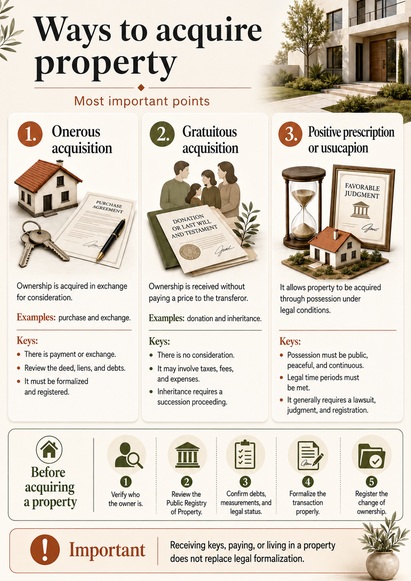
What are the three ways to acquire property? To understand them in practical terms, they can be summarized as acquisition for consideration, gratuitous acquisition, and positive prescription or adverse possession. At Viva México Inmobiliaria, we explain how each method works, which documents may be required, and what you should review before acquiring real estate.
This classification helps determine whether property is obtained by providing consideration, without giving anything in return, or through prolonged possession that meets the conditions established by law.
Direct answer: The three most common ways to acquire property are through a purchase or another transaction for consideration, through a gift or inheritance, and through positive prescription or adverse possession. However, Mexican law also recognizes other specific legal concepts, such as accession, adjudication, and the occupation of certain assets.
What does it mean to acquire property?
Acquiring property means legally becoming the owner of an asset. This allows a person to use it, enjoy it, benefit from it, and dispose of it, always within the limitations established by law.
In the case of real estate, handing over money, receiving the keys, or beginning to occupy the premises is not enough. The transaction must be properly formalized and supported by documents that establish who the owner is.
1. Acquisition of property for consideration
An acquisition for consideration occurs when a person receives ownership of an asset and provides something of value in return. This consideration may consist of money, another asset, or an obligation agreed upon by the parties.
A purchase and sale is the most common example, although it is not the only one.
Purchase and sale
In a purchase and sale transaction, one person agrees to transfer ownership of an asset and the other agrees to pay a specified price.
When the transaction involves real estate, it is essential to verify that the seller has the legal authority to transfer it. The property’s registry history, liens, outstanding debts, and legal status must also be reviewed.
The process normally includes:
-
Identification of the registered owner.
-
Review of the deed and the property’s history.
-
Obtaining registry certificates.
-
Verification of outstanding debts and restrictions on ownership.
-
Preparation and execution of the corresponding legal instrument.
-
Registration of the new title with the Public Registry of Property.
Exchange
An exchange is also an acquisition for consideration. Instead of paying exclusively with money, the parties exchange assets.
For example, a person may transfer one property and receive another in return. When the assets have different values, an additional payment may be agreed upon to compensate for the difference.
What should be reviewed in an acquisition for consideration?
Before signing a purchase and sale or exchange agreement, it is advisable to verify:
-
That the seller is listed as the owner.
-
That the property is free of mortgages, attachments, or litigation.
-
That there are no outstanding taxes or service charges.
-
That the measurements and characteristics match the documents.
-
That the intended use of the property is compatible with the buyer’s plans.
-
That the agreement specifies the price, payment method, deadlines, and obligations.
-
That the transfer is formalized in accordance with the applicable legislation.
Paying a deposit without reviewing these elements may result in financial losses or subsequent disputes.
2. Gratuitous acquisition: gifts and inheritance
A gratuitous acquisition occurs when a person obtains an asset without paying consideration to the person transferring it.
This does not mean that the procedure is free of taxes, professional fees, or formalization expenses. The term “gratuitous” only means that the acquiring party does not pay a price in exchange for the property.
Gift
A gift is a legal act through which one person transfers an asset to another without consideration.
The parties involved in a gift are:
-
Donor: the person who transfers ownership.
-
Donee: the person who receives and accepts the asset.
A gift of real estate must be formalized in accordance with the applicable civil and notarial provisions. It may also create tax obligations depending on the relationship between the parties, the value of the property, and the relevant legislation.
Before accepting a gift, any liens, restrictions, outstanding debts, and conditions imposed by the donor should be reviewed.
Inheritance
Inheritance allows the transfer of assets, rights, and obligations that do not terminate upon a person’s death.
It may occur in two ways:
-
Testamentary succession: a will exists and establishes who will receive the assets.
-
Legal or intestate succession: there is no valid will, and the distribution is carried out according to the order established by law.
Although inheritance rights arise upon death, a probate or succession proceeding is normally required to identify the heirs, prepare an inventory, address outstanding obligations, distribute the assets, and formalize the change of ownership.
A gift and an inheritance are not the same
Both are gratuitous acquisitions, but they have important differences:
| Aspect | Gift | Inheritance |
|---|---|---|
| Time of transfer | During the owner’s lifetime | After the owner’s death |
| Main document | Gift agreement or deed of gift | Will or declaration of heirs |
| Acceptance | The donee must accept | The heir may accept or disclaim the inheritance |
| Procedure | Transaction between living persons | Probate or succession proceeding |
| Possible obligations | Taxes, government fees, and conditions | Estate debts, taxes, and expenses |
3. Positive prescription or adverse possession
Positive prescription, also known as adverse possession or usucaption, is a way of acquiring ownership through possession of an asset for the period and under the conditions established by law.
This does not mean that a person automatically becomes the owner simply by living in a property for several years. For this legal concept to apply, possession must meet specific requirements and generally must be recognized through a court judgment.
General requirements for adverse possession
Civil legislation establishes that possession must be:
-
As an owner: the person publicly behaves as the owner of the asset.
-
Peaceful: possession is neither obtained nor maintained through violence.
-
Continuous: possession is maintained throughout the statutory period without material interruption.
-
Public: possession is not exercised secretly or covertly.
The origin of the possession, the date on which it began, and the circumstances under which it has been maintained must also be proven.
As a reference, the Federal Civil Code establishes different periods for real estate depending on factors such as good faith or bad faith. However, the exact requirements and time periods must be verified under the civil code of the state in which the property is located.
Adverse possession does not operate automatically
Meeting a certain number of years is not sufficient by itself. The interested person must submit evidence and initiate the corresponding proceeding against the person listed as the owner.
Evidence that may be used includes:
-
Documents related to the origin of possession.
-
Receipts and supporting documents connected with the property.
-
Testimony from neighbors or other persons familiar with the facts.
-
Inspections and expert evidence.
-
Records concerning the duration and manner of occupancy.
-
Certificates issued by the Public Registry of Property.
When the authority determines that positive prescription is valid, the judgment must be registered with the Public Registry so that it may serve as title to the property.
Difference between ownership and possession
Ownership and possession are not synonymous.
Ownership is the legal right to enjoy and dispose of an asset. Possession is the factual control that a person exercises over that asset, even when the person is not necessarily its owner.
A person may possess real estate as a tenant, borrower, caretaker, or custodian. In those cases, the person acknowledges that someone else is the owner, so the mere passage of time does not necessarily allow ownership to be acquired through adverse possession.
How is ownership of real estate proven?
The strongest document for proving ownership of real estate is the public deed or corresponding legal title registered in the owner’s name with the Public Registry of Property.
Registration makes it possible to determine who is listed as the owner and whether there are mortgages, attachments, restrictions, or previously registered transactions.
Other documents, such as private agreements, payment receipts, or tax records, may serve as evidence of a transaction or possession, but they do not always replace the formalities required to fully transfer and prove ownership.
Are there other ways to acquire property?
Yes. The three methods explained above are a practical classification, but they are not an exhaustive list. Civil law also recognizes other legal concepts.
Accession
Accession allows an owner to acquire what an asset produces or what becomes naturally or artificially joined or incorporated into it. Its application depends on the type of assets involved, the good or bad faith of the persons concerned, and the circumstances of the incorporation.
Adjudication
Adjudication is the formal assignment of an asset to a person within a specific proceeding. It may occur in an estate proceeding, liquidation, division of co-owned property, auction, or court proceeding.
In some cases, adjudication recognizes a previously acquired right and identifies the specific asset corresponding to each person.
Occupation
Occupation primarily concerns certain movable assets that have no owner or that may be appropriated in accordance with the law. It should not be confused with entering and remaining in another person’s real estate, because doing so does not automatically make the occupant the owner.
Expropriation
Expropriation is a mechanism through which the government acquires privately owned property for a public purpose and upon payment of compensation. It is not a voluntary method of acquisition available to private individuals.
Comparison of the three main forms
| Form of acquisition | Is payment involved? | Who transfers the property? | Document or procedure |
|---|---|---|---|
| For consideration | Yes | The owner or an authorized titleholder | Agreement, deed, and registration |
| Gratuitous | No consideration is provided | The donor or the deceased person whose estate is inherited | Gift or succession proceeding |
| Adverse possession | Not necessarily | Ownership is acquired through legally proven possession | Lawsuit, judgment, and registration |
Steps for acquiring property safely
Regardless of the form of acquisition, it is advisable to follow a review process.
-
Identify the legal method. Determine whether the transaction involves a purchase and sale, gift, inheritance, adjudication, or positive prescription.
-
Verify ownership. Confirm who is listed as the owner and whether that person has the legal capacity to transfer the property.
-
Review the Public Registry. Request the necessary certificates to identify liens, attachments, or restrictions.
-
Confirm the physical condition. Verify the location, surface area, characteristics, and consistency with the documents.
-
Investigate outstanding debts. Review taxes, services, maintenance fees, and other related obligations.
-
Formalize the transaction. Use the appropriate legal instrument and avoid relying solely on verbal agreements.
-
Register the change of ownership. Registration provides public notice and greater protection against third parties.
Important: Requirements may vary depending on the state, the value of the property, and the circumstances of the transaction. This information is for general guidance only and does not replace a review by a notary public or legal professional.
Conclusion
The three most common ways to acquire property are acquisition for consideration, gratuitous acquisition, and positive prescription or adverse possession. The first requires consideration; the second includes legal concepts such as gifts and inheritance; and the third depends on possession that meets the legal requirements.
In every case, the security of the acquisition depends on verifying ownership, properly formalizing the transaction, and registering the corresponding document. Receiving the keys, paying the price, or occupying the property does not replace these steps.
To begin a search supported by clear information, review the homes for sale in Oaxaca available through Viva México Inmobiliaria and verify the home’s legal status before signing or making any payment.
Frequently asked questions
Is a purchase and sale the only way to acquire property?
No. Although a purchase and sale is the most common method, property may also be acquired through a gift, inheritance, exchange, adjudication, or positive prescription. Each alternative has different requirements, tax consequences, and documentation, so the correct legal method must be identified before formalizing the transfer.
Does a gift of real estate require a public deed?
A gift of real estate must comply with the formalities established by the applicable legislation. It generally requires the involvement of a notary public, acceptance by the donee, and subsequent registration with the Public Registry of Property. Any taxes, government fees, liens, and conditions imposed by the donor must also be analyzed.
Does living in a property for many years make someone its owner?
Not automatically. To acquire ownership through positive prescription, possession must be exercised as an owner and must be peaceful, continuous, and public throughout the statutory period. In addition, it is normally necessary to initiate a lawsuit, prove that the requirements have been met, and register the judgment recognizing ownership.
Is inherited property transferred automatically?
The right to inherit arises upon death, but the formal transfer of real estate usually requires a probate or succession proceeding. During this process, the heirs are recognized, debts are reviewed, assets are distributed, and the adjudication is completed before being registered with the Public Registry.
Which document proves who owns real estate?
Ownership is primarily proven through a public deed or legal title registered with the Public Registry of Property. Private agreements, receipts, and supporting documents may serve as supplementary evidence, but they do not always replace the formalities required to prove ownership against third parties.