What should you check before buying land in Oaxaca?
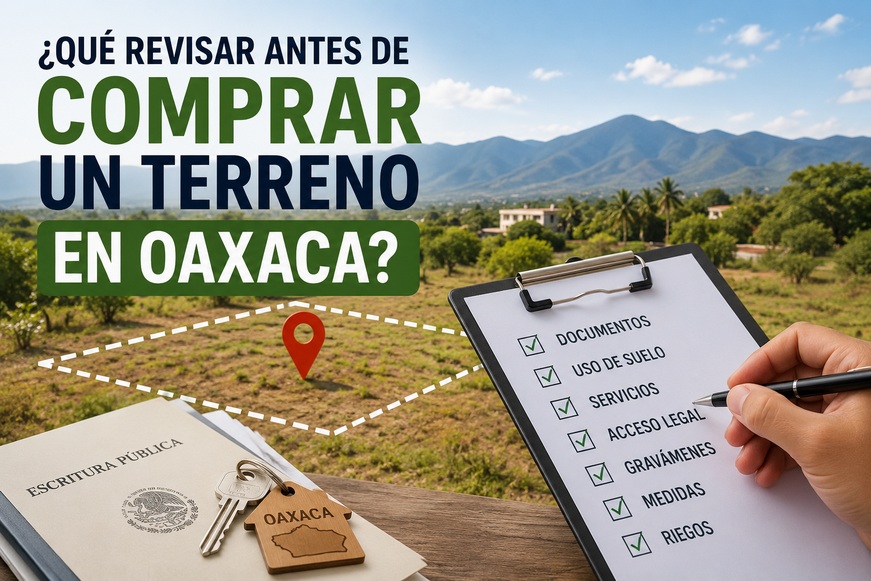
Knowing what to check before buying land in Oaxaca is essential to avoid fraud, deed problems, hidden debts, or restrictions that prevent construction. Before making a down payment, you should confirm the property’s legal status, identify the true owner, determine whether the land is private, ejido, or communal property, and verify that it has appropriate land use authorization, utilities, and legal access.
Buying land can be an excellent investment, but in Oaxaca it requires special care because of the variety of property ownership systems, communal areas, ejido land, growing urban zones, coastal properties, and lots involving family or inheritance matters.
[xyz-ips snippet="Oaxaca"]
The most important things to check before buying land in Oaxaca
Before signing any agreement, confirm the following:
- The seller is the legal owner.
- A public deed or other valid legal documentation exists.
- The property is correctly registered.
- The land is free of liens, seizures, or legal disputes.
- The physical measurements match the documents.
- The permitted land use allows your project.
- The property has legal access and available utilities.
- The land is not unregularized ejido or communal property.
- There are no outstanding property taxes, water bills, or other service debts.
- The transaction can be formalized before a notary public.
In simple terms, do not buy solely because of the location or price. Purchase only when you can verify that the property has legal certainty and can actually be used for your intended purpose.
First, review the property ownership system
In Oaxaca, you may find several types of land: private property, ejido land, communal land, subdivisions, urban lots, rural land, coastal properties, or real estate located in areas subject to special regulations.
This point is essential because these properties are not all purchased in the same way and do not offer the same level of legal certainty.
Private property
This is the clearest scenario for a purchase and sale transaction. The land should have a registered public deed, property registry information, a cadastral identification number, and an identified owner.
Even so, it is not enough for the seller to show you a copy of the deed. You must verify that the information matches the Public Registry, cadastral records, property tax receipts, and the physical characteristics of the land.
Ejido land
Ejido land is not purchased in the same way as ordinary private property. There may be a parcel certificate, possession certificate, or agrarian rights, but these documents are not necessarily equivalent to a private deed allowing the land to be sold freely to any person.
If the land originated as ejido property, verify whether it has already obtained full ownership status and whether it can be formally deeded. Otherwise, you may be paying for possession or an assignment of rights rather than fully transferable private property.
Communal land
In Oaxaca, it is also common to find land governed by a communal property system. In these cases, ownership is usually connected to an agrarian community, and its transfer may depend on assembly decisions, internal recognition, and community rules.
Buying communal land without understanding its legal system may lead to disputes, denial of rights, or an inability to obtain a deed.
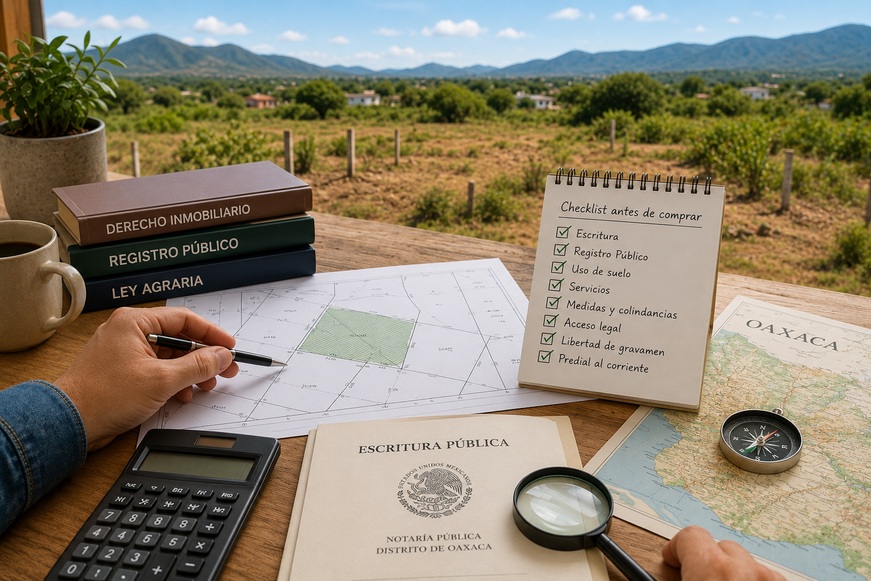
Verify the public deed and the owner’s information
The public deed is one of the most important documents when purchasing private land. It should identify the owner, explain how the property was acquired, and include its location, surface area, measurements, boundaries, and registration information.
When reviewing it, confirm:
- The owner’s full name.
- The seller’s official identification.
- The owner’s marital status.
- Whether there are co-owners.
- Whether spousal authorization is required.
- The property’s registry information.
- Surface area and boundaries.
- Ownership history.
- The corresponding stamp or registration record.
If the seller claims to be acting under a power of attorney, request the notarized power and verify that it is current and grants sufficient authority to sell the property.
Request a certificate confirming the property is free of liens
A certificate confirming that the property is free of liens is used to determine whether the land has mortgages, seizures, annotations, restrictions, or encumbrances that could affect the transaction.
This document must be current. You should not accept an outdated certificate because the legal status of a property may change.
Land may have a deed and still be affected by a debt, lawsuit, or security interest. For this reason, the certificate is essential before signing.
Confirm registration with the Public Registry
The deed must be correctly registered with the corresponding property registration authority. This helps confirm that the seller appears as the legal owner and that the property has a traceable legal history.
When reviewing the registry, pay attention to:
- The registered owner’s name.
- The property folio or registration information.
- Liens.
- Seizures.
- Easements.
- Preventive annotations.
- Transfer history.
- Consistency of the surface area and location.
If there are inconsistencies between the deed, registry, cadastral records, and the physical land, stop the transaction until they are clarified.
Review the cadastral identification number and property taxes
The cadastral system identifies the land for administrative, tax, and location purposes. Although cadastral registration does not replace legal ownership, it helps confirm important information.
Request:
- The cadastral identification number.
- A current property tax receipt.
- A certificate confirming there are no outstanding property taxes.
- A cadastral map or location record.
- The registered surface area.
- The taxpayer’s name.
Also verify whether the land requires a cadastral update, ownership transfer procedure, or correction of information. Buying property with outdated cadastral records may complicate the deed process.
Verify the measurements, boundaries, and actual surface area
One of the most common mistakes when buying land is relying only on what the advertisement or seller says.
Before paying, compare:
- The measurements stated in the deed.
- The cadastral measurements.
- The actual physical measurements.
- Property boundaries.
- Walls, fences, or boundary markers.
- Access points.
- Adjacent streets.
- Possible encroachments.
Ideally, you should request a professional land survey or boundary assessment. This helps confirm that you are purchasing exactly the surface area being offered.
If the property is smaller than advertised, has encroachments, borders an irregular road, or does not match the deed, the price and transaction should be reconsidered.
Verify permitted land use before building
Not all land can be used to build a house, commercial property, apartments, warehouses, or tourism projects. Land use regulations determine which activities and structures are permitted.
Before purchasing, check with the corresponding municipality:
- Residential use.
- Commercial use.
- Mixed use.
- Construction restrictions.
- Maximum building height.
- Permitted density.
- Required setbacks.
- Open-space requirements.
- Official alignment and street number.
- Eligibility for a construction permit.
If you buy land without a permitted use compatible with your project, you may legally own the property but be unable to use it for your intended purpose.
Verify that the land has legal access
A property may appear attractive, but if it does not have legal access, it may become a serious problem.
Confirm that the access:
- Is recognized in the deed or official documents.
- Does not depend solely on verbal permission.
- Does not cross private property without an easement.
- Connects to a public road.
- Is accessible throughout the year.
- Allows the entry of construction materials and machinery.
In rural, communal, or developing areas, some access roads are used through custom or informal arrangements, but they are not always legally guaranteed. This may affect the property’s value and its suitability for construction.
Confirm basic utilities and infrastructure
Before purchasing, determine whether the property already has utilities or whether you will need to contract, extend, or install them at your own expense.
Verify:
- Potable water.
- Electricity.
- Drainage.
- Sewer service.
- Street lighting.
- Paved roads.
- Waste collection.
- Internet and telephone service.
- Nearby transportation.
Land without utilities may appear inexpensive, but connecting to utility networks, drilling a well, installing a septic system, or extending electrical service can significantly increase the true cost of the investment.
Review natural hazards and physical land conditions
Oaxaca includes mountainous, coastal, urban, and rural areas, as well as land with steep slopes. For this reason, the physical inspection of the property is just as important as the legal review.
Before purchasing, analyze:
- The slope of the land.
- Landslide risk.
- Flood risk.
- Soil type.
- Natural drainage patterns.
- Nearby waterways.
- Protected trees or significant vegetation.
- Construction stability.
- The cost of leveling or filling the land.
If the property is located on the coast, near rivers, ravines, slopes, or urban expansion areas, you should review risk maps, environmental restrictions, and construction feasibility.
Be cautious with unusually inexpensive land
A very low price may represent an opportunity, but it may also be a warning sign.
Be suspicious if the seller:
- Pressures you to close quickly.
- Requests cash payment without a formal agreement.
- Does not provide deeds.
- Offers only a possession certificate.
- Says the property can be regularized later.
- Does not allow the documents to be reviewed by a notary.
- Refuses a property registry investigation.
- Avoids discussing property taxes, liens, or permitted land use.
- Promises utilities that do not yet exist.
- Sells lots in an unauthorized subdivision.
The rule is simple: if it cannot be verified, you should not pay.
Check whether the property is in a coastal or restricted area
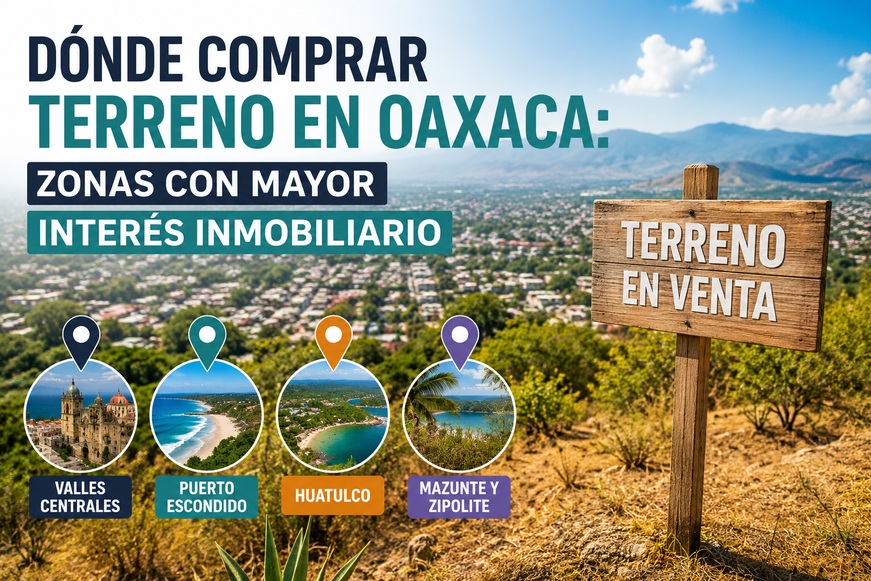
If the property is located in areas such as Puerto Escondido, Huatulco, or another location near the coast, additional rules must be reviewed, especially when the buyer is a foreign national.
In coastal areas, the purchase may require a bank trust or another legally permitted structure. There may also be environmental restrictions, construction limitations, federal maritime land-zone rules, or specific municipal regulations.
Before buying on the Oaxaca coast, review:
- Distance from the ocean.
- The property’s status in relation to the federal coastal zone.
- A bank trust, when applicable.
- Tourism, residential, or mixed-use zoning.
- Environmental restrictions.
- Legal access.
- Actual available utilities.
- Risks from hurricanes, flooding, or erosion.
Determine whether there are historical, environmental, or community restrictions
Some areas of Oaxaca may be subject to special restrictions. This is especially common in historic districts, agrarian communities, archaeological zones, natural areas, or protected urban centers.
Before purchasing, ask whether the land is subject to:
- Restrictions imposed by INAH.
- Urban appearance regulations.
- Environmental protection.
- Community consultation requirements.
- Easements.
- Rights of way.
- Agrarian rights.
- Construction limitations.
- Internal subdivision regulations.
These restrictions do not always prevent the purchase, but they may limit what you can build or modify.
Review agreements, down payments, and payment methods
Never provide money without a clear document. The agreement should properly identify the parties, the property, the price, the payment method, obligations, penalties, and conditions for completing the deed.
Before signing, confirm:
- Complete information for the buyer and seller.
- An exact description of the property.
- Surface area.
- Total price.
- Down payment.
- Deadline for completing the deed.
- Obligation to provide documents.
- Responsibility for outstanding debts.
- Penalties for noncompliance.
- Signing before a notary, when applicable.
Avoid ambiguous agreements or simple receipts. A poorly documented down payment may be difficult to recover.
Consider all additional costs
The price of the land is not the only expense. You should also consider legal, notarial, tax, technical, and construction costs.
Common expenses include:
- Notary fees.
- Property acquisition taxes.
- Certificates.
- Appraisal.
- Land survey.
- Administrative processing services.
- Property registration.
- Ownership transfer procedure.
- Cadastral update.
- Utility connections.
- Construction permits.
Before purchasing, request a complete estimate to understand the true cost of the property.
Warning signs before buying land in Oaxaca
Stop the transaction if any of the following situations arise:
- The seller does not appear as the legal owner.
- There is no public deed.
- The land is ejido or communal property without clear documentation.
- There are significant outstanding debts.
- There are discrepancies in the measurements or boundaries.
- The lien-free certificate shows encumbrances.
- The permitted land use does not allow construction.
- There is no legal access.
- The seller requests full payment before verification.
- The price is significantly below market value without explanation.
- There are family or inheritance disputes.
- The property is part of an informal subdivision.
Buying when there are unresolved concerns may cost far more than losing a supposed opportunity.
Checklist for buying land in Oaxaca
Before signing, make sure you have reviewed the following:
- A public deed or other valid legal document.
- The owner’s identity.
- Property registration.
- A certificate confirming the property is free of liens.
- The cadastral identification number.
- Current property tax payments.
- A certificate confirming there are no outstanding debts.
- Permitted land use.
- Measurements and boundaries.
- A land survey.
- Legal access.
- Available utilities.
- Physical risks associated with the property.
- Environmental, historical, or community restrictions.
- An agreement reviewed by a specialist.
- Signing and formalization before a notary.
Is buying land in Oaxaca a good idea?
Buying land in Oaxaca may be a good decision when the location, documentation, price, and permitted use are aligned with your objectives. Oaxaca has areas with strong residential, tourism, and investment demand, but it also presents risks when property ownership systems are not properly reviewed.
The best purchase is not necessarily the least expensive one, but the property that offers legal certainty, a good location, utilities, access, and a realistic opportunity to build or resell.
Frequently asked questions
What is the first thing I should check before buying land in Oaxaca?
The first step is to confirm the property ownership system and the seller’s identity. You must determine whether the land is private, ejido, or communal property and verify that the seller has the legal authority to complete the transaction. Then review the deed, registration, liens, property taxes, measurements, and permitted land use.
Is it safe to buy ejido land in Oaxaca?
It may be risky if the land has not been regularized. Ejido land is not purchased in the same way as private property and may require full ownership status before a deed can be obtained. If you are only offered a possession certificate or assignment of rights, consult a specialist before making any down payment.
What documents should land have for it to be purchased safely?
The property should have a public deed or valid legal document, property registration, a certificate confirming it is free of liens, a cadastral identification number, current property tax payments, identification of the owner, a certificate confirming there are no outstanding debts, and compatible land use authorization. A land survey and prior notarial review are also advisable.
What happens if I buy land without a deed?
Buying land without a deed may leave you without legal certainty. You may acquire only possession rights, face claims from third parties, or be unable to build, sell, mortgage, or obtain a deed. Before purchasing, verify whether the property can be regularized and how much the legal process would cost.
How can I determine whether land has legal problems?
Request a registry search, a certificate confirming the property is free of liens, a review of its ownership history, property tax records, cadastral information, and the seller’s documents. Also verify whether there are lawsuits, seizures, easements, unresolved inheritance matters, surface-area discrepancies, or agrarian disputes.
Do I need a notary to buy land in Oaxaca?
Yes. When dealing with private property, the transaction should be formalized before a notary public to provide legal certainty and register the purchase. The notary reviews the documents, calculates taxes, prepares the deed, and arranges the corresponding registration. Do not sign or make full payment before this review.