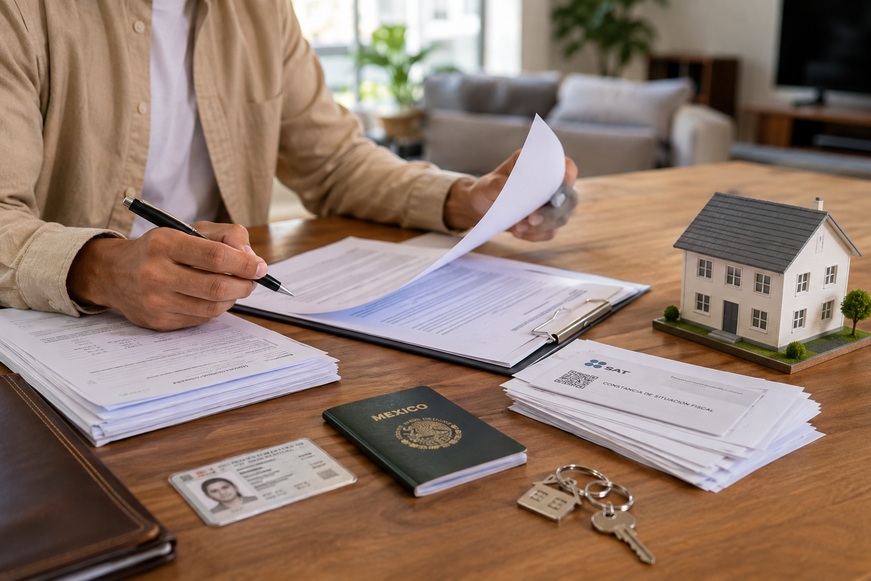
How long does the home-buying process take?

Buying a home involves much more than finding a property you like and agreeing on a price. Before receiving the keys, there are legal reviews, financial procedures, appraisals, and notarial processes that can significantly affect the overall timeline of the transaction.
That is why, if you are wondering how long does the process of buying a house take?, you should know that there is no identical timeframe for every buyer. At Viva México Inmobiliaria we want to help you understand what happens during each stage so you can prepare better and avoid unnecessary delays.
How long does it take to buy a house in Mexico?
As a reference, a new home with all its documentation in order can complete the purchase process in approximately 4 to 8 weeks, while a pre-owned home may require between 2 and 4 months, especially when it is necessary to review its background, outstanding debts, or carry out any regularization process. A cash transaction can be considerably faster.
When the time spent searching for the property, negotiating the price, obtaining financing, and preparing the documentation is also taken into account, the entire process can extend over several months. Some industry references place the purchase of a completed home at around 10 to 14 weeks when conditions are favorable.
Therefore, rather than focusing on an exact date, it is useful to understand what happens at each stage.
1. Searching for and choosing the house
Everything begins by defining how much you can invest, what location you need, and which features are essential in your future home.
This stage is one of the most variable. A person with a defined budget and clear needs may find a property quickly, while another buyer may need several weeks to compare alternatives.
Before moving forward, it is advisable to review aspects such as:
-
Property price.
-
Location and accessibility.
-
Available services.
-
Physical condition of the property.
-
Legal status.
-
Financing options.
-
Additional expenses related to the purchase.
Having these criteria defined from the beginning considerably reduces the time spent visiting properties that do not actually meet your needs.
2. Negotiation and property reservation
Once you find a suitable house, negotiations with the owner begin.
At this stage, the final price, payment method, expected dates for formalizing the transaction, and any additional conditions are established.
Depending on the difference between the seller's asking price and the buyer's offer, negotiations may be resolved quickly or extend over several days.
Once an agreement has been reached, a reservation payment is usually made or the agreed terms are formalized through the appropriate document.
The key at this stage is to clearly establish the commitments of both parties before moving forward with expenses such as appraisals, bank procedures, or notarial processes.
3. Mortgage application and approval
If you are buying with financing, this is usually one of the stages that has the greatest influence when answering how long does the process of buying a house take.
The financial institution will analyze information such as your income, payment capacity, credit history, and documentation.
Mortgage approval can take approximately 2 to 4 weeks, although the timeframe may increase when additional documents are requested or issues are identified in the application.
For this reason, it is advisable to begin your home search with a pre-qualification or a fairly clear idea of the financing available to you.
This way, you can avoid finding a property only to later discover that the approved mortgage is not enough to complete the transaction.
4. Appraisal and legal review of the property
Buyer approval is only one part of the process. It is also necessary to verify that the property can legally be sold.
During this stage, the following may be reviewed:
-
Deeds.
-
Owner's identity.
-
Liens.
-
Outstanding debts.
-
Registry status.
-
Cadastral information.
-
Commercial appraisal.
-
Taxes related to the property.
A home with all its documentation up to date can move forward relatively quickly.
On the other hand, if inconsistencies appear in the deeds, there are outstanding debts, ownership disputes, or modifications that need to be regularized, the transaction may be delayed for weeks or even longer.
For this reason, reviewing the legal status before committing a significant amount of money is essential.
5. Notarial preparation and signing of the deeds
Once the buyer, seller, financing, and documentation are ready, the formalization stage begins.
The notary reviews the transaction documents, prepares the deed, determines the corresponding taxes and fees, and coordinates the signing.
The signing itself may take only a few hours; what takes time is all the preparation required beforehand.
Afterward, the corresponding registration with the Public Registry of Property must also be completed. Depending on the transaction and the state, this final stage may add additional administrative time to the process.
What can delay the purchase of a house?
Even when the buyer and seller want to close quickly, there are situations that can significantly extend the timeline.
Among the most common are:
Incomplete documentation
When one of the parties does not provide identification documents, certificates, deeds, or other requested paperwork, the process comes to a halt.
Legal issues with the property
Liens, inheritance matters, co-ownership, registry errors, or legal disputes must be resolved before the deed can be signed.
Mortgage delays
A clarification related to income, credit history, or payment capacity can increase the approval period.
Problems during the appraisal
If the determined value does not match the purchase price, adjustments to the financing or a new negotiation may be necessary.
Outstanding property debts
Pending payments related to taxes or certain services may need to be settled before the transaction can be completed.
Last-minute changes
Changing the price, conditions, payment method, or dates when the process is already underway may result in additional reviews.
Is buying with cash faster?
Generally, yes.
When there is no mortgage loan, one of the most time-consuming stages is eliminated. If the home has all its documentation completely in order, some cash transactions can move from document review to formalization within just a few weeks.
However, paying in cash does not mean that legal verifications can be skipped.
Even when the funds are immediately available, it is still necessary to verify who owns the property, review the documentation, and properly formalize the transfer of ownership.
What if the buyer is a foreigner?
In certain real estate transactions in Mexico, additional processes may be involved.
For example, when a foreign buyer acquires property within certain restricted zones established by Mexican law, it may be necessary to use a bank trust.
Setting up this type of structure may take several weeks, although part of the process can be carried out simultaneously with the legal review of the property.
This can be especially relevant when evaluating properties located in coastal areas.
How can you speed up the process of buying a house?
Although not all timelines depend on the buyer, being prepared can help prevent many delays.
Try to:
-
Define your budget before beginning your search.
-
Obtain a pre-qualification if you will be using financing.
-
Prepare your personal and financial documents.
-
Look for properties with their documentation in order.
-
Ask from the beginning about deeds, liens, and outstanding debts.
-
Include notarial expenses and taxes in your budget.
-
Respond quickly when the bank, advisor, or notary requests information.
-
Avoid changing the conditions once the transaction is already underway.
Good coordination between the buyer, seller, financial institution, real estate advisor, and notary can make an important difference in the total timeline.
So, how long does the process of buying a house take?
In general terms, you should prepare for a process that can take from a few weeks to several months.
A straightforward purchase, with available funds and proper documentation, can move forward quickly. A transaction involving a mortgage loan usually requires more time, while a property with legal or administrative issues can significantly extend the process.
The important thing is not to try to speed up every procedure at any cost, but to make sure each stage is completed correctly. Buying a house represents a significant investment, and carefully reviewing the property's legal status can help prevent much bigger problems in the future.
If you are beginning your search and want to explore options for houses in Oaxaca, you can review the available properties and compare locations, features, and conditions before beginning your buying process.