What is the difference between communal lands and ejido lands?
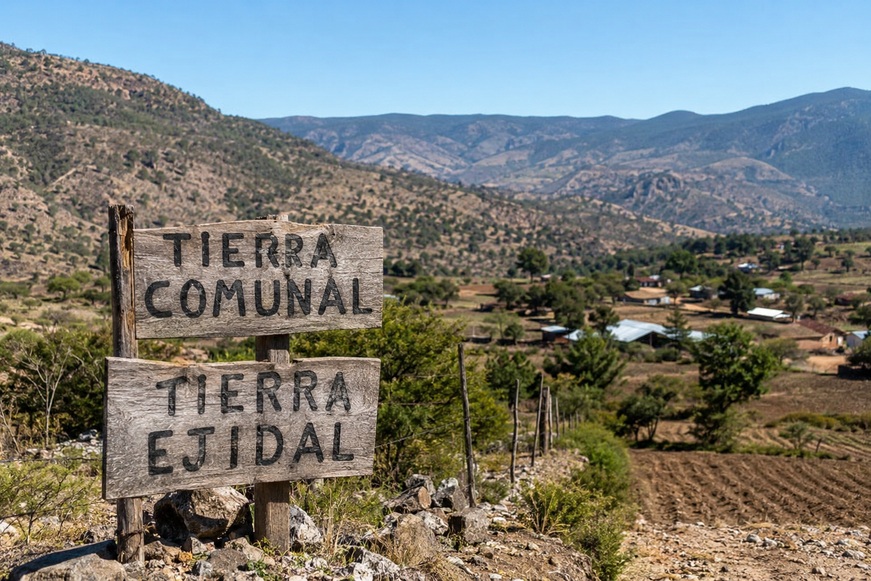
The difference between communal and ejido property lies in their origin, ownership, organizational structure, and the rules governing the use or transfer of the land. Both belong to Mexico's social property system, but they are not the same: communal property is usually linked to communities with historical possession of the land, while ejidos primarily originated through agrarian land-grant processes.
In simple terms, an ejido is organized around ejidatarios who hold rights over individual parcels, common-use land, and human settlement areas; an agrarian community is organized around comuneros and assets recognized as the collective property of the community.
What is communal property?
Communal property consists of land, forests, water, and resources that collectively belong to an agrarian community. It is generally associated with indigenous peoples or communities that have occupied and worked a territory for generations.
Under communal ownership, the land does not belong to an individual as private property. It belongs to the community, and the comuneros have rights of use, development, and participation in accordance with the Agrarian Law and the community's internal regulations.
Main characteristics of communal property
- Ownership belongs to the community.
- Rights are exercised through recognized comuneros.
- The communal assembly is the highest decision-making body.
- It usually has a strong historical, cultural, and indigenous component.
- The transfer of rights is more restricted.
- Internal rules and community customs are highly important.
What is ejido property?
Ejido property consists of land granted to an ejido population group, generally as a result of agrarian reform. The ejido is made up of ejidatarios, who hold rights over parcels, common-use areas, and human settlement zones.
Unlike an agrarian community, an ejido usually has a structure more oriented toward the individual allocation of parcels, although it also retains common-use land that is administered collectively.
Main characteristics of ejido property
- It belongs to the ejido population group.
- Ejidatarios may hold parcel rights.
- There are individual parcels, common-use land, and human settlement areas.
- The ejido assembly makes the principal decisions.
- Rights may be inherited or transferred under specific rules.
- In certain cases, some parcels may be converted to full private ownership.
Difference between communal and ejido property
The main difference is that communal property is recognized as the collective property of a community, while ejido property belongs to an ejido population group, with rights assigned to ejidatarios.
Communal property emphasizes the protection of collective territory and community decision-making. In ejido property, although collective organization also exists, it is more common to find parcels individually assigned to ejidatarios.
Comparison table: communal property vs. ejido property
| Aspect | Communal property | Ejido property |
|---|---|---|
| Origin | Recognition or restitution of a community's historical lands | Agrarian land grant to a population group |
| Members | Comuneros | Ejidatarios |
| Ownership | Agrarian community | Ejido population group |
| Organization | Communal assembly | Ejido assembly |
| Land use | Primarily collective, under internal rules | Individual parcels, common-use land, and human settlement areas |
| Transfer of rights | More restricted and subject to community regulations | Regulated by the Agrarian Law and ejido agreements |
| Privatization | Generally more limited | Possible in certain cases through full private ownership |
| Focus | Territorial, cultural, and community protection | Agrarian use and productive organization |
Who makes decisions regarding communal and ejido land?
In both cases, the assembly is the principal authority.
In an agrarian community, the communal assembly makes decisions regarding land use, resource development, recognition of comuneros, internal rules, and territorial administration.
In an ejido, the ejido assembly makes decisions regarding parcels, common-use land, human settlement areas, transfers of rights, authorizations, and other relevant matters concerning the ejido population group.
Can communal or ejido property be sold?
They should not be treated as ordinary private property. Communal and ejido lands are governed by special rules.
In the case of ejido land, legal mechanisms exist to transfer rights or, in certain cases, convert parcels to full private ownership. However, this requires compliance with formal procedures and assembly resolutions.
For communal property, a sale or assignment is usually more restricted because the land is protected as the collective heritage of the community. Any transaction must be reviewed with particular legal care.
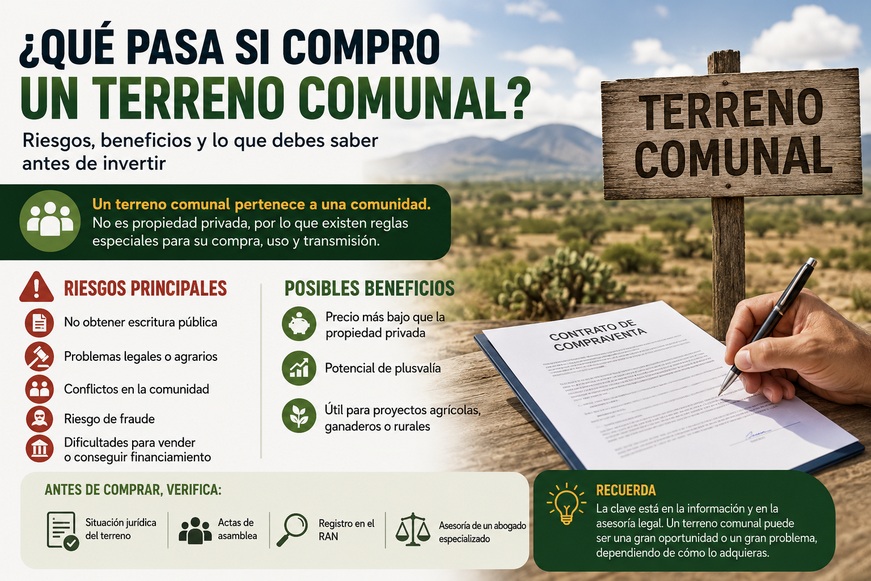
What happens if I purchase ejido or communal land?
Purchasing ejido or communal land without verifying its legal status can create significant risks. Signing a private agreement or receiving a local certificate is not sufficient.
Before completing any transaction, it is advisable to verify:
- Whether the land is ejido, communal, or private property.
- Who holds legally recognized rights.
- Whether a parcel certificate, title deed, or valid certificate exists.
- Whether the assembly authorized the transaction.
- Whether the transaction can be registered with the appropriate authority.
- Whether there are internal disputes, overlapping possession claims, or unclear boundaries.
Which is better: communal or ejido land?
The issue is not which one is better, but rather what legal system governs the land and what may legally be done with it.
For housing, investment, agriculture, tourism, or real estate development, the key point is to review the agrarian status, recognized rights, restrictions, and documentation. Ejido land may offer clearer legal avenues for certain transactions; communal land may have stronger collective protection and more limitations.
Direct answer
Communal property collectively belongs to an agrarian community and is governed by its internal bodies, customs, and community regulations. Ejido property belongs to an ejido population group and may be divided into individual parcels, common-use land, and human settlement areas. Both are forms of social property, but they have different origins, organizational structures, and rules.
Frequently asked questions
Are communal and ejido properties private property?
No. Both are part of Mexico's social property system. Although an individual may hold rights of use, possession, or development, this does not mean that the land is private property. To be considered private property, it must comply with specific legal procedures and have valid documentation.
Is a comunero the same as an ejidatario?
No. A comunero belongs to an agrarian community and exercises rights in accordance with the communal assembly and its internal regulations. An ejidatario belongs to an ejido and may hold rights over parcels, common-use land, and participation in the ejido assembly.
Can an ejido parcel receive a private title deed?
In certain cases, yes, but not automatically. For an ejido parcel to be converted into private property, a legal procedure must be followed, usually involving full private ownership. Without this process, it should not be treated as an ordinary private-property purchase and sale.
Can communal land be sold?
It is generally more complicated and restricted than in the case of ejido land. Communal land is protected as the collective heritage of the community. Any assignment, transfer, or use must comply with the Agrarian Law, assembly decisions, and the applicable internal regulations.
How can I determine whether land is ejido or communal?
The safest method is to review agrarian records, certificates, assembly minutes, official documents, and registrations with the appropriate authorities. It is also advisable to confirm whether the land is classified as ejido, communal, or private property before signing any agreement.